


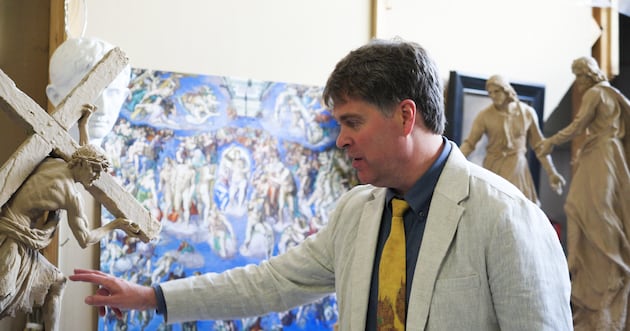
Before creating the sculpture for Salt Lake City’s Temple Square, sculptor Michael Hall’s artistic life took many unexpected turns, including facing financial and health problems. He questioned how fit he was for the job. However, by persevering in developing his gifts and talents, Hall found that his relationship with God developed in the process.
Reflecting on his artistic and spiritual journey, Hall spoke to Church News about the process of creating two sculptures, one of Jesus carrying a cross and the other of Joseph Smith’s First Vision, on the grounds of the newly renovated Temple Square.
In an interview featured on the Church News podcast on June 2, Hall spoke about his upbringing, how he finds God in the details of his life, and his process for depicting Jesus Christ in his work.
Hall’s family, including his loving mother and talented uncle, fostered his love of art from an early age.
As a young boy, Hall’s great-uncle Avard Fairbanks handed him a chisel and brush and encouraged him to help with his ongoing carving of a marble statue.
Later, as a teenager, Hall imitated Michelangelo by painting copies of Michelangelo’s paintings on the unfinished concrete walls of his parents’ basement. He wanted to learn the techniques of Renaissance artists.
Developing human resources through services
Hall’s appreciation for art continued during his time serving as a missionary in Russia, where he encountered works of art in St. Petersburg’s museums, including the Hermitage Museum.
The museum offered Hall and his companion free admission in exchange for their services.
The Hermitage, whose name comes from the French word meaning a place of solitude, was a place of reflection for Hall.
The museum’s artworks, such as Michelangelo’s marble sculptures, and his friendly companions had a deep impact on him.
“At that point, I knew what I wanted to do with my life,” he said.
Hall always loved the visual arts, including painting, drawing, sculpture, and photography, but an opportunity to start a business with his brother took him away from work for a season.
“I always had this urge to focus on my work,” Hall recalled, recalling recurring spiritual impressions and guidance from her family.
follow promptings
Hall bravely heeded the invitation and returned to the art world, studying with Swiss artist Patrick Devonas, who advised him to devote himself full-time to sculpture. He listened and, 20 years later, is still practicing carving.
Hall said mentors and family members like Devonas have told me “truths that Heavenly Father wanted me to understand.”
He always wanted to portray Heavenly Father and Jesus Christ through his work, and hopefully build a relationship with them in the process.
The path from aspiring artist to professional artist was not without its obstacles.
“There were many times I wanted to quit,” Hall said. Financial and other difficulties continually discouraged him from pursuing a career as an artist.
Still, he felt called to the job. Hall was motivated by the confidence that he would be blessed if he could focus on his career as an artist, even in the face of many challenges.
Then a miraculous request came from The Church of Jesus Christ of Latter-day Saints to submit a portfolio. After careful consideration, he was selected as a finalist to create the Temple Square sculpture.
artistic revelation
What started as a post from the hall turned into an exchange with prophetic authorities and other artists.
Hall listened to church leaders and trusted them to have special insight into the sculpture, “even though I’m an artist and they’re not professional artists.”
After an extensive and collaborative refinement process involving leaders such as the late President Russell M. Nelson and Elder Gerald Cause (who served as presiding bishop prior to his call to the Quorum of the Twelve Apostles), Hall’s depiction of Christ carrying the cross became a reality.

He named the statue “Jesus Christ Carrying the Cross.” Hall pointed out that the painting depicts three people in addition to Jesus, representing different belief systems. The closest person to Jesus is a Jewish woman, and right behind her is a Roman woman. And the third is a Roman soldier with his helmet hidden underneath.
Hall said he did this “with the hope that people who see this piece will be able to connect with one of those people.”
Hall was then commissioned to sculpt the First Vision.
He chose to depict Joseph Smith sitting barefoot and reaching out to the figures of Heavenly Father and Jesus Christ, with Joseph Smith’s fingers imitating the fingers of Adam reaching for the finger of God in Michelangelo’s Sistine Chapel.
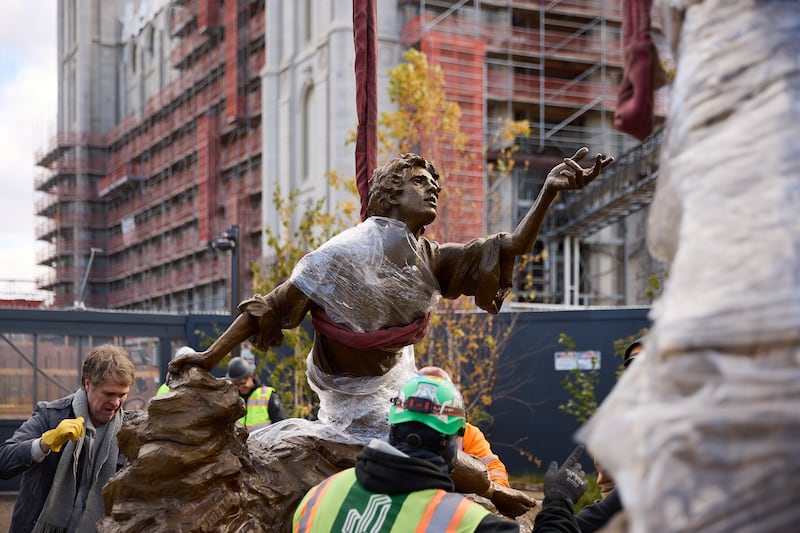
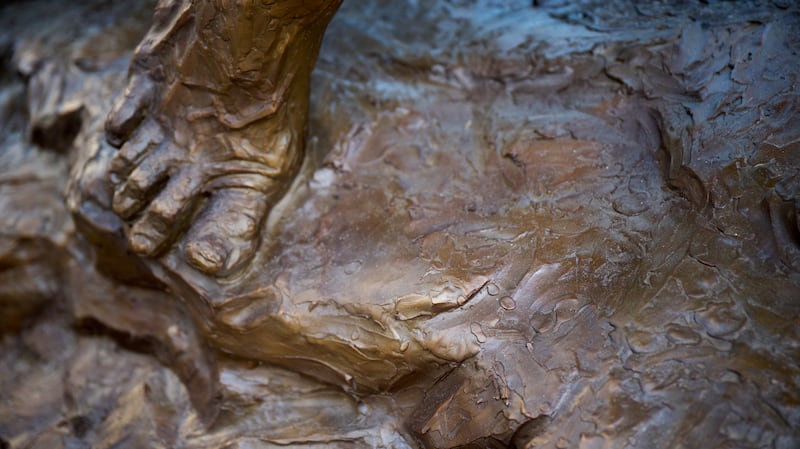
The statue of Joseph was left barefoot, alluding to the Biblical story of Moses. Moses showed respect by taking off his shoes before the Lord (see Exodus 3:5).
“How would you describe God?”
Hall was humbled by the process.
“How do you portray God? How do you portray God in a way that people can look at your work and feel the Spirit instead of always being critical?”
Guided by the Holy Spirit, Hall aimed to make Jesus the center of the sculpture. With this in mind, he placed God the Father slightly above Jesus and Jesus near Joseph.
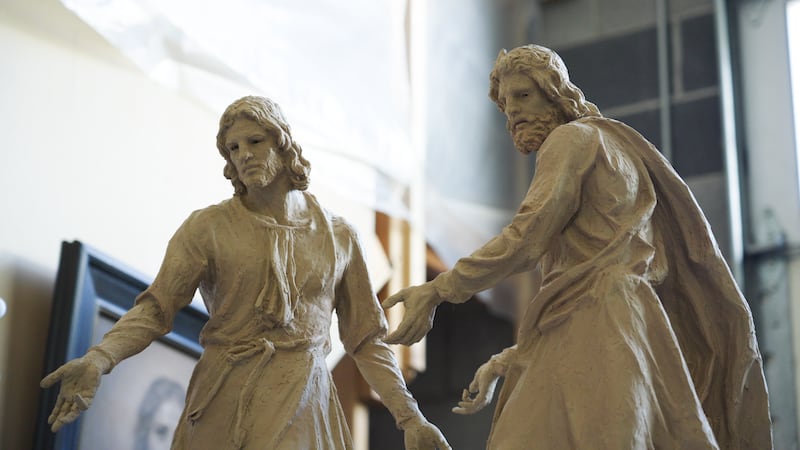
“Heavenly Father glorifies His Son by putting Him first above all else,” Hall said of the placement of the figures.
During the creation process, Hall reflected on the miracles he experienced, including revelations, greater peace in his life, and the joy and happiness of knowing that Heavenly Father and Jesus Christ knew and loved him.
The knowledge of God’s love “is irreplaceable.”
