


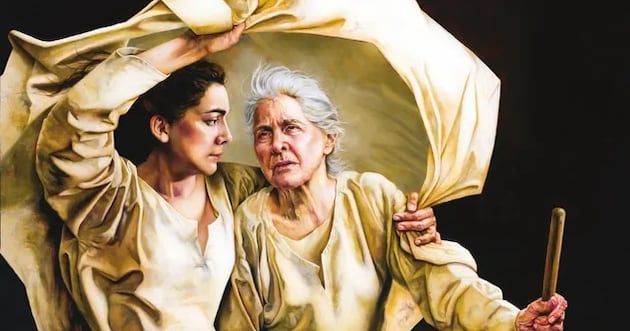
This week’s Come, Follow Me study guide covers Ruth and Samuel 1-7 and includes the stories of Ruth, Hannah, and Samuel.
Below are quotes from past and present leaders and scholars of The Church of Jesus Christ of Latter-day Saints regarding these chapters of the Bible.
Ruth
“The model of the ideal woman is Ruth. Sensing the grief-stricken heart of her mother-in-law, Naomi, who had lost two brilliant sons, and perhaps sensing the pangs of despair and loneliness that plagued Naomi’s very soul, Ruth uttered the words that have become the classic words of loyalty: ‘Begged me not to leave you, or to return from following you; wherever you go, I will go. Ruth’s actions showed the sincerity of her words: “Where you lodge, I will also lodge. Your people will be my people, and your God my God.” (Ruth 1:16) Ruth’s actions demonstrated the sincerity of her words.
“Ruth’s unwavering loyalty to Naomi led to her marriage to Boaz, thereby making the foreign Moabite convert the great-grandmother of David and thus the ancestor of our Savior Jesus Christ.”
—The late President Thomas S. Monson, then First Counselor in the First Presidency, October 2002 general conference, “A Model to Follow.”
“A good example of the real-life situations that good people face in this world is found in the very short, five-page book of Ruth in the Old Testament. Every time I read it, I discover something new. Lately, I’ve been thinking of it as a story of conversion, a story of courage and determination. It’s about another time, another culture, but it’s also about us.
“Naomi, her husband Elimelech, and their two sons went to the enemy country of Moab because there was a great famine in their homeland of Israel. Eventually, their sons married Moabite wives named Orpah and Ruth. Ten years later, Naomi hears that the famine in Judah has ended and she wants to return to her people. Naomi invites her stepdaughters to return to Judah.” Naomi calls them her daughters, and they kiss. I cried tears of love for her (isn’t this quite surprising? I can’t understand how this clear and well-known record could not have had more of an impact on all the unfunny mother-in-law jokes that are flooding the world) But in the end Orpah decided to remain in Moab, and again Naomi said to Ruth, “Behold, your sister-in-law has returned to her people.” Follow her back to her gods.” (Ruth) 1:15).
“At this point, in a solemn Hebrew verse, Ruth announces her decision and confirms her conversion: “I beseech you not to leave me, or to come back after me; for wherever you go I will go, and wherever you lodge, I will lodge. Your people are my people, and your God is my God” (Ruth 1:16).
“Naomi herself, being pragmatic and wise, saw Ruth’s firmness and “stopped talking to her” (see Ruth 1:18). This did not mean that she stopped talking to Ruth, but that she stopped trying to convince her of the difficulties she would face in Israel. The Moabite woman Ruth faces prejudice, poverty, and much anxiety, but she is converted and determined. She and Naomi become a great team, working together not only on their previous problems, but also on the opportunities that will come their way.
“In time, Ruth married Boaz and they had a child.”Then the women said to Naomi, “Blessed be the Lord…your daughter-in-law, who loves you more than seven sons, has given birth to you.”
“And Naomi took the child and became his nurse.
“And the women of the neighborhood gave it a name, saying, ‘A son was born to Naomi, and she called his name Obed, the father of Jesse, and the father of David'” (Ruth 4:14-17).
“This was a kind of prophecy that was very important to us. In a culture that was hostile to women’s leadership, these women, Naomi and Ruth, lived to bring about the outcome that the Biblical writers carefully emphasize. Through the lines of Obed, Bid’s father, carefully detailed for us in Matthew chapter 1, Jesus, who is called the Christ, appeared. Who would have expected Ruth’s little book to foretell so great an event?
“Ruth confidently faced the challenges that are common in our time: the death of a loved one, loneliness in a new place, and having to work hard for one’s bread and butter. Her small efforts have a lot to do with the big things that came later, and they teach us that each of us can take seriously the importance of our daily lives and decisions as we choose to follow God.”
—The late Sister Eileen H. Clyde, then second counselor in the Relief Society general presidency, October 1992 general conference, “Conviction through Conversion.”
1 Samuel 1
“I testify that God hears our prayers when we pray with faith and a sincere heart. Hannah is a powerful example of this. She went to the house of the Lord to pour out her soul in prayer (1 Samuel 1:7, 15). Her deep faith and desire to keep her covenant were evident: “The Lord remembered her” (1 Samuel 1:19), just as He remembers us even when we feel otherwise. But we must also remember our role. Hannah remained faithful to the covenant and fulfilled her promise to give Samuel to serve the Lord (see 1 Samuel 1:28).
— Elder Wayne Maurer, Area Seventy, June 2026 issue of Liahona, article “God Hears and Speaks to His Children”
“Faithful daughters of God desire children. . . . Some women are not given the responsibility of bearing children in this life, but just as Hannah of the Old Testament prayed fervently for her children (see 1 Samuel 1:11), we recognize the value women place on motherhood in this life and the value they receive here. The quality of motherhood increases with the Resurrection (see Doctrine and Covenants 130:18). The blessings of this life are promised for eternity, and eternity extends beyond mortality. Motherhood has eternal influence and power.”
— Sister Julie B. Beck, then Relief Society general president, October 2007 general conference, “Mothers in the Know.”
1 Samuel 2
“When I think of the need to cultivate the virtue of temperance, I am reminded of the words of Hannah, the mother of the prophet Samuel. Hannah was an outstanding woman of faith who, even after great trials, sang songs of thanksgiving to the Lord. She said, ‘Speak no more proudly, let no arrogance come out of your mouth, for the Lord is a God of knowledge, and your actions are measured by him’ (1 Samuel). (2:3) Her song is even more beautiful: it is a call to ourselves to act with humility, self-control, and moderation, that true spiritual strength is expressed not in impulsive reactions and proud words, but in modest, thoughtful attitudes consistent with the wisdom of the Lord.”
— Elder Ulises Soares of the Quorum of the Twelve Apostles, October 2025 General Conference “Glorified with the Virtue of Temperance”
“1 Samuel 2:12-17, 22-34 Then we learn of the evil that the sons of Eli the priest did. They took advantage of their father’s position and broke the priestly covenant. They indulged in immoral acts with female worshippers and took the sacrificial flesh of the children of Israel as their own in order to satisfy their lustful desires. “The Lord pronounced harsh judgment upon the sons of Eli, and upon Eli himself who did not restrain them.
“Such fleshly desires can be overcome by a commitment to keep our covenants with God. Even when we succumb to temptation, our desire to restore our relationship with our Heavenly Father leads us to sincere repentance, where the Atonement of our Savior Jesus Christ helps us become worthy again.”
— Elder Joseph W. Sitati, then a General Authority Seventy, July 2016 Liahona article, “Honoring God by Keeping Covenants”
1 Samuel 3

“We can get our children’s attention when they hear or feel the Spirit. Let’s go back to the Old Testament and see how Eli did just this for Samuel.
“When young Samuel heard a voice twice, he ran to Eli and said, “Here I am.”
“‘I didn’t call,’ Eli replied.
“But, “Samuel did not yet know the Lord, and the word of the Lord had not yet been revealed to him.”
“By the third time Eli realized that the Lord had called Samuel and said to him, “Speak, Lord, and your servant will listen” (see 1 Samuel 3:4-10).
“Samuel was beginning to feel, recognize, and hear the voice of the Lord. But the boy did not begin to understand until Eli facilitated this recognition. And the teachings helped Samuel become more attuned to that still, small voice.”
— Sister Mary R. Durham, then second counselor in the recently removed Primary general presidency, April 2016 general conference, “The Gift of Leading Children.”
“Eli served as high priest in Israel during the prophet Samuel’s childhood. The scriptures tell us that the Lord severely rebuked him, saying, ‘Because his sons had done despicable acts, and the Lord did not restrain them’ (1 Samuel 3:13). Eli’s sons never repented, and all Israel suffered because of their foolishness. The story of Eli shows us that parents who love their children cannot allow them to intimidate them.”
— Elder Larry R. Lawrence, then a General Authority Seventy, October 2010 general conference, “Raising Courageous Parents.”
“You must keep your mind clear so that you can recognize and respond to the silent whispers of the Spirit. Choose the information that enters your mind carefully. Avoid the clutter and noise of the world. Television, movies, and especially the Internet provide an open window through which you can peer into the far reaches of the world. They provide you with uplifting, good, and inspirational information. But when used improperly, these media technologies can fill your mind with unhealthy thoughts, preventing you from hearing the Spirit’s gentle promptings, and living each day in a way that, like the boy prophet Samuel, you can attune to the Spirit and say to the Lord, “Your servant hears.” (1 Samuel 3:10)
—The late Elder Harold G. Hillam, then a General Authority Seventy, April 2000 general conference, “Future Leaders.”
1 Samuel 7
“In 1 Samuel 7 we read of the Israelites being attacked by the Philistines. Outnumbered and in fear for their lives, they prayed to the prophet Samuel for divine help. Samuel offered a sacrifice and prayed for protection. In response, the Lord smote the Philistines, and they retreated into their own territory. This victory occurred in 12 It is recorded in the verse: “So Samuel took a stone and placed it between Mizpeh and Mizpeh.” Shen called his name Eben-ezer and said, “Hitherto has the Lord helped us.”
“The word “Ebenezer” in Hebrew means “Stone of Help.” This raised stone was a reminder to the Israelites of what the Lord had done for them. The Ebenezer was literally a monument erected to commemorate the great help God had given to those who raised the stone. The Old Testament is full of examples of the children of Israel forgetting the many miracles and spiritual experiences the Lord had given them.
“It’s about remembering our own spiritual experiences and recognizing that these experiences from the Lord have led us to each of us today. In other words, by remembering, we are developing our own Ebenezer.”
— Kurt Holman, then associate dean of the Brigham Young University School of Dance, at the July 2013 BYU devotional “Raising Your Ebenezer: A Monument to Remember.”
