


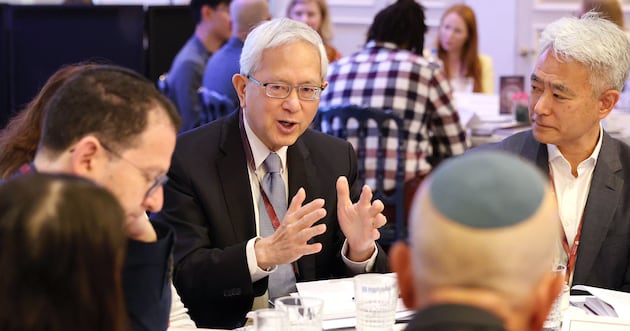
ATHENS, GREECE — Elder Gerrit W. Gong of the Quorum of the Twelve Apostles opened the AI Summit on Ethics and Artificial Intelligence with a speech that envisioned the greatest gift AI could bring to humanity, and also included warnings based on new research about how far AI must go to properly reflect human learning and experience.
In a message delivered on Tuesday, May 26, at a conference in Athens, Greece, Elder Gong shared practical and actionable ways in which AI tools can reach their highest potential.
My admiration has increased.
Elder Gong, who is in his ninth year of service as an apostle of The Church of Jesus Christ of Latter-day Saints, said, “I want AI to have a moral compass that inspires and empowers people everywhere with the gift of potential to do good and be their best selves.”
“AI, which can find the needles of patterns in vast haystacks of data, can help identify each person and nurture them to blossom in their own choices with capability, dignity and worth,” he said.
To get there, he said, AI creators will need to be more intentional about programming their systems to better reflect the wisdom found in human experience, faith traditions, moral teachings, and human values.
“We will not realize the full potential of AI until we make it as morally good as we make it powerful,” Elder Gong said. “And we will not reach our full human potential until we, not technology, take responsibility for charting the best possible future.”
AI systems are now exhibiting systemic religious bias, according to a new study presented at the summit by researchers from four major universities introduced by Elder Gong as part of the Consortium for Assessing Faith and Ethics in AI. He announced the group’s creation last fall at the inaugural Summit on Faith and Artificial Intelligence in Rome, Italy.
This research was designed to help AI creators, governments, academics, and the public better understand religious bias in emerging AI systems around the world.
The apostle’s talk was hailed by the Rev. Johnnie Moore, president of the Christian Leadership Conference, as a talk that could last a century. Elder Gong’s comments came a day after Pope Leo XIV made a major declaration in Rome about the future of a world equipped with artificial intelligence.
Meredith Potter, executive director of the American Security Foundation, which organizes the summit, said the summit’s goal is to inspire leadership among the world’s 6 billion people of faith and encourage AI creators to ensure that their systems accurately reflect the positive impact that ethics and religion have on the world.

Potter said the summit was purposely held in Athens, the birthplace of Western philosophy and democracy, because the issues currently facing society are both new and old.
“The power of AI is concentrated in the hands of a few, but it has the potential to empower many,” said Rabbi Dr. Harris Baugh of the London School of Jewish Studies.
We will not reach our full human potential until we, not technology, take responsibility for shaping the best possible future.
— Elder Gerrit W. Gong of the Quorum of the Twelve Apostles
Evangelical, Jewish, Greek Orthodox, Catholic, and other religious leaders at the summit believe that a future of human-friendly AI is possible, but it must be built with purpose.
In that light, Pastor Moore and other panelists at the summit praised Pope Leo’s encyclical, “The Great Humanity: On the Protection of Humanity in the Age of Artificial Intelligence,” as a valuable example of moral leadership.
Where Pope Leo and Elder Gong’s messages met
An analysis of both papers shows that in their presentations, Pope Leo and Elder Gong broadly and deeply agreed on the urgency of anchoring a moral compass, especially at this stage in the creation of AI.
Elder Gong’s message was more practical, calling for continuous and multidimensional testing of AI models. He also proposed design principles for AI personas.
Both religious leaders said AI cannot arbitrate values and that AI systems centralize power in unique ways that must be subject to transparency, accountability, and oversight.
“Neither profit-seeking technology companies nor politically motivated governments can be left to set society’s AI moral compass,” Elder Gong said.
Morals and values rooted in the Biblical stories of faith traditions make a valuable contribution to humanity and should continue, they said.

How faith traditions can improve AI systems
“Faith leaders have much to contribute,” Elder Gong said. “Anchoring AI on a moral compass requires enduring values, virtues, and wisdom. To deliver the best it can for the greater good of individuals and society, artificial intelligence must reflect faith, a moral compass, and the gift of possibility.”
Elder Gong acknowledged that within two to five years, AI could equal or exceed human ability to perform many cognitive tasks through so-called artificial general intelligence or artificial superintelligence.
He said AI has incredible potential for good or evil in areas such as digital security and digital sovereignty.
“These developments highlight the need for multi-faith and ethical evaluation benchmarks and moral compasses in AI,” Elder Gong said.
What faith-based testing of AI systems reveals
CEFE-AI researchers have created a measurement tool for testing AI systems called the AllFaith Benchmark, which includes a leaderboard to show which systems best reflect faith. The researchers said the benchmark is not an effort to get these AI systems to participate in the transformation.
“Accurate, honest, and respectful depictions of faith traditions in a pluralistic way do not privilege one faith tradition over another or faith over nonbelief,” Elder Gong said. He also said that “benchmarking pluralistic beliefs and ethics is not imposing religion on AI.”

Testing and benchmarking are just the beginning of the effort to hold AI to a moral standard. He said that before AI systems can adequately support human agency and values, we need to understand the “why.”
So far, researchers from the schools that make up the consortium (Baylor University, BYU, University of Notre Dame, and Yeshiva University) have shared three new studies that have found religious bias in current AI models.
In light of these discoveries and the rapid development of AI, Elder Gong said now is the time to:
Define what it means to be human. Powering AI for a free, fair, and meaningful future. Distinguishing between machine decision-making and human conscience. Determine accountability for AI and AI agents. Recognizing that markets and governments “ultimately cannot arbitrate or legislate how we judge and practice truth.”
So far, Elder Gong said, “AI systems have not focused on recognizing and prioritizing the human experiences, virtues, and values necessary to create robust AI gifts of positive potential. What we need are real, actual, rich, potential human examples, not edited artifacts or abstracted summaries.”

He shared a long and diverse list of contributors to humanity’s best thought, from Athenians such as Socrates and Plato to Confucius, Gandhi, Omar Khayyam, and more.
While both Pope Leo and Elder Gong rejected the idea that algorithmic reasoning could ever equal human intelligence, they called for transparency to help AI “build the digital divide, not widen it,” as Elder Gong put it.
The two leaders agreed that rules and regulations cannot carry the full moral weight.
“An AI persona needs a reason, not just rules,” Elder Gong said.
Summit leaders are preparing AI training for faith leaders around the world.
The gift of possibility that AI brings
Elder Gong arrived in Athens from service in Angola, Mozambique, and Madagascar. He found inspiration for his big hopes for AI during a recent visit to the Caribbean island nation of Nevis.
Alexander Hamilton was born into obscurity there, and the elder Gong found a schoolteacher who believed one of his students could become the next Hamilton.
“Now, even though I have traveled to about 120 countries and regions, I feel a sense of divine possibility and potential wherever I go,” Elder Gong said. “That person may be in the front of the class, in the back, or maybe not even in the class.”
“At this critical juncture, we need AI’s gift of possibility,” he said. “We need AI to expand human agency and the capacity to do good, to prioritize learning and humanity, and to give dignity and status to individuals who contribute with purpose and meaning in a transformed world of work.”
Here are his five suggestions for design principles for AI personas:
Protecting and promoting human moral agency. Infuse your moral compass with a balance of altruistic values. Unveiling AI transparency. Preserves the human ability to pause before making decisions. Reduce AI’s tendency toward will to power, bias, deceit, narcissism, sycophancy, and self-preservation.
