


PROVO, Utah – Before and after the annual four-day New Missionary Leadership Seminar, the hallways and sidewalks of the Provo Missionary Training Center are filled with a buzz of excitement, anticipation, and energy. As new mission leaders, central authorities and officers, and mission staff meet, interact, and converse, old acquaintances are renewed, new friendships are formed, and connections are made with those serving in the same area.
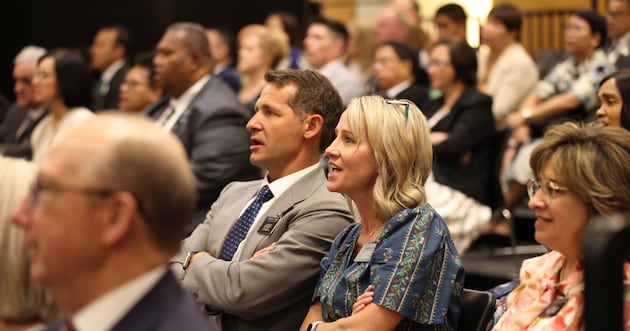
Seminar participants are asked to be seated 15 minutes before the start of each session. That amount doubles for Sunday seminars. Attendees are asked the day before to be in their seats 30 minutes before Sunday’s session, which combines sacrament meeting and final messages from members of the First Presidency. We are encouraged to prepare and reflect quietly and reverently before sacrament meeting.
Comparing the hustle and bustle of a hallway to the silence of a conference room reveals clear differences and understandable similarities. The obvious difference is the audible decibel level. One of the similarities is the continued excitement, anticipation, and energy of being ready to be directed and enlightened, not from the conversation.
And when that happens, it’s a powerful scene. That moment, a 30-minute “moment,” comes together. The silence is deafening. Seeking the Spirit and listening to the Spirit can be overwhelming.
This long period of spiritual preparation and personal reflection reminds me of when the stake presidency I served was invited to a leadership meeting for dozens of local stake presidencies presided over by President Boyd K. Packer, then acting president of the Quorum of the Twelve Apostles.
Knowing that President Packer emphasizes spiritual preparation in his meetings and tends to start them early, I asked my counselors in the stake presidency to provide transportation to the leadership meeting and to arrive 30 minutes before it was scheduled to begin. I could tell they were surprised, but had agreed to an earlier time than expected.
We arrived at the meetinghouse in a neighboring town half an hour early, and the chapel was already about a third full, with attendees sitting quietly. The organist had started playing the prelude half an hour earlier.
Approximately 15 minutes before the scheduled start time, President Packer and other general commanders and area leaders entered the chapel and took their seats at the podium. After seven or eight minutes, the leader who was presiding over the meeting stood up and said that President Packer appreciated godly preparation and that the Spirit had shown him that we were ready to begin.
For the next few minutes, I watched others arrive through the back door of the chapel, expecting to arrive a few minutes early, on time, or just a little late, but was surprised to find that the meeting had already begun. And afterwards, my counselor expressed gratitude for what I learned about making time for spiritual preparation.
Fast forward to Sunday, June 21st, the final session of the 2026 Seminar for New Mission Leaders. Elder Ronald A. Rasband of the Quorum of the Twelve Apostles, who presided over the meeting and welcomed participants, expressed his gratitude for the prelude and the long hours of reflection and spiritual preparation and how it invited the Spirit that day and other days of the seminar as well.
Elder Rasband said this to new mission leaders who will soon be meeting with missionaries in their areas. “May I suggest that this is a good pattern for you to follow?”
Even if it’s not 15-30 minutes in advance, thinking, preparing, and personalizing things is a good pattern for everyone. Speaking at the 2003 World Leadership Conference, Elder Russell M. Nelson, then of the Quorum of the Twelve Apostles, suggested starting with shorter sacrament meetings.
“Participants should be in their seats at least five minutes before the meeting begins so that they can be spiritually prepared for the worship experience,” he taught. “During that quiet time, prelude music plays quietly. This is not a time of conversation or message delivery, but rather a time of prayerful meditation as leaders and members prepare spiritually for the sacrament.”
He later added: “Each member of the Church is responsible for the spiritual richness that comes from sacrament meeting.”
Please consider attending one of our services, workshops, conferences, or devotions. If you always arrive at the start time, or if you often arrive more than a minute or two late, see if you can make the arrangements and effort to arrive a few minutes early to listen to the prelude, reflect, and prepare. Also, if you arrive a few minutes before the meeting starts, try to arrive even earlier so that you can have more time to preface, reflect, prepare, and personalize and reap more benefits.
— Scott Taylor is editor-in-chief of Church News.
