


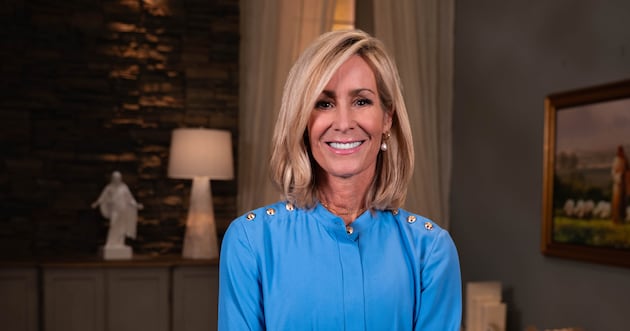
Sister Tamara W. Runia, first counselor in the Young Women general presidency, had simple advice for those struggling to pray: “Keep praying.”
On Friday, April 3, in a BYU Pathways devotional broadcast to students around the world, Sister Runia taught: Because Jesus Christ did it. When Jesus lived on this earth and returned as a resurrected being, he prayed to the Father as if it had changed everything. And it happened. And it’s possible for you and me. Let’s keep praying. ”
Sister Runia spoke about her and her husband’s calling as mission leaders in Australia. Six months later, my two youngest children decided to move back to Utah to finish high school.
When her daughter Barclay was preparing to leave Australia, Sister Runia suggested she set an alarm on her phone to remind her to contact her daily. Sister Runia spent her mornings in Australia and Berkeley spent her after-school afternoons in Utah.
“I remember waiting for her call one morning and thinking, ‘What if each of us could make a similar agreement with our Heavenly Father as we leave our heavenly homes?'” Sister Runia said. “And imagine what would happen if we said, ‘We’re going to miss each other so much. Let’s get ready. We’re going to talk through prayer every morning and every evening, so we can connect every day.'”
Echoing her daughter’s story, Sister Runia asked, “Are we connecting with our Heavenly Father every day?”
She then shared three truths she learned about prayer. “Prayer is a kind of work,” “God wants to be found,” and “Prayer changes us.”
“Prayer is a kind of work”
How is the work of prayer carried out? what does it look like? “I think it might be something like this: Keep on our knees until our casual prayers turn into ‘powerful prayers.’” To be honest, this change happens when I finish speaking and am about to say “Amen.” But I stop and think about what I don’t want to say. I think about the heavy burdens I carry and the fears I don’t want to admit to myself. ”
Sister Runia said her heart is softened and “opened wide open.” “I talk to my Heavenly Father, and He listens as if I were the only one. When I pray with all my heart, it is a powerful prayer.”
Sister Runia says her prayers are now more like real conversations that include listening and responding. “As I rise from my knees to begin my day, with prayer in my tender, newly wounded heart, revelations continue to occur as I travel.”

“God wants to be found.”
Our loving Heavenly Father truly wants His children to seek and find Him. “But one thing is clear: He protects our freedom of choice,” Sister Runia said. “God wants to help us with blessings, and He is already willing to give, but only if we ask for blessings.”
Through the process of prayer, one can seek God and know God. “That’s the covenant. I think God also wants our prayers to be a mirror to see ourselves as He sees us, as well as a window to see others who need our help every day as His children,” she said.
“Prayer changes us”
Like the Book of Mormon prophet Nephi, Sister Runia said: “I also prayed for ‘my people’ by day, and moistened my pillow with my eyes at night” (see 2 Nephi 33:3).
Not every situation she prayed for changed. “But I have changed, and so has my relationship with my Heavenly Father,” Sister Runia said.
Prayer has become like a reset button. “Each morning I can step out of my time-bound world and see the big picture and become a faith-filled person again. Especially when life seems haphazard and full of suffering, the universe helps me get back in the right place.”
And sometimes, Sister Runia said, when there is no relief from her pain, the only answer is the words “I know.” “It’s not so much an answer as an assurance from a loving God that I’m not alone.”
2025: President Johnson and Sister Runia meet “known, loved and needed” Latter-day Saints in the Pacific region
2025: Truths that guide Sister Tamara W. Runia’s return to her heavenly home
RootsTech 2026: How BYU–Pathway helps individuals develop family history research skills
