


November 25, 2025, 7:12pm MST
On October 10, 1975, President Spencer W. Kimball of the Church stood at the Marriott Center in Provo, Utah, and addressed Brigham Young University’s faculty, administrators, and students in commemoration of its 100th anniversary.
In his gravelly but powerful voice, the prophet spoke to the assembled crowd for more than 40 minutes, offering insights, visions and advice for the university’s next 100 years.
Fifty years later, President Kimball’s landmark speech, titled “Two Centuries of Brigham Young University,” remains a touchstone for the school.
President Kimball taught that BYU will be distinguished “not just by our student population or the beauty of our campus, but by the unique light that BYU shines on the world of education.”
BYU President C. Shane Reese said President Kimball’s address was mentioned, highlighted and elaborated upon by President Dallin H. Oaks in his devotion to the university. President Jeffrey R. Holland, President of the Quorum of the Twelve Apostles. Several Apostles, including Elder David A. Bednar, Elder Quentin L. Cook, then-Elder D. Todd Christofferson, and Elder Ronald A. Rasband. Both President Oaks and President Holland have served as presidents of BYU.
President Reese called President Kimball’s speech “truly remarkable” and “prophetic.” President Kimball foresaw many of the ideologies and pressures that BYU and its students would face and offered “a recipe for success despite those growing pressures.”
What are the main ingredients in that recipe? “We had to be willing, courageous, fortitude, to be different, to be different, not just to ‘imitate the world,’ but to use his words, to go out and be a university that was unique not just to the world, but to the world,” President Reese said.
October 2025 marks BYU’s 150th anniversary. This is the midpoint of the century that President Kimball spoke of. President Reese said the 500th anniversary provides an opportunity for university leaders and administrators to reflect and evaluate “how far we have come.” Then look forward and ask yourself, “Now, what jobs do I have left?”
In a recent interview with Church News, President Reese and BYU Vice President for Advancement Keith Borkink, who also chairs the Centennial Committee, reflected on this year’s anniversary and how the university “can make us unique as a university.”

Some of BYU’s unique features
President Reese said most first-time visitors to Brigham Young University’s campus are impressed by its impressive mountainous backdrop.
“I have people come into the office all the time, and they see the mountains that surround this campus and are in awe of the physical environment,” he said.
But for Chancellor Reese, BYU’s true beauty has always been its students. “They’re vibrant, they’re loyal, they want to make a difference in the world, and being around students like that is truly the magic of this campus,” he said, adding that the students “radiate a light, and we deeply believe that it is the light of Jesus Christ shining through them.”
President Reese, quoting President Holland, emphasized that BYU must remain “unequivocal and true to the restored gospel of Jesus Christ” (“Brigham Young University’s Late Second Century,” BYU University Conference, August 23, 2021).

Volkink pointed out that in 1975, when President Kimball spoke, there were many faith-based private institutions. Now that number is decreasing. “So one of the ways we need to be different is by strengthening that bond, not weakening it, because the pressures in higher education are pushing people away from their faith.”
President Kimball spoke of the need for BYU students and faculty to be “bilingual” or able to integrate faith and academics. Chairman Rees said: “While we will not shun our faith and use it as an excuse for not (not) achieving academic excellence, we will not make sacrifices to build faith in Jesus Christ and His restored gospel.”
Faith and scholarship are not mutually exclusive, and in fact, they are mutually reinforcing, President Reese said.
In his 2021 speech, the Dutch President also emphasized the need to focus on undergraduate education. President Reese said higher education has become a faculty-centered endeavor with an emphasis on research.
“While we place great emphasis on research at BYU, it will never replace our primary purpose, which is undergraduate education. And we are committed to that. It is one of the ways BYU is unique as an institution,” said Chancellor Reese.

established in the service
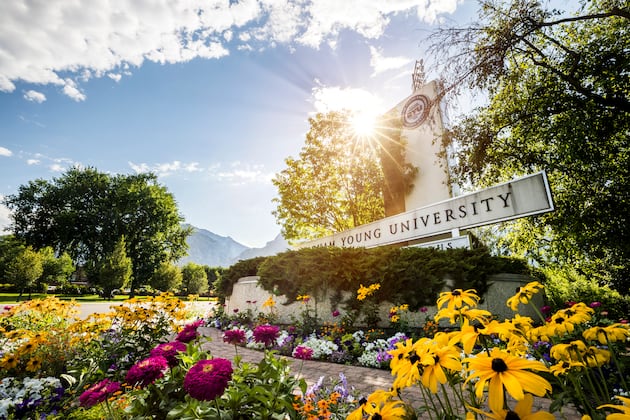
A sign at the entrance to BYU’s Provo, Utah, campus bears the university’s unofficial motto: “Enter to learn, go to serve.”
The late President Russell M. Nelson taught that the motive of education is greater service. “Educating and gaining knowledge is the difference between simply wanting to help someone and actually having the ability to do so,” said President Reese.
Vokink pointed out that data shows that many young people today are suffering from a lack of purpose. “What BYU gives them is a serious, important and essential purpose. The church has created this environment for them to gain skills, grow as well-rounded people and go out and serve the world,” he said.

Then-Elder Christofferson once taught that BYU is not about enhancing privilege, but about enhancing service (“The Purpose of a BYU Education,” Aug. 22, 2022). “Like the sign at the entrance to campus, it’s so much fun to go out and serve because they can do it with a purpose,” Volkink said.
President Reese added that in his October 2022 general conference address, President Christofferson, now Second Counselor in the First Presidency, taught that the secret to creating a sense of belonging and thereby combating loneliness is to serve and sacrifice for others.
“It’s a bold concept that defies all the teachings of the world, but it gives us an education that gives us the ability to go out and serve, which strengthens our sense of belonging and solidarity in the world. So we love this unofficial motto…’Come to Learn, Go to Serve,’ because we believe a BYU education equips students to serve, just as President Nelson has taught,” President Reese said.

As we celebrate our 150th anniversary, President Reese said on campus, “How can we become more Christ-centered? How can we demonstrate our uniqueness as a university? And the reality is, we believe that the students who attend this university are a light, and we deeply believe that the light of Jesus Christ is shining through them.”
Any effort to shine BYU’s “unique light” must be done with humility, President Reese warned, “and recognizing the source of that light, the ultimate source, and that is Jesus Christ.”
Although the university still has work to do to become a Christ-centered university, “we are absolutely committed to doing so,” President Reese said.
