


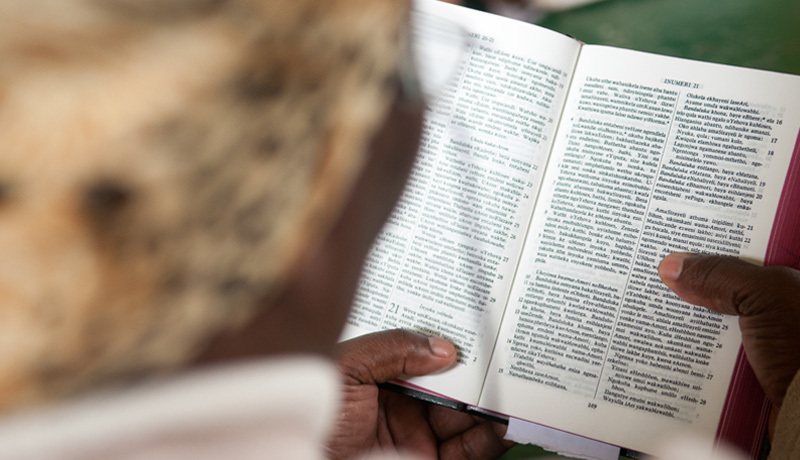
As the son of a Bible Translator, I grew up immersed in the work and culture of Bible translation. When I became an adult and decided to take part in the effort, I imagined myself walking the same pioneering path as my previous parents. So far, I have dedicated 30 years of my professional life to the mission of bringing the Bible to all people in their language.
But something surprising unfolds in the translation of the Bible, and instead of the path of my parents, I see a beautiful convergence of the path. On the one hand, there are decades of basic work by families of biblical translation organizations, including language studies, cultured relationships, and patient labor in the translation itself. This represents years of faithful service and accumulated expertise. It’s a job my parents loved and dedicated to their time, talent and life. That’s the job I loved.
There is a vibrant, growing local church movement characterized by enthusiasm and passion for reaching what has been reached.
Meanwhile, there is a vibrant, growing local church movement, characterized by enthusiasm and passion for reaching the unreachable. The local knowledge, cultural understanding and spiritual enthusiasm of these church leaders brings essential elements to work around the world.
While our followers embrace and build upon the fundamental work of their community, our people who work in Bible translation are updated and redirected by this local passion and vision.
The resulting partnerships produce much greater than translation organizations and local churches can achieve on their own. It is a stunning display of divine wisdom and timing. God’s people are gathering together to help God’s people contribute their role and ensure that God’s Word reaches those who are still waiting.
God’s heart is revealed to us in a new and wonderful way.
God’s heart is revealed to us in a new and wonderful way. I recently saw this truth come to life. I met with a small group of pastors and discussed launching a new initiative in their area. Travel remains difficult in parts of the world, so we were disappointed that only a handful of pastors could attend.
But something incredible happened at the end of the day. As we stood together singing “Great is Your Faithfulness,” a beautiful moment of harmonious worship in three different languages, I was deeply reminded that it was not our careful planning or impressive numbers. It’s God alone.
One pastor’s story made this even more specific. A few years ago, during the birth of her eldest daughter, doctors made catastrophic news. His wife was almost dying. He needs to prepare to say his final farewell. In that moment of despair, he remembered his sister, who believed in Christ. She lived in a far-flung part of the country, but he reached out to her with a simple text message.
She immediately mobilized and prayed for the countryside church community. He explained that even farmers working in remote fields are stopping their labor for women they have never met.
Just an hour after these prayers began, the doctor emerged from his wife’s room. The pastor supported himself due to the news that she had passed away, but instead he heard words that could only be described as miraculous.
As a result of that miracle, the rest of his family quickly placed their faith in Jesus, and ever since he has been fully committed to sharing the gospel. Today he is excited to engage the language community in the area of his province, where he wants to be involved in biblical translation.
God brings life from death, purpose from pain, and use ordinary people to accomplish extraordinary missions.
This pastor’s journey to becoming a translation advocate is advanced by the miraculous fruit of one hopeless text message, embodying everything I believe in how God works. God brings life from death, purpose from pain, and use ordinary people to accomplish extraordinary missions.
Looking back, I can say I have experienced a deep journey of transformation in myself. Initially, I joined the Bible Translation Movement and continued my parents’ legacy of translation work. Their approach to reach their country is part of my DNA and I have seen God’s heart for the nation for years, filled by my efforts and the efforts of people like me. But as the world’s landscape evolved, so did our methods. I confess that this transition wasn’t easy for me.
God wants not only to reach the nation, but to include the nation in his work.
But God has gently changed my understanding of his heart. I realized that God wanted not only to reach the nation, but also to include the nation in his work. His plan is to make room for local followers, the very fruit of the faithful service of my generation of parents, to fully participate as important members of the living, breathing body of Christ.
In recent years I have witnessed a beautiful evolution from the pioneering model of early decades of Bible translation, to the full and active participation of local believers in sharing God’s Word with their own community as well as the whole world.
This new class of involvement represents something remarkable. This is a mature church equipped with abilities, skills and passion, with the abilities, skills and passion to meet the needs of future generations and generations.
God’s mission is not just to reach the nation. It is about transformations that see Indigenous churches transition from recipients to agents of God’s Word. What moves me most is that I realize that the translation of the Bible itself reflects the remarkable nature of God. The words that become physical in each unique cultural and linguistic context are known in a deep, personal way in which he exists.
How does God want to use me?
While we continue to witness this transformation, trust God’s process. He is the man who uses us all in the body of Christ, bringing in an increase, not to our background, to achieve his purpose. And ask each one of them: “Why does God want to use me?”
Daniel Watters grew up in Asia. There, through my parents’ work in the remote language community, I first experienced the life-changing impacts of Bible translation. Inspired by their examples, he joined Wycliffe USA in 1992 shortly after completing his Bachelor of Arts in Linguistics from the University of Washington. He later received his Master of Arts in Linguistics and Interpretation from Trinity Western University in 2000. From 1994 to 2019, Daniel worked in Asia through Wycliffe USA and partner organizations, holding various administrative and leadership positions. Today, Daniel is part of Wycliffe USA’s Global Partnership Team.
