


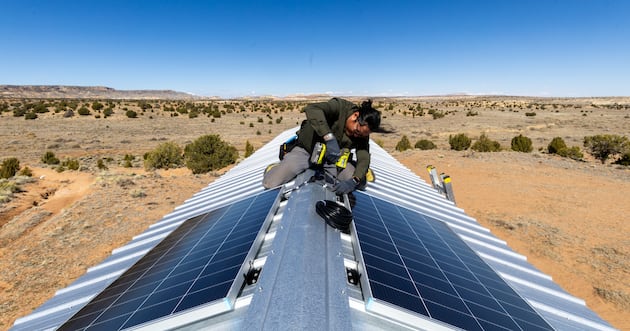
The Church of Jesus Christ of Latter-day Saints partnered with Heart of America, a national education nonprofit, to install solar power on Navajo homes near Chinle in northeastern Arizona.
In March 2026, the church funded solar power installations for 100 homes and age-appropriate educational materials for families.
Approximately 14,000 homes on Navajo tribal lands are without electricity. Heart of America works to provide light to families with school-age children, focusing on educational stability and student well-being.
Heart of America President and CEO Jill Heath said this is a game-changer that will “bring home electricity and power to students and their families.”
“We are focused on making sure our students have what they need to be successful: the ability to do homework after dark, the ability to read, and the ability to connect with their families,” Heath said in a ChurchofJesusChrist.org news release.
Heath said the organization’s leaders were excited to learn of the church’s desire to support Heart of America’s mission.
“When this grant arrived and the church generously said, “We want to help bring electricity and power to more students,” we knew this would be a great collaboration,” Heath said.

Heath said the donation is “more than just light.”
“This is about hope. It really provides opportunities and hope for the future for families and students.”
Impact on family
Milo Fowler of Heart of America, who helped install the 100 solar kits donated by the church, said installation takes about an hour.
“So in one day, you can effectively deliver solar power to your home for the next 10 years,” Fowler said.

Each solar kit includes roof panels, batteries, lighting, charge controller, inverter, and refrigeration unit. The system provides reliable power for lighting, food storage, and critical equipment, replacing temporary solutions such as fuel generators and battery lighting.
“I often hear that students’ grades have improved because they can do their homework after dark,” said Lian Ma, who has worked on the installation team for several years. “We hear from students who are now able to store their medications in the refrigerator, so they don’t have to store their medications next door. To keep their food cold,[some families]would literally freeze a gallon of water next door and bring it in every day and put it in their own cooler to keep their food cold. And now they have fresh food in their home 24/7 because of that. It’s really amazing.”
Before installing the solar kit, Colin Begay used small battery-powered lights while helping his five sons with homework and bedtime each night.
“Life is very difficult because there is no electricity,” she said.

Begay installed the new lights on March 5th.
“I am filled with joy and love,” she said. “We can read bedtime stories, the kids can do their homework, there is light, and we can charge our laptops.”
Heath said schools have seen improved attendance, engagement and academic focus among students living in homes that use solar power.
“Home is where you should feel most stable, and home is where you should feel most secure,” Heath said.

Eugene Gorman, a father of three who lives in the Red Valley area, said his family had relied on generators for years. He said they often spend a lot of money on fuel.
“This solar power is going to be a huge help to us,” Gorman said. “You’ll be able to spend your money in different places for your kids instead of just constantly worrying about your electricity bill.”
Gorman said he is truly grateful to the people who made this possible.
“Nobody else did it, but you guys did it,” he said.

Other church efforts on the Navajo Nation
The Church of Jesus Christ of Latter-day Saints works with charities and nonprofit organizations around the world to provide resources and assistance to people. Following the teaching of Jesus Christ, “Love your neighbor as yourself” (Matthew 22:39), the Church and its members strive to be the Savior’s hands in caring for those in need.
Starting in September 2022, a Diné (Navajo) community near Blanding in southeastern Utah will have water and electricity, thanks to a donation from the church.
The church also helped donate 3 million pounds of firewood to Navajo families. Most Navajos rely heavily on burning wood to heat their homes during the winter.

