


Editor’s Note: In March 2026, The Church of Jesus Christ of Latter-day Saints published 10 short discussion videos in the Women’s Gospel Library featuring 10 members of the Relief Society General Advisory Committee.
Council members wrote to Church News about five topics in the video. This is the fourth of five articles on the topic of “Remaining committed in the face of attack, hurt, and challenges.” Read Part 1 on “Finding Strength and Peace in Jesus Christ” here, Part 2 on “Managing Competing Priorities” here, and Part 3 on “Building Emotional Resilience” here.
Sometimes we want our leaders to deliver perfection, but we also expect the same perfection from ourselves. We have come to understand how difficult that expectation can be, especially when it goes against the plan of the gospel. The gospel was never intended to produce instant perfection. Rather, it brings growth, understanding, patience, and love for each other.
Sister Elaine Thornton: I learned this through a difficult experience with a leader who had a painful impact on my family. For a moment, I held onto the wound tightly. I replayed the situation in my head and had a hard time understanding it. But eventually I had to stop and look within myself. I remember thinking, “He’s a really hurtful person. But maybe I’ve hurt someone too. Maybe I’ve said or done something that hurt someone.” I’ve come to recognize my own shortcomings as well.
That realization softened my heart and brought me back to the basics of what I knew. In many ways, that painful experience brought me closer to the Lord in a deeper and more meaningful way. If that hadn’t happened, I might not have returned to my spiritual foundation so intentionally.
Throughout the process, I realized that I had a growing desire to know my Heavenly Father and my Savior more personally. And the reason I want to know them is simple. Because I want to be more like them.
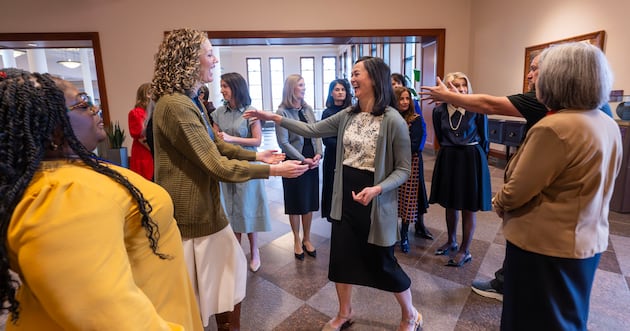
So as we think about our Relief Society gatherings and how we can counsel together as women, I feel a strong urge to encourage all of us to huddle a little more. Lean on your sister who doesn’t think the same way as you. Be there for those who are worried about her testimony. Hear from sisters who have recently gone through a divorce or who are quietly wondering if divorce is worth it.
I believe this will make us more useful to the Savior. We begin to learn how to do what God does.
Sister Emme Martin: By drawing ourselves into sisterhood and sharing pieces of our hearts with each other, we find a sense of belonging and healing. When we think of our hearts being broken by sin, we first try to remember that our Savior and Redeemer also suffered “pains and sufferings and temptations of every kind” (Alma 7:11). Jesus Christ went through this life in order to know for himself the challenges of mortality, “so that according to the flesh his bowels might be filled with mercy, and that he might know according to the flesh how to help his people according to their weaknesses.” (Alma 7:12). As I remember the sufferings of my Savior, I try to remember that I am not alone in the burdens I carry, and neither are the brothers and sisters I meet.

The late Elder Neal A. Maxwell of the Quorum of the Twelve Apostles shared great insight on this topic, saying, “The church is ‘for the perfecting of the saints’ (Ephesians 4:12). The church is not a well-equipped haven for those who have already been perfected. Similarly, some fail to remember the reality that in the kingdom we are each other’s clinical material. The Lord allows us to practice with one another, even though we are imperfect.” (See “Brothers Offended,” April 1982 general conference). In this learning laboratory of life, we are essentially going to experience pain and hurt each other. It’s like an occupational hazard in our deadly situation. But we must prayerfully decide how to move forward with the Savior, even though it may be painful.
Elder David A. Bednar of the Quorum of the Twelve Apostles said: “Neither you nor I can control the intentions or actions of others, but we are the ones who decide how we act.…One of the greatest indicators of our own spiritual maturity is the weakness of others. It manifests itself in how we respond to rudeness, immaturity, and potentially aggressive behavior. Things, events, or expressions may be offensive, but you and I can choose not to offend them.” (October General Conference).
When we are in the learning laboratory of the church community, we can choose to remember our Savior and allow Him to help us. We can choose to remember our circle of sisterhood and allow it to sustain us. We can choose to remember the comfort that comes from keeping our covenants and let them strengthen us through hardships such as abuse. Instead of the bitter parts, you can choose the better parts.
—Sister Elaine Thornton and Sister Emme Martin are members of the Relief Society General Advisory Committee.


