


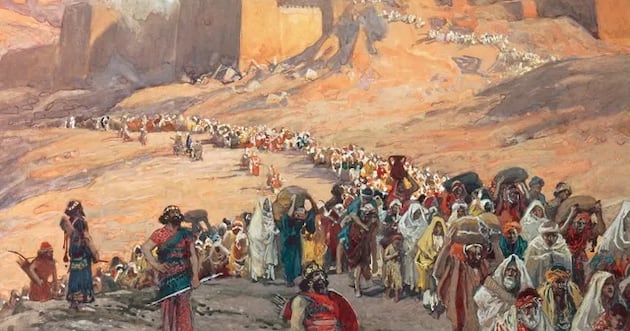
This week’s Come, Follow Me study guide covers 2 Kings chapters 16 through 25, including the scattering of Israel.
Below are quotes from past and present leaders of The Church of Jesus Christ of Latter-day Saints regarding these chapters of the Bible.
2 kings 16
“The glorious eminence (of Solomon’s Temple) was short-lived. Thirty-four years after its consecration, and five years after Solomon’s death, its decline began. And this decline soon developed into general encroachment, and finally into actual desecration. Solomon was an idol. Misled by the wiles of the worshiping women, his wayward ways fostered lawlessness in Israel. The temple soon lost its holiness, and Jehovah withdrew his protective presence from the no longer sacred place.
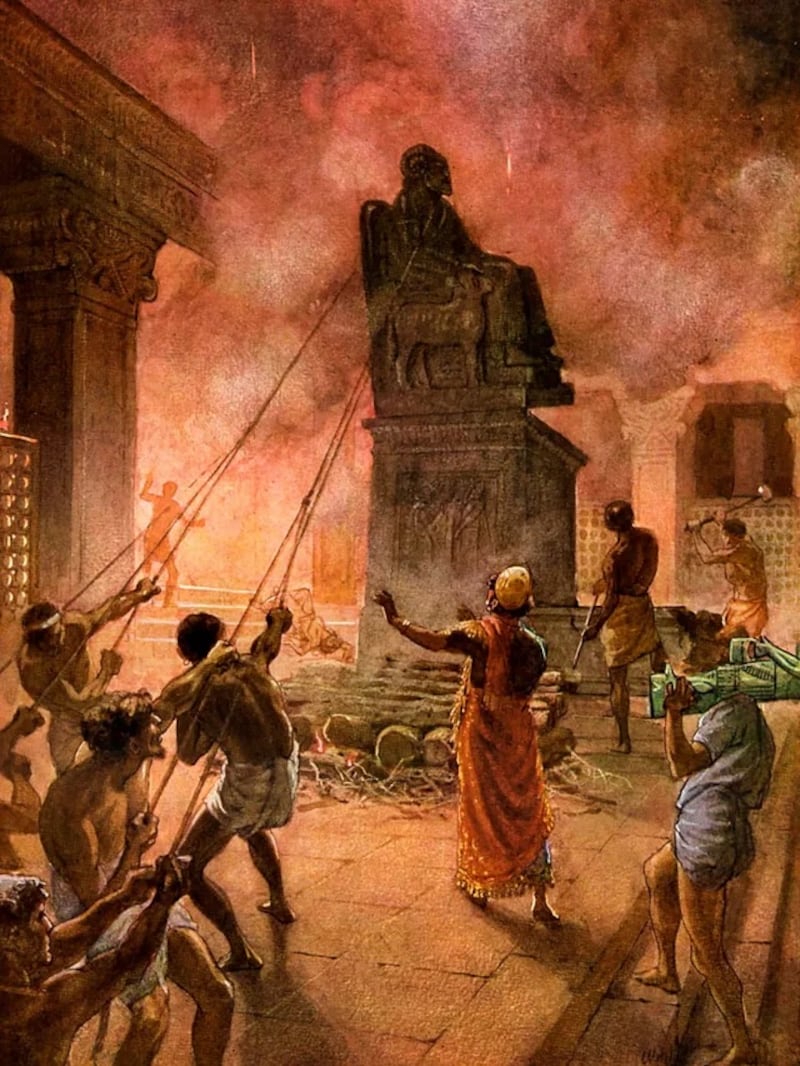
“The Egyptians, who had freed their people from bondage, were allowed to oppress Israel again. Shishak, king of Egypt, captured Jerusalem, and ‘and he took away the treasures of the house of the Lord’ (1 Kings 14:25-26). The desecration continued for centuries. 216 years after the Egyptian sack, Ahaz, king of Judah, and removed the altar, leaving only the house.” A temple had once stood there (see 2 Kings 16:7-9, 17-18; see also 2 Chronicles 28:24-25). Nebuchadnezzar, king of Babylon, then completed the sacking of the temple and burned the building with fire (see 2 Chronicles 36:18-19; see also 2 Kings 24:13; 25:9).
—The late Elder James E. Talmage, then a member of the Quorum of the Twelve Apostles, in the October 2010 Liahona article “History of the Temple.”
2 kings 17
“The captivity of the Jews and the dispersion of the tribes of Israel, including the ten tribes, are prominent doctrinal factors in the Restoration of the Gospel. They went to the northern nations (see 2 Kings 17:6; Doctrine and Covenants 110:11). The 10th Article of Faith says, “We believe in the literal gathering of Israel and the restoration of the ten tribes.” We also believe that as part of the Lord’s covenant with Abraham, not only Abraham’s lineage will be blessed, but all people on earth will be blessed as well. …
“Our doctrine is clear: ‘The Lord scattered and afflicted the twelve tribes of Israel because of their iniquity and rebellion. But the Lord also used the scattering of his chosen people throughout the nations of the world to bless those nations'” (Bible Guide, Israel).
“We have learned a valuable lesson from this tragic period. We should do everything in our power to avoid the sin and rebellion that leads to bondage. We also recognize that righteous living is a prerequisite for helping the Lord’s chosen people and the literal gathering of Israel.”
— Elder Quentin L. Cook of the Quorum of the Twelve Apostles, October 2013 general conference, “Jeremiah’s Lamentations: Beware of Bondage.”
2 kings 18
“Rehoboam rejected the advice to humble himself and serve others. Instead, he chose to rule Israel with a very harsh hand, causing a great division between the northern kingdom of Israel and the southern kingdom of Judah (see 1 Kings 12:20).
“For the next 220 years the people generally set aside the sacred covenant and wandered in the ways of the world. Then a young man named Hezekiah began to reign in Judah. ’And he did what was right in the sight of the Lord,’ and ‘he trusted in the Lord, the God of Israel’ (2 Kings 18:3, 5).
“Both King Hezekiah and King Benjamin (see Mosiah 2-5) teach us a very positive lesson about leadership. Things don’t always have to be the same. Leaders can make a difference. Faith in the Lord and high expectations can bring about a profound change of heart in an entire people.”
— Elder Spencer J. Condie, then General Authority Seventy, April 1990 general conference, “Biblical Lessons on Leadership.”
2 kings 20
“As we live on earth, we must walk in faith without doubting anything. When the journey seems unbearable, we are comforted by the words of the Lord: “I have heard your prayers, I have seen your tears. will heal you’ (2 Kings 20:5). Some of the healing may happen in another world. We may never know why something happens in this world. Only the Lord knows the reasons for some of our suffering.”
—The late President James E. Faust, then Second Counselor in the First Presidency, October 2004 general conference, “Where Do I Stand?”
2 Kings 22 and 23
“The story of King Josiah in the Old Testament is the most instructive story to ‘liken ourselves to’ (1 Nephi 19:24). To me, it is one of the greatest stories in all of scripture.”
“Josiah was only eight years old when he began to reign in Judah. Although his immediate ancestors were extremely wicked, the Bible says, “He did what was right in the sight of the Lord, turning not to the right hand or to the left, but walking in the path of David his father” (2 Kings 22:2). This is all the more amazing when you realize that by that time (just two generations before the destruction of Jerusalem), 587 B.C. In 1993, the written law of Moses was lost and was virtually unknown even among the temple priests.
“But in the 18th year of his reign, Josiah ordered the temple to be repaired. At that time, Hilkiah the high priest found the Book of the Law, which Moses had placed in the Ark of the Covenant, and handed it over to King Josiah.”
“When the Book of the Law was read to Josiah, he ‘borrowed his garments’ (2 Kings 22:11) and wept before the Lord.
“’Great is the anger of the Lord kindled against us,’ he said, ‘because our fathers did not listen to the words of this book, according to all that was written concerning us’ (2 Kings 22:13).
“Then the king read the book in the presence of all the people, and at that time all the people made a covenant to obey all the commandments of the Lord “with all their heart and with all their souls” (2 Kings 23:3). Then Josiah began to purify the kingdom of Judah, removing all the idols, groves, and high places, and all the abominations that had accumulated during the reign of his fathers and had defiled the land and the people.
“‘And there was no king before him who turned to the Lord with all his heart, and with all his soul, and with all his strength, according to all the law of Moses; and no king after him rose up like he did.'” (2 Kings 23:25)
“Like King Josiah, I feel strongly that all of us must return to the scriptures and let them work powerfully within us and move us to an unwavering commitment to serve the Lord.”
—The late President Spencer W. Kimball, Teachings of the President of the Church: Spencer W. Kimball, 2011, chapter 6, pages 62-63.
“My favorite example in the Old Testament is the boy king Josiah, who ascended to the throne at the age of eight. His story represents the shock of a young man who realized that the scriptures were more precious than gold and sweeter than honey. All the kings before Josiah and those after him were wicked. They either did not have the law or chose not to read it and follow it. But during the reign of Josiah, Hilkiah the high priest found the lost Book of the Law in the temple.” It was read into Josiah’s heart, and he repented and wept before the Lord (see 2 Kings 22:19) and gathered all the people into the temple and vowed to them to keep God’s commandments.
“And he read in their ears all the words of the book of the covenant that was in the house of the Lord.
“‘And the king (and his people) stood by the pillar, and made a covenant before the Lord, to walk after the Lord, to keep his commandments, and his testimony, and his statutes, with all his heart, and with all his soul, and to do the words of this covenant, which are written in this book; and all the people kept the covenant” (2 Kings 23:2-3).
“What a moving story. I often wonder why Josiah had the courage of spirit to respond to the teachings of the Book of the Law. Why was his response different from that of the kings before and after him? He read the scriptures, listened to them, and vowed to keep the commandments therein. Regarding honoring the scriptures by keeping the covenant, did this apply to you when you were young? Perhaps the scriptures touched an eternal chord.” Josiah trotted out the teachings of his past life. ”
– Sister Susan W. Tanner, then Young Women general president, said in a devotional at Brigham Young University in September 2005, “The Bible is more precious than gold and sweeter than honey.”
2 kings 25
“Please tell me what the phrase ‘bearing the vessels of the Lord’ means. In ancient times, this phrase had at least two meanings, both of which were associated with the work of the priesthood.
“The first refers to the recovery and return to Jerusalem of the various Temple utensils brought to Babylon by King Nebuchadnezzar. In physically handling the return of these items, the early Brethren believed that everything associated with the Temple was sacred. Therefore, when they brought these various bowls, basins, cups, and other vessels back to their homeland, they themselves had to be as clean as the ceremonial utensils they wore (see 2 Kings). 25:14-15; Ezra 1:5-11).
“The second meaning is related to the first. Similar bowls and utensils were used for ritual cleansing in the home. The apostle Paul, writing to his young friend Timothy, said of these: ‘In the great house there are…vessels of gold and silver…vessels of wood and clay.’ is a means of washing and purification that was common in the Savior’s time. But Paul goes on to say, “If a man…purify himself (worthiness), he will become a vessel…” sanctified, available for the master’s use, ready for every good work. ” So Paul said, “Flee…the lusts of youth…obey righteousness…call on the Lord with a pure heart” (2 Timothy 2:20-22).
“In both of these Biblical accounts, the message is that as priesthood holders, we are not only to handle sacred vessels and symbols of God’s power—think, for example, of preparing, blessing, and administering the sacrament—but that we are to be sacred instruments. Because of what we should be, but more importantly because of how we should be, the prophets and apostles tell us to ‘flee from the lusts of youth’ and to ‘call upon the Lord with a pure heart.’
— Late President Jeffrey R. Holland (then a member of the Quorum of the Twelve Apostles), October 2000 general conference, “‘Sanctify Yourself’”
