


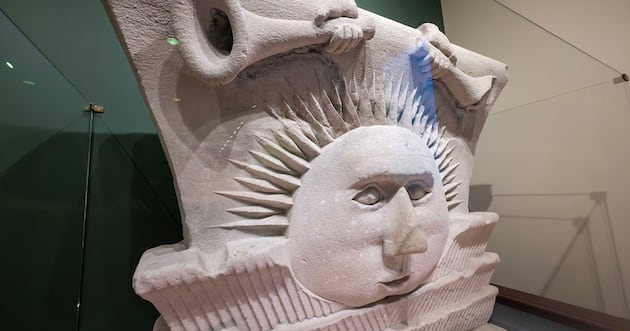
One of the most famous architectural features of the original Nauvoo Temple is its sunstone capitals.
When completed in 1846, the temple walls had 30 pilasters, each with a limestone capital sunstone carved into the top. These pillars surrounded the perimeter of the temple, nine on each side and six on each side.
Each 2.5 ton stone had a carving of a glowing sun face emerging from a cloud bank beneath a hand-held trumpet.
“The sunstone represents the heavenly light of Christ’s latter-day church breaking through the clouds of darkness (see Revelation 12:1). The trumpet heralds the restoration of the gospel before Jesus Christ returns to earth,” says an exhibit in the new Nauvoo Temple Visitor’s Center.
After the temple was destroyed by fire and tornado, only two sunstones likely survived intact.
One of them is currently leased from the state of Illinois to The Church of Jesus Christ of Latter-day Saints and is on display at the Nauvoo Temple Visitor’s Center.
The other is in the Smithsonian National Museum of American History in Washington, DC. Previously on display at a museum in Quincy, Illinois, it was purchased by the Smithsonian Institution from the Quincy and Adams County Historical Society for $100,000, the Church News reported in 1989.

The third sunstone, which is severely damaged with visible wear including a missing nose, was used during the transfer of sacred sites and historical documents from the Christian community to the church in March 2024.
Alexander Baugh, a retired Brigham Young University professor of church history and doctrine, researched the path the sunstone, which was on loan to the Church from the state of Illinois, made from its original temple to its current location today at the Nauvoo Temple Visitor’s Center.
“We believe that by understanding this important and rare historical artifact from the original Nauvoo Temple, our patrons will gain a deeper appreciation for the early people who contributed to the construction of the temple, as well as the artisans who painstakingly crafted the unique and symbolic spiritual expression of the Restoration of the Gospel and temple ordinances that Jesus Christ gave to the Prophet Joseph Smith,” Baugh wrote in an email to Church News.
stone sculptor
Skilled stone cutters began the complex process of shaping the capital’s Sunstone in March 1844.
According to a BYU article written by Baugh, people known to have worked as stone carvers for Nauvoo Temple’s capital sunstone include Charles Lambert, Benjamin T. Mitchell, Harvey Stanley, John Harper, James Sharp, Rufus Allen, and James Henry Rollins.
Workers installed the first capital Sunstone on September 23, 1844.
Nauvoo Visitors Center Sunstone Timeline
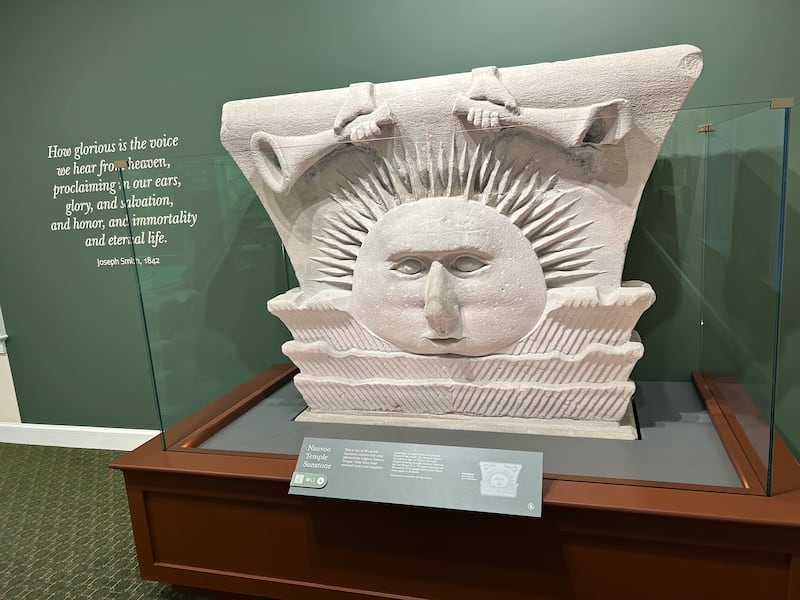
How did one sunstone end up at the Nauvoo Temple Visitor’s Center?
Bo has compiled the following chronology.
1865 — George W. Gray, president of the Methodist English and German College (often referred to as Methodist University) in Quincy, Illinois, travels to Nauvoo and acquires two Capital Sunstones from what remains of the ruins of the original Nauvoo Temple. The sunstone was intact, but the pedestal stone and the upper abacus stone were missing. Gray brought the capital stone to Quincy by steamboat and placed it opposite the main gate on the college grounds, then at Third and Spring Streets.
1870 — One of the Methodist English-German College sunstones was donated or acquired by the state of Illinois, transported to Springfield, and placed in the Old State House, the former state capitol made famous by Abraham Lincoln.
1876 — Sunstone is moved to the new state capitol grounds four blocks southwest. There, samples of native Illinois stone were being transported for the new Capitol building (now the state capitol) that was being constructed at the time.
1894 — The Sunstone was moved to the entrance to the Illinois State Fairgrounds in Springfield and placed in the middle of a decorative lily pond.
1955 — Sunstone was transported from Springfield and placed at Nauvoo State Park.
1992-1994 — Sunstone, owned by the state of Illinois, is leased to The Church of Jesus Christ of Latter-day Saints. In June 1994, the work was moved to its original temple block on the cliff and placed in a sealed display case to protect it from vandalism and the elements.

1999 — The sunstone and sealed display case were moved to just outside the north entrance of what is now called the Historic Nauvoo North Visitor’s Center.
November 2012 — The stone was placed in an open display case inside the Historic Nauvoo North Visitors Center.
June 2026 — Sunstone is installed in the new Nauvoo Temple Visitor’s Center, a short distance northwest of the rebuilt Nauvoo Illinois Temple.
How to see sunstone
Elder Gerrit W. Gong of the Quorum of the Twelve Apostles dedicated the new Nauvoo Temple Visitors Center on June 27.
The center opened to the public on June 29th. Visitors are welcome during normal business hours.
Those who are unable to visit the new visitor center in person can still enjoy and view some of the exhibits by visiting the online exhibit, which shares many messages and images.
For more information about the Illinois Church Historic Site and the Nauvoo Temple Visitor’s Center, visit ChurchofJesusChrist.org.

