


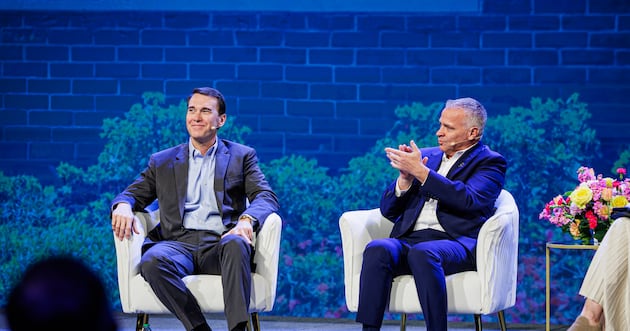
Brigham Young University President C. Shane Reese and Taylor University President D. Michael Lindsay, who each lead faith-based institutions of higher education, agree on the power of faith and inspired learning.
Both leaders and both universities were featured in a recent three-part BYUtv documentary titled “Higher Education: The Power of Faith-Inspired Learning.” The documentary focuses on both BYU and Taylor University, as well as other universities, and shows how leaders use faith to encourage learning.
And on Tuesday, May 19, presidents from both universities appeared at a BYU forum to discuss topics of faith and higher education. The event was held at the Marriott Center in Provo, Utah.
Following a video consisting of documentary clips, Chancellor Reese spoke about the challenges and scrutiny some religious colleges face. He advised students to make the most of receiving both academic and religious education and encouraged them to “lean into it.”
“I think these two things can happen at the same time, even though people say they’re different,” he said.
President Lindsay said two bell towers stand at the heart of Taylor University, an evangelical, nondenominational Christian liberal arts college located in Upland, Indiana. We have a similar mission as BYU. It is about encouraging students to put Christ at the center of their lives.
Lindsey added that at night, lights from each tower will be shot skyward, and the two lights will intersect rather than traveling in separate directions.
“One represents faith and the other represents learning,” he said. “That’s exactly what we try to do at Taylor, to encourage our students to integrate faith and learning.”
In the video shown, President Lindsay emphasized that as students discover who they are to God, they will deepen their understanding of themselves. This knowledge empowers students in their personal and academic lives.
“We don’t know who we are until we know who we are,” he said in the video.
President Lindsay and President Reese agreed that the pursuit of academic and spiritual growth is ultimately a joyful pursuit.
The conversation then turned to how religious institutions can maintain respect for those who disagree with them.
President Lindsay referred to one of the fundamental principles of Christianity: loving your neighbor (see Matthew 22:39).
Following this commandment, Taylor University has raised nearly $100 million to support local businesses in the small town of Upland, where the university is located.

President Reese then spoke about remaining humble when interacting with those who do not share our approach to pursuing faith and inspired learning.
“As a faith-based organization, I hope we have a healthy dose of humility. I think this is a commandment and we need to abide by it,” he said.
President Lindsay said Taylor’s model of faith and humility was a man named Samuel Morris, who came to Taylor in the late 19th century.
A former prince of Liberia, he fled his homeland due to a coup d’état. After moving to Indiana, he converted to Christianity. Morris, the university’s first student of color and its first international student, became known for standing strong for his beliefs while seeking understanding.
“We are willing to tackle big problems because we believe that all truth is God’s truth,” President Lindsay said, a commitment to faithfulness in the pursuit of truth that continues to inspire him to this day.
When asked how faith strengthens learning, President Reese said:
“We believe that research amplifies faith, faith strengthens inquiry, and revelation leads to deeper understanding.”
President Reese quoted Church President Spencer W. Kimball as saying that students must become bilingual in both faith, which is the word of God, and academics, which is the language of learning.
This dual understanding allows students at religious colleges to ask bigger questions and find answers to those questions, while secular schools would not be able to ask the same questions and find answers to those questions, he said.

Asked to share his final thoughts with BYU students and other students at religious universities, President Lindsay first touched on how BYU has impacted him on a personal level, mentioning his daughter, who has a severe intellectual disability.
President Lindsay said he loves listening to music, especially Noteworthy and Vocal Point, two a cappella groups formed by BYU students. He said their music brought comfort to both him and his daughter.
He first expressed his gratitude for BYU and its mission, joking that they were “BYU groupies.” “It’s amazing to see how your ministry is reaching out and impacting my daughter’s life,” he said. “Our family has been so blessed by the ministry here.”
In his final thoughts, President Lindsey encouraged everyone in attendance to seek to become like Jesus Christ.
“This is my encouragement and admonition to all of us to embody grace and truth to a world in need,” he said.
