


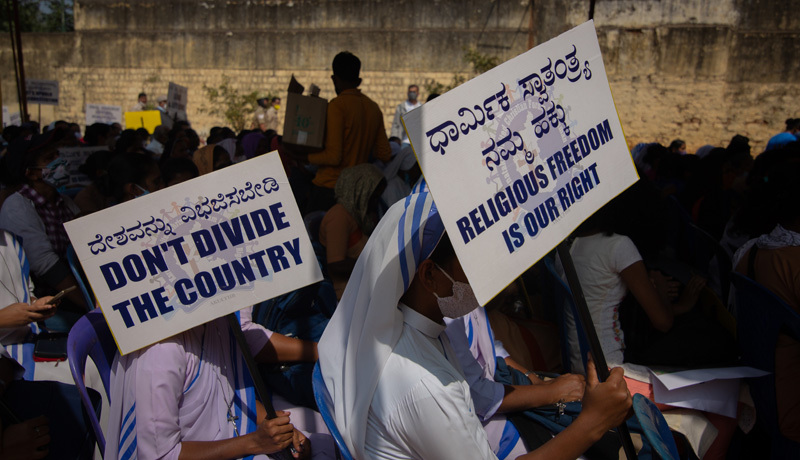
The famous Indian emperor Ashoka was an ancient convert from Hinduism to Buddhism. He demonstrated that a person is not forced to convert another person from one religion to another. Today, “religious transformation is being forced” is a flawed premise of all India’s anti-fusion laws. Who could have forced the mighty Emperor Ashoka to change his religion? The Emperor’s famous religious conversion was his choice.
His achievements are recognized both within and outside India. In his book “A Summary of History” (1920), HG Wells said, “Asoka’s name shines brightly among the tens of thousands of names of monarchs, such as the history column, their proud grace and grace, and the royal His Highness.
India is proud of its famous religious converts
The famous religious conversion of Emperor Ashoka, which occurred about 2,400 years ago, is proudly recorded in Indian history books and is taught in all Indian schools.
Between 268-332 BC, Ashoka the Great, the emperor of the Maurya dynasty, ruled the entire Indian subcontinent, except for some of the southernmost tips of India. After a successful but bloody victory in the Kalinga (Odisha/Odisha) War in 260 BC, the realization of the degree of cruelty and death caused by this historical war persuaded the emperor to convert to Buddhism and embrace the extreme form of non-violence or “Ahimsa”. He didn’t stop there. He sent Buddhist monks to India and surrounding locations, spreading non-violence and Buddhism. He remains a highly respected ruler of India.
Legal opinion on India’s anti-conversion laws
Constitutional means you can choose your religion or choose at any point in your life.
In his article, Myth and Rhetoric: An Analysis of Anti-fusion Law, Arok Prasana Kumar actively promoted the Indian opposition law, actively sought this related question from lawmakers, which appeared in the Indian newspaper Deccan Herald (19 December 2021). They practice birth religion only (and worse, there is only one religion required by the state.
He implies that India’s anti-fusion law makes Hindu birth religion a practically state-worthy religion. Such a mission is not consistent with the Indian constitution due to the lack of a religion that has a state duty.
Furthermore, in the same article, Prasana Kumar dealt with the false claims behind these anti-joining laws. The “coercive conversion” claim is an imaginary excuse for anti-conversion. He said, “It turns out that those who were allegedly “forced conversion” had been voluntarily converted, if any. However, the claims have been repeated loudly and unproven.
You must learn to watch past this “coercive” Strowman.
We must learn to look past this “coercive” strooman in favour of anti-transformation law before we truly understand the deeper cultural issues hidden behind India’s anti-transformation law.
How anti-conversion methods work
Krittivas Mukherjee in this article focuses on this invasive aspect of anti-conversion law, and converts Indian Hindu exiles to end the social stigma.
Therefore, the anti-group law requires Hindu converts to report details of conversion to government officials who are always one of the upstream elite or sympathizers. This request in the law regarding converts can be extremely threatening to new converts when he or she is a non-elite, low caste, or a member of the outcast community.
As intended, this requirement discourages conversion, prevents the exercise of religious freedom in fear of consequences reporting a transition to the upper elite in the position of police authority, and obstructs the court system required by anti-internal laws to document each conversion.
Furthermore, advance notice of prior conversion of decision/events is another requirement under India’s anti-fusion law. Anesha Mathur in her article states that “India Anti-fusion Law: How States Deal with Religious Conversion” (India Today, December 23, 2020) requires “all other states (with anti-group laws), priests or “advance notice by religious converters” and converts. 60-day notice to district authorities.
In parts of India, India’s constitutionally acquired religious freedom is distorted.
Unfortunately, in parts of India, India’s constitutionally significant religious freedom has been distorted to require an authorities to “60 days’ notice” before Hindus changes their faith!
India is run by its elite
Consider the NBC News Report. “Harvard adds caste bias protection to graduate student workers” (December 2, 2021), Shakshiven Katraman said, “Harvard University is the latest US school to add measures to protect caste-invasive students…” for thousands of years. ”
India was always run and controlled by its elite. Hindu religions identify who the elite is and who is not. Indian elites dislike non-elite lower castes and the conversion of exiled Hindus to other religions. Given their disproportionate impact on policymaking, the elite have enacted “anti-conversion laws” in 10 Indian states to prevent disproportionate religious conversion of non-elite Hindus and exiles.
Anti-Government Act only punishes Hinduism, those who leave their birth religion. Therefore, India’s anti-fusion law is discriminatory by selectively hitting only those converted from Hinduism.
An unconstitutional remedy for hurt feelings?
The legitimate question the Indians ask is, “Why did India constitutionally recognize religious freedom from her non-elite, low caste, or poor Hindu citizens?”
The anti-group law places elitist Hindus.
Currently, opposition laws place elitist Hindus. Elitist Hindus are hurt by emotions because some Hindus have converted to another religion. This is not an appropriate reason to strip Hindus from their constitutional rights to leave their Hindus faith and to assume another faith, such as the Christian faith.
Why are Hindus transforming into Christian faith?
Some of the converts to the Christian faith come from privileged superior castes and elites, but most do not. Poor, non-elite Hindus tend to pay more attention to Jesus Christ’s claims in the Bible.
In the article, “Indian Hindu exiles are converted into social stigma” (19 January 2007), Krittibas Mukherjee wrote: dignity. “The anti-conversion method is intended to put an end to this.
What does Emperor Ashoka say about India today?
If Emperor Ashoka comes to life in India, he is disappointed and embarrassed by the rebellion laws and fears it creates among Hindus who voluntarily seek a religious transformation.
Furthermore, Emperor Ashoka, who promotes non-violence, may have shed tears when he saw India listed on the annual list of Open Doors, the 10 most dangerous places for Christians. India’s inclusion in this humiliating top 10 list is partly due to India’s anti-conversion laws that contribute to violence against religious converts. The inclusion of India in this unnamed top ten is a betrayal of the famous non-violent emperor Ashoka.
India could abandon its anti-conversion laws and would likely withdraw this humble list.
Originally published by the Christian Post. It was reissued with permission.
Dr. Paul Swamidass is Professor Emeritus at Herbert University of Business, Auburn, USA. After 30 years of education and publication as a professor of business management at various universities, he retired from Auburn University in 2016. His latest book is bigger. Bible Leader, Video Press, Qualifications for 2020.
