


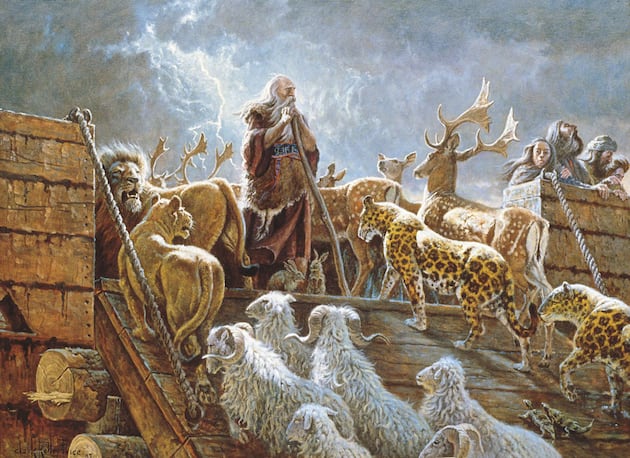
This week’s Come, Follow Me study looks at Genesis 6-11 and Moses 8, which includes the story of Noah’s Ark.
Below are quotes from past and present church leaders and scholars regarding these chapters of the Bible.
Genesis 6
“The Bible describes Noah, Seth, and Job as fully human (see Genesis 6:9; Doctrine and Covenants 107:43; Job 1:1). No doubt the same term applies to the many faithful disciples of various dispensations.…
“This does not mean that these people never made mistakes or never needed to be corrected. The process of becoming perfect includes challenges to overcome and steps toward repentance.
“Mortal perfection can be achieved when we fulfill all our duties, keep all the laws, and strive to be as perfect in our realm as our Heavenly Father is perfect in ours. If we do our best, the Lord will bless us according to our deeds and the desires of our heart.”
— Late President Russell M. Nelson, then a member of the Quorum of the Twelve Apostles, October 1995 general conference, “Awaiting Completion.”
“In the Old Testament, we are taught the type of the Lord’s covenant in Noah’s experience with the wicked world and the Lord’s plan to cleanse the earth. Because of Noah’s faithful and steadfast dedication, the Lord said to Noah:
“‘But I will make a covenant with you, and you will go into the ark with your sons and your wives and your sons’ wives.
“‘And Noah did all that the Lord commanded him” (Genesis 6:18; 7:5).
“We have entered into a sacred covenant with the Lord to protect us from our enemies. Just as in the days of Noah, we live in a day of prophetic promise and fulfillment.”
—The late Elder Paul E. Keriker, then a General Authority Seventy, October 2005 general conference, “Gospel Covenants Bring Promised Blessings.”
“Like all gifts,[the priesthood]must be received and accepted in order to be enjoyed. When the hand of the priesthood was placed on your head to confirm your membership in the Church, you heard the words, ‘Receive the Holy Ghost.'” This did not mean that the Holy Spirit would be your constant companion unconditionally. The Bible warns that the Spirit of the Lord “does not always strive with man” (Genesis 6:3). Confirmation gives us the right to the companionship of the Holy Spirit, a right that must continue to be earned through obedience and worthiness. We cannot take this gift for granted. ”
—The late Elder Joseph B. Wirthlin, then member of the Quorum of the Twelve Apostles, April 2003 general conference, “The Unspeakable Gift.”
“The one who was “righteous and perfect from generation to generation” and who “walked with God” (Genesis 6:9) was the prophet Noah. Ordained to the priesthood at an early age, “he became a preacher of righteousness, preaching the gospel of Jesus Christ…faith, repentance. He warned the people that if they did not listen to his message, there would be a flood. They heard his voice, but they did not listen to his words.
“Noah obeyed God’s command to build an ark to save himself and his family from destruction. Noah followed God’s command to gather all living creatures into the ark, two by two, so that they too could be saved from the flood.
“Noah had an unwavering faith in following God’s commandments. May we be the same. God’s wisdom often seems foolish to humans, but the greatest lesson we can learn in this life is that when God speaks and we obey, we are always right.”
—The late President Thomas S. Monson, then First Counselor in the First Presidency, October 2002 general conference, “A Model to Follow.”
Genesis 7
“The Second Dispensation is known as the time of Enoch, who “walked with God” (Genesis 5:24). He founded the city of Zion, which became a powerful symbol of righteousness available in heaven and on earth (see Moses 7:18-21).
“Next was the dispensation of Noah. Noah lived in a time of great evil. Noah cried out to his people to repent, but they did not listen to him. When the flood came, only Noah and his family were saved (see Genesis 7:23).
“The Second and Third Dispensations teach us great lessons about what comes from choosing good over evil. Enoch and all those with him received great blessings as a result of righteousness. Those who disobeyed Noah realized that destruction followed sinners.
“These two dispensations teach us to pursue what is good and wholesome. In our plan for life, our purpose is undoubtedly to absorb as much good as we can find here on earth. As we search the scriptures daily, we can find much of that good that will lead us to eternal life.”
—The late Elder L. Tom Perry, then a member of the Quorum of the Twelve Apostles, said in the February 2009 Liahona article “The Great Plan of Our God.”
“The Lord said to Noah, “Let me make you an ark,” and “I will make a covenant with you” (Genesis 6:14, 18).
“And Noah did all that the Lord commanded him…
“’And only Noah and those who were with him in the ark survived’ (Genesis 7:5, 23).
“We all need to build our personal arks and fortify ourselves against this surging wave of evil and protect ourselves and our families from the flood of injustice all around us. And we need to prepare in advance, not wait until it starts raining. This has been the message of every prophet in this dispensation, and of the prophets of old.”
—The late Elder W. Don Rudd, then a General Authority Seventy, October 1994 general conference, “‘Make thee an ark.’”
Genesis 9
“Each week as we partake of the sacrament, we covenant to always remember the Lord. … We can always remember Him by having confidence in His covenants, promises, and guarantees.
“The Lord remembers His everlasting covenant, that from the days of Adam the descendants of Adam will “receive the truth and look upward, until the day when Zion looks downward, and all the heavens tremble with joy, and the earth trembles with joy” (Joseph Smith Translation, Genesis 9:22).
— Elder Gerrit W. Gong of the Quorum of the Twelve Apostles, then General Authority Seventy, April 2016 General Conference “Remember the Lord Always”
“Fixing Heavenly Father’s plan as our reference point brings into sharp focus the purpose of marriage. The commandment to leave father and mother, to be united to one another in marriage, and to multiply and replenish the earth (see Genesis 9:1) makes Heavenly Father’s plan possible. Through marriage, we bring God’s spirit children into the world and partner with God in helping God’s children participate in God’s plan.”
— The late Elder Robert D. Hales, then a member of the Quorum of the Twelve Apostles, said in the October 2015 Liahona article “The Plan of Salvation: The Treasure of Sacred Knowledge to Guide Us.”
Genesis 11

“Language has been an object of interest and study among humans for probably as long as languages have existed, certainly going back to the time when we have written records. Linguists and anthropologists continue to try to show connections between existing and extinct languages, and are keen to discover the original language. Unfortunately, the Book of Genesis, which refers to the period just before the construction of the Tower, There is no information about the early history of human speech, except in a few scriptures, such as chapter 11, verse 1. The words of Babel: “And the whole earth was one language, and one manner of speaking.” In verse 8 we read that the Lord was not pleased with the building of the tower, so he confused the language of the people and “from there scattered them over the face of all the earth.” …
“Language, like many things that our Heavenly Father has blessed us with, can be used as a force to bring much righteousness, to bless us, and to bless the lives of those around us. But it can also be used as an instrument of destruction. It can enlighten and uplift, as well as denigrate and destroy.”
“Watch your language. Words are a much more powerful tool than you can imagine. Think of the good you can accomplish by using them the way the Lord intended them.”
— The late Randall L. Jones, then professor of Germanic languages and linguistics at Brigham Young University, in the March 1998 BYU devotional “Language: A Miraculous Gift.”
moses 8
“I think our popular culture has become increasingly violent, voyeuristic, and misogynistic. This was in the days of Noah, when ‘the earth was corrupt before God and full of violence’ (Moses 8:28).”
“Unfortunately, there is violence and alienation in the world. But I believe that focusing only on evil is a kind of tunnel vision, a soda-straw view of the universe. … The truth is that our Creator knows and loves each of us as individuals. Joseph Smith first heard his name from his Heavenly Father in the Sacred Grove. Isn’t it impressive that each of us hears our own name when we are baptized? Sometimes we forget that in this life God knows us intimately. ”
— Paul Alan Cox, then dean of general education and dean of honors education at Brigham Young University, in October 1995 BYU devotional “Seeing with New Eyes.”
“Mortal sin will prevail in the last days, just as it did in the days of Noah. The scriptures warn that society in Noah’s day was ‘corrupt before God’ and ‘full of violence’ (Moses 8:28). Corruption and violence, have you heard? These terrible conditions are Both culminate in the rise of individual selfishness. When consumed in this way, it is no wonder that the hearts of modern people can break with fear.” Expect a few fibrillations. ”
—The late Elder Neal A. Maxwell, then a member of the Quorum of the Twelve Apostles, October 1990 general conference, “Put off the natural man and put off the conqueror.”
“Prophets are the spokesmen of God, and God is consistent, so he says the same things over and over again.
“If you’re looking for newness, you’ll get one of the great benefits of following living prophets. For example, the prophets before Noah didn’t build arks. To get into it, it was important to be on the lookout for new messages. But those who couldn’t get into it were drowned out laughing at the old message that every prophet since the time of Adam had repeated over and over again. It was simple and familiar. Here it is:
“‘Listen, pay attention to my words.
“‘Believe and repent of your sins, as our fathers did, and be baptized in the name of Jesus Christ, the Son of God, and you will receive the Holy Spirit, and all things will be revealed to you. And if you do not do this, the flood will come upon you” (Moses 8:23-24).
“Those who survived recognized the truth of the long-ago message. Without it, this novel message would have been of no value.”
— President Henry B. Eyring, then the first counselor in the Presiding Bishopric, in the May 1986 Brigham Young University devotional “Children of Promise.”
“From the time of Father Adam to the time of the Prophet Joseph Smith and his successors, whenever the priesthood has been on earth, its primary responsibility has been to preach the eternal principles of salvation of the gospel, the plan of salvation. Father Adam taught these things to his children (Moses Consider the long ministry of Noah and the preaching of all the ancient prophets (Moses 8:16-20).
— Late President Ezra Taft Benson, then President of the Quorum of the Twelve Apostles, April 1974 general conference, “Missionary Work: A Grave Responsibility.”
