


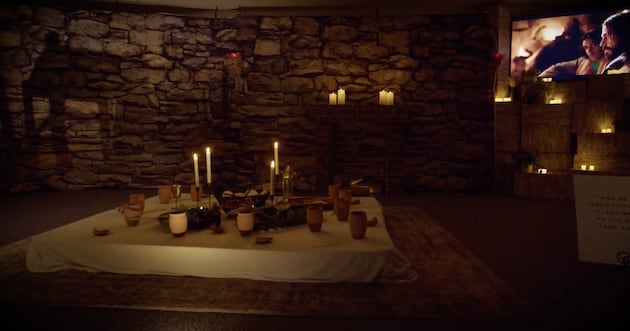
One of the most famous events of Jesus’ last day in Jerusalem was the last supper he had with his disciples on the eve of his crucifixion.
On this occasion, Jesus gave his final teachings to his closest followers, introducing what modern Christians often call the sacrament of the Eucharist, or the Lord’s Supper: the eating of the broken bread in remembrance of Jesus’ soon-to-be-crucified body, and the sharing of the cup of wine in remembrance of his blood “poured out for the remission of sins” (Matthew 26:20-30, cf. Mark). 14:17–25, Luke 22:14–38, John 13–17).
Today, these sacramental symbols are well known as symbols of the Christian Holy Communion. But what may not be obvious to modern worshipers is that Jesus’ Last Supper, where these elements first appeared, took place within the context of an ancient Jewish holiday called Passover. Understanding this context and the rich symbolism associated with it can bring to life the event of Jesus’ last meal and give deeper meaning to the modern Christian sacraments that arose from it.
The Jewish Passover has its origins in the Old Testament story of God delivering the Israelites from slavery in Egypt during the time of Moses. According to the book of Exodus, a family of Israelites who had been enslaved for generations were finally rescued from slavery by the power of Jehovah, the God of their ancestors.
Jehovah demonstrated this power through a series of plagues, plagues, and hailstorms that brought great destruction to the land of Egypt, using Moses as his spokesman. Both of these plagues were meant to demonstrate God’s “mighty hand” and persuade Pharaoh to “let (his) people go” (see Exodus 6-10). However, after Pharaoh refused to do so, Moses warned that the last plague would be the most devastating. The angel of death would pass through the area, and then every Egyptian family would lose their firstborn (see Exodus 11).
As described in the Bible, God promised the enslaved Israelites that if they followed Moses’ specific instructions, they would be spared from the final plague on that fateful night (see Exodus 12:1-7).
In the hours before sunset, Israelite families were to remove any leaven (yeast) from their homes as a sign of purification and prepare the sacred meal. A dead one-year-old ram was slaughtered to replace the firstborn of the family. We roasted the sheep on a bonfire in the courtyard of our house. He spread the lamb’s blood on the gateposts of his house.
When the sun set, the family gathered at home and ate a meal together. This meal consisted of roasted meat and was eaten in memory of the lamb that was slaughtered for the family. Bitter herbs are roots with an unpleasant taste that were eaten in memory of the family’s bitter slave life. And unleavened bread, which in God’s rush to deliver, he probably won’t have time to bake it in the oven.
Moses promised that by following these instructions, the angel of death would “pass over” the Israelites’ homes and the firstborn of each family would be saved (see Exodus 12:8-13).
The book of Exodus goes on to record that the events of that night unfolded as predicted. The angel traveled through the land of Egypt while Israelite families gathered behind closed blood-stained house doors, ate ritual meals, and awaited deliverance. That liberation occurred when Pharaoh finally relented and allowed the enslaved Israelite families to depart (see Exodus 12:28-42).
What followed was the mass exodus of the 12 tribes of Israel from the land of Egypt, the miraculous crossing of the Red Sea on dry land (see Exodus 13-15), and the next 40 years of wandering in the wilderness until the tribes settled in the land of Canaan that had been promised to their ancestors.
This series of events became a foundational story for later Israelites, reminding them of God’s power to deliver His people from their oppressors and free them from burdens. As a result, subsequent generations began ritually recreating the Passover meal each spring (on the 14th or 15th of the Hebrew month of Nisan) as a way to remember God’s past intervention on behalf of their ancestors and to instill hope in God’s ability to intervene again in future times of need (see, for example, Joshua 5:10-11, 2 Kings 23:21-23, and 2 Chronicles 30).
The exact customs used to observe the annual Passover meal varied over the centuries, but in the time of Jesus, Jewish families or neighborhood groups were required to make a week-long pilgrimage from their hometown to the Jerusalem Temple.
There, he imitated the Israelites in Exodus and joined the crowd of other pilgrims in sacrificing a lamb near the temple altar. To do this, it was first necessary to purchase an unblemished lamb at a nearby market and submit it to the priest for inspection. Pilgrims and priests then slaughtered the lambs in the temple courtyard by cutting their throats, draining their blood, removing their skins, and separating the pieces of meat for consumption at local homes later that night.

On the other hand, in the homes where Passover was eaten, the leaves were removed, as in the original Israelite households, and the meal prepared, either by setting up banquet tables in tricliniums (as was practiced among Jerusalem’s Romanized aristocracy), or by using communal cooking vessels and rolling mats on the floor for more modest meals (which was a common dining practice among the non-elite masses).
After roasting the lamb in the home’s courtyard and waiting for sunset, the family and guests would have gathered in the dimly lit house to tell the Passover story from the Hebrew Bible and eat lamb, unleavened bread, and bitter herbs in imitation of the ancient Israelites. By the time of Jesus, these practices were often reinforced by drinking wine and singing psalms (such as Psalms 113-118) to celebrate the joy of God’s saving power.
This common pattern of commemorating the sacrificial Passover meal was observed among the Jewish community every spring until the destruction of the Jerusalem Temple by the Romans in 70 CE, and was an important part of the religious calendar throughout most of the first century. In fact, it was in the context of the Passover pilgrimage that Jesus made his final journey with his disciples from his home village in Galilee to the crowded city of Jerusalem.

According to the Synoptic Gospels (Mark, Matthew, and Luke), the disciples spent their final days with Jesus, making the necessary preparations, and participating together in the final Passover meal, now known as the Last Supper.
These Biblical accounts suggest that Jesus and his disciples, like other Jewish families, gathered in local homes that night to tell the story of God’s deliverance of Israel from Egyptian bondage, sing psalms reminding us of God’s power of deliverance, and participate in Passover rituals (see Mark 14, Matthew 26, Luke 22).
But what made Jesus’ last Passover remarkable was the fact that it took two items from the memorial meal, a piece of unleavened bread and a cup of poured wine, and offered an additional interpretation for the disciples to consider: “Take and eat, for this (bread) is my body. …Drink from (this cup), for this is my blood of the (new) covenant, poured out for many for the remission of sins” (Matthew 26:27-28). NRSV).

By adding this new layer of meaning to the salvation symbolism of Passover, the Lord essentially told His disciples to eat the unleavened bread and drink the wine to commemorate God’s past salvation of Israel through the death of the First Lamb and to recognize their own personal deliverance through God’s saving work as the Messiah.
In other words, just as Israel was freed from the bondage of Egypt through the slaughter and blood of the first Passover lamb, so too will the followers of Jesus be freed from the bondage of sin through Jesus’ impending death on the cross. In other words, Jesus becomes the ultimate Passover sacrifice provided by God for the salvation of God’s people. (See John 1:29-34 and 19:14-37 for more on the symbolic connections that early Christians made between the Passover lamb and Jesus as the “Lamb of God.” See also Exodus 12:22.) By adding these new layers of meaning to the traditional Passover meal, Jesus He also seemed to be proclaiming to his followers that he was acting as the anticipated “prophet like Moses” (Deuteronomy) who would one day come and bring a “new covenant” of forgiveness reminiscent of the first Exodus (see Jeremiah 31:31-34).
In subsequent generations, Jesus’ early followers continued to commemorate this moment at communal meals. Initially, Christians gathered in house churches to enjoy meals together, ending with eating bread and drinking wine, remembering Jesus’ actions at the final Passover meal.
Paul described one such meal among first-century Corinthian believers by recounting Jesus’ words regarding the bread and cup of the Last Supper (see 1 Corinthians 11:23–25). He taught that these emblems represented “the new covenant in (Jesus’) blood,” and that each time a believer partook of the emblems, they “proclaimed the death of the Lord until he (again) comes” (1 Corinthians 11:25-26).
Over time, more elaborate fellowship meals disappeared from Christian practice, but the ritual of eating bread and wine continued and gradually developed into what Christians came to call the sacrament of the Eucharist or Lord’s Supper.
Although modern Judaism still commemorates the Biblical Passover through the annual Seder meal, most Christian communities do not commemorate this festival as they did in Old and New Testament times. However, modern Christians have preserved small portions of the Biblical feasts in their own worship practices by eating the bread and sharing the cup in regular worship services.

When we partake of these symbolic emblems, it is natural to remember that Jesus commanded us to eat the bread and drink the cup in remembrance of His suffering and death at the Last Supper. It is also pertinent to recall that this custom has its roots in the Jewish Passover meal, observed in the first century. Those who partake of the Eucharist, or sacrament, therefore have a wonderful opportunity to remember God’s past deliverance of Israel (as celebrated at the Biblical Passover), while at the same time pondering their own salvation through the redemptive act of Jesus, and looking forward to the day when Jesus returns to complete his saving messianic mission.
— Matthew J. Gray is professor of ancient scripture and coordinator of the Ancient Near Eastern Studies Program at Brigham Young University in Provo, Utah.
