


brought to you by
You may wonder why it is important to talk about black people in the Bible. This topic can be uncomfortable, especially in racist American culture. If you fall into that unpleasant category, I encourage you to lean into those feelings instead of running away from them. There may be something in you that God wants to reveal and change.
How does the Bible define people?
The Bible does not define people by their skin color. That’s what our modern culture has done. The Bible says nothing about advantage or disadvantage based on skin color. The closest we come to discussing skin color as a disadvantage is in the context that white skin indicates that people suffered from leprosy (Exodus 4:6).
The Bible defines people by tribe and ethnicity. Highlight people’s ethnicity and origin rather than hiding them. In doing so, the Bible emphasizes the importance of all people groups and the role that many of those groups played in the unfolding of history, including human history, Israel’s history, and church history.
Before we dig deeper, I would like to clarify one thing. Salvation is not about culture. It’s about Christ. God did not give the Bible to unite one culture around a particular theme. The Bible reveals who God is and shows all humanity our sinfulness and need for a Savior. This applies to everyone, regardless of where they come from. However, the wide range of ethnic groups mentioned in the Bible makes the gospel message relatable to people of all nationalities.
Another thing I want to be clear about is that when I talk about black people in the Bible, we are not thinking in terms of the racial concepts that we are used to. I just want you to think about what countries these people come from and the possibility that they are darker-skinned people.
Why are we sure there are black people in the Bible?
Multiple ethnic groups are mentioned in the Bible. Most people are familiar with Israel and the nations with which they were associated, such as the Philistines, Canaanites, Amorites, and Hittites. However, many more ethnicities were represented. Since we are talking about black people in the Bible, let me tell you why it is logical for black people to appear in the Bible.
When you read the Bible, you learn that much of what happened in the Old Testament happened in North Africa and the Middle East. In the New Testament, the gospel spreads from the center of Jerusalem to Rome, Greece, Türkiye, and even Africa.
Considering the history of the Israelites, they spent 400 years as slaves in Egypt, which is located in North Africa. Even Jesus, after being born in Bethlehem, spent several years in Egypt fleeing Herod. Yes, Jesus also spent part of his life in Africa. In addition to Egypt, the Bible mentions people from North African countries such as Libya, Ethiopia, and Sudan. Considering what races appear in those countries, it is logical to conclude that black people appear in the Bible.
Who are the important black people mentioned in the Bible?
Black people appear in both the Old and New Testaments. Here are four notable references.
moses’ wife
From Numbers 12 we learn that Moses married a Cushite woman. In Biblical times, Cush has always been associated with Africa. Some people place it in present-day Sudan or Ethiopia.
queen of sheba
In 1 Kings 10 and 2 Chronicles 9, the Queen of Sheba, a prominent woman from Africa, came to hear Solomon’s wisdom and test him with tough questions. Scholars have long debated Sheba’s exact location, but many believe it was in Ethiopia, Yemen, or southern Arabia.
Simon of Cyrene
Simon of Cyrene had the difficult task of helping Jesus carry the cross. Mark 15:21 and Luke 23:26 tell us that the Roman soldiers had Simon walk behind Jesus and carry the cross to Golgotha. The Bible mentions where Simon was born, and his nationality draws attention. The ancient city of Cyrene was located in present-day Libya. This further illustrates the ethnic diversity found in important events in the Bible.
Ethiopian eunuch
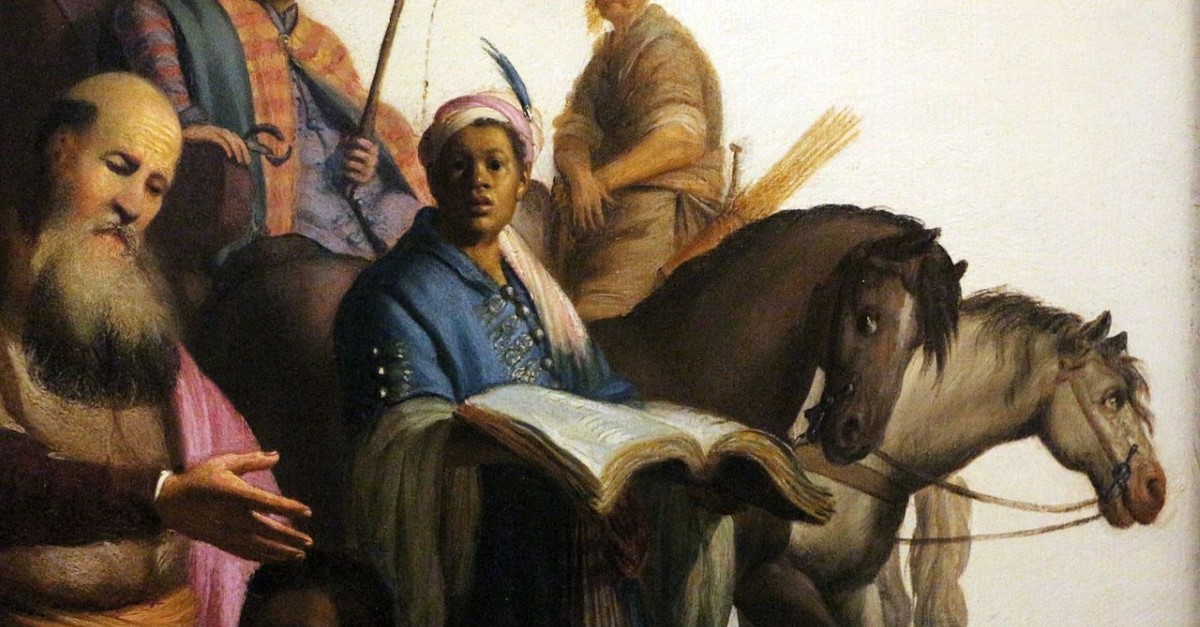
In the book of Acts, Philip met an Ethiopian eunuch who was a high official in the court of the Ethiopian queen Candice. Again, notice how special the Bible was in identifying this eunuch’s nationality. Rather than hiding ethnicity, the Bible embraces it.
What is the significance of the emphasis on black people in the Bible?
Although I grew up in an all-black neighborhood, I have lived in multicultural churches and environments throughout my life. To be honest, I love this piece. Because this work perfectly expresses what God is like.
When I was a child, I sometimes encountered people who called Christianity a white man’s religion, and some may still say so today. One of the main reasons I say this is based on our country’s history. Christianity was the primary religion of most American slave owners. Instead of teaching the freedom in Christ that is available to all, it was used to oppress black people. During the era of slavery, the Bible was used to justify slavery and keep people enslaved. Black traveling ministers who were allowed to preach to slaves during Sunday services were unable to discuss the parts of the gospel that emphasized our freedom in Christ. Slave owners feared that their slaves would hear about this and revolt and demand their freedom. They also neglected to tell their slaves the story of the Israelites when they were enslaved in Egypt. They conveniently omitted the story of the enslaved Israelites crying out to God for freedom. Nor did they mention that God heard their prayers and saved them. Coupled with the European appearance of many depictions of Biblical characters, many people mistakenly thought Christianity was a “white man’s religion.”
Ironically, most of the central figures in the Bible were from Africa and the Middle East. This means they are brown or dark-skinned people.
This misuse of the Bible and mischaracterization of Biblical characters makes it necessary to accurately portray Biblical characters. We do this not because we are trying to address issues of race or whiteness or whiteness, but because we want to treat the scriptures truthfully and accurately. This does not change the message of the gospel or the hope we find in Christ. On the contrary, it helps break down barriers and show the true ethnic diversity that is common throughout the Bible. Given how the Bible has been used against Black people in the past, a focus on Black people in the Bible is necessary to disrupt the destructive narratives of the past.
How can the church highlight the presence of black people in the Bible?
I always like that the Bible doesn’t try to hide things. We see all the strengths and weaknesses of the heroes of the faith. Thankfully, the Bible does the same with people’s ethnicity.
The church does not need to overemphasize black people in the Bible. However, its existence should not be underestimated. If you see it in the pages of the Bible, say it and don’t pretend it doesn’t exist. Remember, it’s not black and white, it’s a matter of truth and accuracy.
Learning about the different cultures of the people depicted in the Bible and those present in the church today makes our faith even more appealing. I pray that we will eliminate all racial divisions and embrace the Biblical view of ethnicity. After all, heaven will be filled with people of all nationalities. Because that’s exactly what God wants.
“After this I looked, and there before me was a great crowd that no one could number, from every nation and kindred and people and tongue, standing before the throne and before the Lamb, clothed in white robes, and holding palm branches in their hands” (Revelation 7:9).
Photo courtesy of Rembrandt’s “The Baptism of the Eunuch” via Wikimedia Commons
 Clarence L. Haynes Jr. is a dynamic speaker, Bible teacher, and co-founder of a Bible study club dedicated to helping people live with purpose and clarity. In addition to his ministry, Clarence has been a trusted financial educator for the past 13 years, coaching thousands of people across the country, including employees of many Fortune 500 companies, toward lasting financial health. His unique ability to blend practical wisdom with spiritual insight enables people to succeed in all areas of life.
He is the author of The Pursuit of Purpose, which helps readers understand how God leads readers to His will, and the author of The Pursuit of Victory: How To Conquer Your Greatest Challenges and Win In Your Christian Life. Clarence is also committed to helping 10,000 people learn how to study the Bible, and has released his first course, Fundamentals of Bible Study, to accomplish that goal. To learn more about his ministry and resources, please visit clarencehaynes.com.
This article is part of our Bible resources for understanding the importance and meaning of Bible words and ideas. Here are some of the most popular Bible articles to deepen your knowledge of God’s Word.
God’s promises in the Bible
Is “this too shall pass” found in the Bible?
What was the Ark of the Covenant?
Top 10 Bible Stories for Kids
Proverbs 27:17 “Iron sharpens iron”
Psalm 139 “Terrible and Wonderful”
Psalm 46:10 “Be still and know that I am God.”
“No weapon formed against me will prosper” – Isaiah 54:17
This article originally appeared on Christianity.com. For more faith-building resources, visit:
Christianity.com.

