


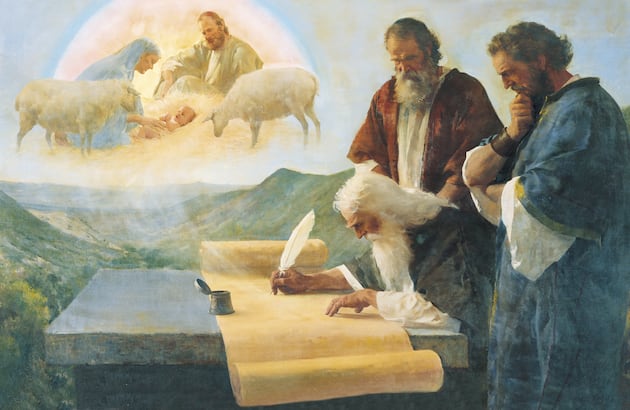
For many members of The Church of Jesus Christ of Latter-day Saints, opening the book of Isaiah can feel like venturing into a beautiful ancient forest without a map.
We know that the Savior commanded us to “search these things diligently” and even said, “Great are the words of Isaiah” (3 Nephi 23:1). We find Nephi’s soul “delighted” in these words, and we hear modern prophets constantly quoting his words. But as you sit reading the scriptures, you may find yourself caught up in the “misfits,” the “silver children,” and the “galleries.”
If you’ve ever gotten lost in the book of Isaiah, you’re in good company. His words were written in a foreign language and culture more than 2,700 years ago. However, as Nephi taught, these words become “plain” to those who are filled with the spirit of prophecy (2 Nephi 25:4).
Learning to love Isaiah is not about becoming a world-class scholar or revealing some “secret” truth that no one knows. Rather, it is a joyful discovery of how the Lord speaks to His children. It is recognizing the voice of the Lord as He emphasizes the same truths found in the Book of Mormon and given by living prophets today.
hebrew poetry music
One of the first steps to finding comfort in Isaiah is to recognize that he was a gifted poet. While English poetry often relies on rhyme and meter, Hebrew poetry uses “idea rhyme,” also known as parallelism. Isaiah “rhymes” his thoughts by stating an idea in one line and then repeating, expanding, or contrasting it in the next line.
A famous example is found in Isaiah 1:18.
“Come, come, let us reason together, saith the Lord, though your sins be red as scarlet, they shall be white as snow; though they be red as crimson, they shall be like wool.”
Notice how the ideas “stack up”. “Scarlet” corresponds to “crimson,” and both represent the deep and everlasting stain of sin. And “white as snow” corresponds to “as wool” and represents the state of purity made possible by the Atonement of Jesus Christ.
Digging deeper, we find that Isaiah uses words to describe two different shades of red. “Scarlet” is a bright red, like fresh blood, reminding us that God, like wet, living snow, can wash away the painful sins of the present. “Crimson” refers to a dry dye, here combined with “wool”. This brings to mind the image of Christ as the sacrificial lamb and the warm and comforting cover of his love. God can cleanse us even from sins that have plagued us for decades.
Recognizing this “rhyming idea” reveals that Isaiah is not simply repeating himself. He uses symbolic parallelism to paint pictures of words. He uses symbols such as scarlet and snow to help us feel the weight of mistakes and the refreshing joy of forgiveness.
Images in all fields
Some worry that the book of Isaiah can only be understood by those with advanced degrees or church leaders. However, Isaiah was a master at using images from every corner of his life. He was an advisor to the king, but he also observed the farmers in the fields, the women in the homes, and the builders of the walls.
The writings of Isaiah harmonize human experience. He spoke of the rich with “fine linen” (Isaiah 3:23) and of the “poor and needy” (Isaiah 41:17). He uses architectural images of “foundations” and “cornerstones” to express faith in Christ, and agricultural images of vineyards to express spiritual growth.
Perhaps most movingly, Isaiah frequently uses the experience of raising children and giving birth to convey God’s love. He describes the Lord as a mother whose “suckling child” is never forgotten (Isaiah 49:15) and uses the stages of pregnancy to describe the “birth” of the new Zion. He speaks of children being “nursed” (Isaiah 60:4) and of the Lord “carrying” His people from the womb to old age (Isaiah 46:3-4).
By drawing on these everyday experiences, Isaiah ensures that his message “reaches the heart” of everyone.
Learning to love Isaiah is not about becoming a world-class scholar or revealing some “secret” truth that no one knows. Rather, it is a joyful discovery of how the Lord speaks to His children.
— Shon Hopkin, BYU Professor of Ancient Scripture
use modern translation
The King James Version (KJV) is our official Bible, but its 400-year-old English can sometimes act as a veil. One of the best ways to feel more comfortable is to use other faithful translations, such as the New Revised Standard Version (NRSV) or the New International Version (NIV), as a comparison.
The Church Handbook (38.8.40.1) states that while members should use Church-published Bibles in meetings, “other Bible translations may also be used. Some may benefit from a translation that is doctrinally clear and easy to understand.”
A perfect example is the parable of the tiller found in Isaiah 28:23-29. In the Colloquial Bible, Isaiah mentions “fit” and “cumin.” To modern readers, “Fitch” may sound like a word from a fantasy novel. However, modern translations reveal that “fitch” is simply black cumin seed. NRSV shows that farmers do not treat all seeds the same. Instead of using a heavy threshing wheel to harvest delicate herbs, he uses light sticks.
The message becomes clear. God is the owner of the farm. God knows that each of us is different. God does not “farm” our lives forever. He prepares the soil and applies just the right amount of “pressure” to help us grow. He was “excellent in counsel and excellent in work” (Isaiah 28:29). Comparing translations helps us get past the “foreign language” of Old English and get directly to the heart of the Lord’s counsel.

Historical background and multiple fulfillments
To understand Isaiah, it helps to understand his “daily work.” He lived in the Kingdom of Judah between 740 and 700 BC. His mission was to warn the people of the rise of the Assyrian Empire and to implore them to put their trust in Jehovah rather than political alliances.
When understood in this context, Isaiah’s prophecy becomes even more powerful due to the “layer cake” effect of prophecy. Just as a cake has many layers, a prophecy can have multiple fulfillments and applications. Living prophets and apostles often interpret Isaiah in ways that are particularly applicable to our covenant responsibilities today.
Nephi taught that we should “liken all the scriptures unto us” (1 Nephi 19:23). For example, when Isaiah speaks of “enlarging the place of your tent” and “strengthening your stakes” (Isaiah 54:2), we recognize the growth of the church in the latter days. This is not about “changing” Isaiah. It is the “Spirit of Prophecy” and shows us how ancient words remain alive and relevant today.
happy discovery
As you study Isaiah, remember that it is not a competition or a test. You don’t have to “crack the code” to be a good disciple. As you read Isaiah, you will see how it supports and reveals truths you already love. When we read about the “Suffering Servant” in Isaiah 53, our minds naturally turn to the atoning sacrifice of Jesus Christ and the testimonies of Book of Mormon prophets like Abinadi. You will see that Isaiah is a powerful witness of the Savior.
Be patient with yourself. Beginner piano players may find complex songs frustrating, but with practice, the music will start flowing. Isaiah’s words may feel like a foreign language at first, but over time they will feel like “coming home.”
The Lord wants you to understand the book of Isaiah. God commands this because He knows that within these ancient poetic and symbolic pages you will find a stable anchor for your faith. You will find that the Holy One of Israel, who cared for a small kingdom 2,700 years ago, cares for you the same way today. Indeed, Isaiah’s words are great. Not because it is difficult, but because it is filled with God’s infinite mercy and vision.
— Shon Hopkin is a professor of ancient scripture at Brigham Young University.

