


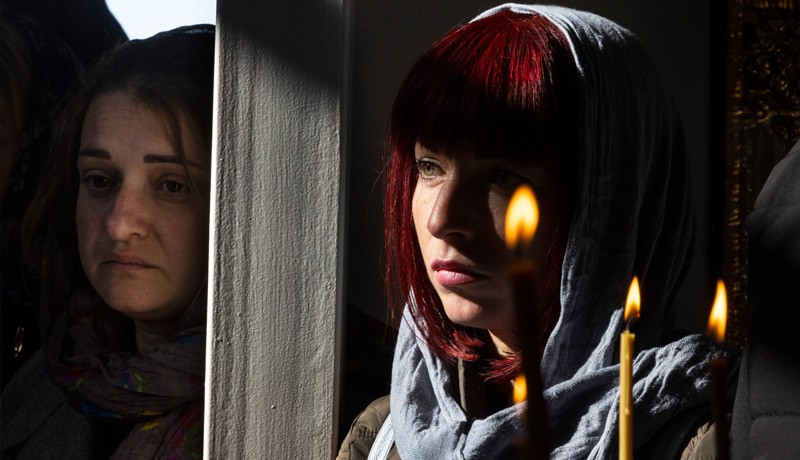
Oleksandra does not remember the sound that killed her family.
Shrapnel wounds left scars on her body.
It was after midnight, in a small apartment on the outskirts of Kyiv. Her husband, young daughter, and herself were each sleeping soundly in their beds. The next thing she remembers is waking up in the hospital. Her pelvis was fractured in multiple places. A grid of metal bars was towing her. Shrapnel wounds left scars on her body.
Then came a proclamation that no one should hear. Her husband and daughter died in the explosion.
What followed was a six-month long physical and mental ordeal. Surgeons replaced the external frame with a metal plate. The plate was then replaced with a titanium component. Learning to move again meant first rolling over, then sitting up, then taking steps. Each action was painful, but also a small act of defiance.
“It was like learning to live life all over again,” she told me. “I don’t know where the will came from. There was just a desire to move.”
The greater suffering was not in her pelvis. It was on an empty bed.
Don’t carry your pain alone.
During this time, she learned one rule. “Don’t carry your pain alone.” Her father and sister were by her side. They talked about their lost husbands and children. They remembered holidays, meals together, and small jokes. They prayed and wept. And she leaned on her faith.
“The support of my friends has been great,” she said, “but a big part of this process is a conversation with God. I tell Him that I don’t want to live in this emotion. It takes away my strength and my focus on the future.”
Immense strength and courage.
I saw that faith in real time when we spoke on Zoom. Electricity was rationed that day and she only had one lamp. Her screen lit up, and only her face appeared in the darkness. The room behind him was pitch black, so I couldn’t read his expression well, but his voice was crystal clear, and I could feel his immense strength and courage.
Today Oleksandra walks again. She leads the teen ministry at her church. She sings in the worship band. She created a space where teenagers and children could gather after school. They come looking for safety, for Bible lessons, and for someone who understands what it’s like to lose everything.
Like her, many of them lost their homes, relatives, or both.
She wants to contribute to the upbringing of a new generation.
Her survival theology is simple and powerful. “The enemy is always targeting your mission,” she said. She believes that Russia tried to kill not only her body, but also her cause and that of Ukraine itself. She describes Ukraine as a “spiritual breadbasket” country aimed at serving others. Her answer was to double down on that mission. She wants to help raise a new generation that can build “a world where evil is reduced and people care for each other.”
For Oleksandra, faith is a source of courage, resilience, and purpose.
But for the Kremlin, faith is a weapon.
Since the invasion began in earnest, Patriarch Kirill, head of the Russian Orthodox Church in Moscow, has been preaching what some Ukrainians call “Orthodox holy war.” In a sermon early in the war, he said that Russian soldiers who died in Ukraine would be forgiven for all their sins. He depicted their deaths as holy sacrifices. In later comments, he cast the war as a sacred struggle against the sinful West and promised eternal salvation to those who fought and died.
Russian forces damaged or destroyed hundreds of religious buildings.
The Russian Orthodox Church targets Ukrainian churches, mosques, and synagogues loyal to Ukraine. Russian forces damaged or destroyed hundreds of religious buildings. Orthodox, Catholic, Protestant, Muslim and Jewish communities have all been hit hard.
Priests were tortured and killed. Religious communities were banned. In parts of occupied eastern Ukraine, congregations now gather in cemeteries, the only place they can gather to sing hymns without being immediately arrested.
In response, the Kremlin launched a second campaign. This is a global propaganda campaign in which Russia defends Christianity and claims that Ukraine, led by Jewish president Volodymyr Zelenskiy, persecutes believers.
The only place in Ukraine where organized religious persecution takes place is where Russia controls the ground.
Igor Bandura, a Baptist minister and vice president of the All-Ukrainian Union of Evangelical Christian Baptist Churches, has spent years setting the record straight. His sect is a member of the All-Ukrainian Council of Churches and Religious Organizations (AUCCRO), which unites more than 90% of Ukraine’s religious communities, including Orthodox, Greek Catholic, Roman Catholic, Protestant, Jewish, and Muslim groups. They say in unison: “The only place in Ukraine where organized religious persecution exists is where Russia rules the ground.”
And as he told me, “When you lose territory, you also lose religious freedom.”
The week before Thanksgiving in the United States, representatives of Ukraine’s Moscow Union Church appeared in Washington, where they were hailed as representatives of the “Ukrainian faith.” This was impressive propaganda, creating the illusion that his small number of pro-Kremlin allies spoke for the entire country.
Ukrainian clerics like Igor are horrified to think that the White House is shaping Ukraine’s religious views based on a figure who represents perhaps 3 percent of Ukrainians’ faith and has pledged allegiance to Patriarch Kirill in Moscow.
Priests who refuse to bless wars are fined, unlocked, imprisoned, or killed.
The difference between Russia and Ukraine is what happens when the church displeases the state. In Russia and its occupied territories, priests who refuse to bless wars are fined, disenfranchised, imprisoned, or killed. Freedom of religion is recognized in Ukraine.
Oleksandra’s life shows what that pluralism looks like in the field.
She belongs to a small evangelical church, one of thousands across Ukraine. There may be a Greek Catholic parish down the street. There is a mosque next door. A Ukrainian Orthodox cathedral located in the city center. All can be operated for free.
“When the enemy bombed my house, they tried to destroy my mission. But I’m still here,” Oleksandra told me.
On a recent Sunday, she stood in front of a room full of teenagers, some newly arrived from frontline communities, and spoke about the future. She asked them to imagine a Ukraine where no one burns churches, tortures priests, or claims God’s blessing for the murder of a neighbor.
Faith can be both a refuge and a calling.
In that sense, her story is the story of Ukraine. A wounded body learns to walk again. A broken family discovering that faith can be both a refuge and a calling.
Behind her, a coalition of bishops, rabbis, imams, and pastors stands silently, appealing to the world: “If you want to see religious freedom in this war, look for a place where the church is free to disagree and where people like Oleksandra are free to lead.”
Mitzi Perdue is from and writes about Ukraine. She is a research fellow at the World Politics Institute and co-founder of Mental Help Global, a charity that uses AI to support mental health.
