


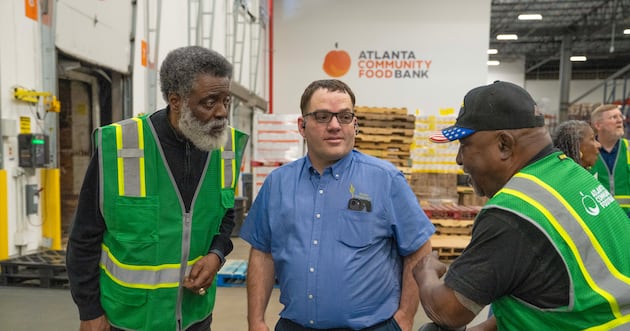
EASTPOINT, Ga. — In partnership with The Church of Jesus Christ of Latter-day Saints, 14 Black Charities and the College Football Hall of Fame donated 36,000 pounds of food to the Atlanta Community Food Bank on Tuesday, April 7.
“Part of our mission is to help communities in need of food,” said Mel Hamilton of Black 14 Philanthropy. “Since 2020, we have delivered 1.75 million pounds of food so far. … We want to get food to as many people as possible.”
Hamilton and former teammate Tony McGee represented the Black 14 at a donation event at the Atlanta Community Food Bank.
Hamilton and McGee were two of 14 black players unfairly dismissed from the University of Wyoming football team in 1969 after calling for a peaceful racial protest before a game against Brigham Young University. At the time, the Church of Jesus Christ of Latter-day Saints had a policy of prohibiting the ordination of black men to the priesthood. Church policy changed in 1978.
The players have since settled with the University of Wyoming, BYU and the church. In 2019, surviving members of the Black 14 started Black 14 Philanthropy to give back to the community and help those in need. In 2020, they began partnering with churches to donate food to food banks across the country.
This donation to the Atlanta Community Food Bank was especially meaningful to Maggie, who lives in Atlanta. “We are 14 people who could have had bad things happen to us, but we are above that,” McGee said of the 14 Black people. “What we want to do now is help as many people as possible. … We’re not worried about our legacy. What we’re worried about is our legacy to the world.”

Non-perishable foods such as applesauce, beans, macaroni, peanut butter and rice will provide much-needed support to the Atlanta metropolitan area. Atlanta Community Food Bank works with 700 partner agencies to serve 29 counties.
Atlanta Community Food Bank President and CEO Kyle Wide expressed gratitude for the donation.
“We currently serve 70% more people than we did four years ago,” he said. “Due to inflation, lines at food pantries across the region are getting longer, so we need all the help we can to meet that demand. Your donation today will help us get more food to those in need, and it couldn’t come at a more important time.”

The event was also attended by several of Atlanta Community Food Bank’s partner agencies that will benefit from the donations.
Rashaun Quinn of Southeast Gwinnett County Cooperative Ministries explained what this donation means to her organization. “We are a ministry that happens to be a food pantry and this is how we show love to people. Our clients are not just clients who come to pick up food, they come to be loved. … So this donation that we are receiving through the Atlanta Community Food Bank through Black 14 is very historic and will definitely impact our families not just today but for some time to come.”
Farah Quraishi of Humanity First USA Duluth Food Pantry said the donation will help serve existing families and expand services to new families arriving. “Essentially, this donation will ensure that no one is left without food,” she said.
This donation marks the second time Black 14 and the church have teamed up with the College Football Hall of Fame to donate to the Atlanta Community Food Bank. In February 2024, Black 14 donated £40,000 to food banks. The donation coincided with a Black History Month event at the Hall of Fame, which featured an exhibit honoring the stories of the Black 14 and a screening of short films about the Black 14 made by BYU students.

College Football Hall of Fame historian and exhibit designer Dennis Crawford said he was inspired by the story of the Black 14 and wanted to work with The Church of Jesus Christ of Latter-day Saints to “address the issue of food inequality head on.”
“I’m honored to be able to play a small part in perpetuating that here in town,” Crawford said. “This is truly an honor and a privilege, because the Hall of Fame can only do so much on its own. But the Hall of Fame, in partnership with Black 14 and the (Church of Jesus Christ), was able to deliver tens of thousands of pounds of food to the community, and that means a lot to us.”


