


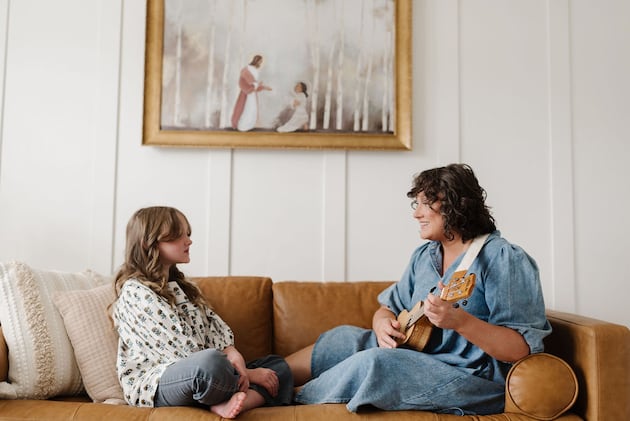
In 2017, Angie Killian wrote the nursery rhyme “My Own Sacred Grove,” which has since been published in the January 2025 issue of The Friend magazine and received 2.7 million views on Killian’s YouTube channel. So when Killian received an email informing him that his song had been selected for a new hymnbook in 2023, he knew “My Own Sacred Grove” was the song that had been chosen.
She was surprised to learn that it was actually “anytime, anywhere.” She called it the “nursery version” of “My Own Sacred Grove.”
Killian said she was shocked that the church’s music committee chose the song because it was the shortest song she had ever written, with only 10 lines. She wrote “Anytime, Anywhere” for her own children, who were ages 2, 4, and 6 when “My Own Sacred Grove” was published. She felt she needed something simpler.
“(‘Anytime, Anywhere’) teaches the most important parts of ‘My Own Sacred Grove’ but in a very small, bite-sized way that young children can really understand and internalize,” she said.
At first, Kilian couldn’t understand why this simple song was chosen over the thousands of other songs in Hymns for Home and Church, but he came to believe that the song’s simplicity was what made it a worthy addition to the collection.
“I feel like songs like that are so needed. They say so much with so few words.”

“Anytime, Anywhere”
1. You can pray to your Heavenly Father.
Anytime, anywhere.
God is always caring,
And He hears my prayers—
Anytime, anywhere.
2. I can hear guidance from above.
Anytime, anywhere.
The Spirit will guide you.
Seeking His light —
Anytime, anywhere.
Please take the time to listen
The “anytime, anywhere” truth teaches, among other things, that praying to our Heavenly Father is a two-way communication.
The first verse says, “You can pray to your Heavenly Father anytime, anywhere,” and the second verse says, “You can listen to heavenly guidance anytime, anywhere.”
“If you just press ‘send’ and never read the replies, that’s not communication, right?” Killian said. “So it’s very important to pray, but then it’s also important to take the time to listen.”

Killian recalled a time in his own life when he thanked someone for taking the time to listen to him after prayer.
While preparing to shoot the music video for his song “Liahona,” Killian was looking for a private beach near San Diego, California. She had already recorded the song and booked hotels for the children who appeared in the video. But if you can’t find a beach, you won’t be able to shoot a video.
She was frantically calling state parks and hotels asking about beaches when the idea occurred to her: “Let’s stop and pray.” Killian knelt down and asked for a miracle.
When she stopped after praying, she felt she should email the children’s parents and ask if there was anyone connected to the private beach.
“And I thought, ‘That’s the last thing I want to do right now. Text your kids and tell them they might not be able to do this either,'” Killian said. “I think God just smiled and said, ‘Trust me on this.'”

Killian relented and sent an email that I now think probably sounded a little depressing.
Within minutes of sending the email, one of the children’s parents called and said they had a friend who lived in a gated community in San Diego and had a private beach where they could film.
“It was a huge miracle,” she said. “If I had just sent a prayer and then not listened, I don’t know what would have happened, but none of that would have happened.”

find light through music
Killian said that for her, writing music has always been about children.
It started in 2016, right after my daughter Janie was born. Killian said her daughter had trouble sleeping and both of them often woke up in the middle of the night.
One night, Killian heard an unfamiliar melody playing in his head. She added words to the song and sang it to her daughter.
“The song itself wasn’t important,” she said, “but the way it made me feel inside was amazing. It felt like pure light.”

Killian was experiencing postpartum depression and was desperate for how coming up with this song would make her feel.
“So within a few days I decided to write music to teach children about Jesus, the scriptures, and the gospel,” she said.
online miracle
Now, thanks to technology, Kilian is able to share his music and testimony with children around the world through his website and YouTube channel.
Killian said he has seen many miracles through his work, but his favorite is when his music leads people to the Savior. She remembered that time.
When Kilian first posted the music video for “My Own Sacred Grove” on YouTube in 2020, a teenage girl from Finland named Anna Vanoran commented, “Even though I’m not a member of the LDS Church, I feel a kind of peace listening to this.”

Killian said she and others began ministering to Banoran in the comments section, but that Banoran’s responses to their comments diminished after a few months. Killian didn’t hear from her for five years.
But a few months ago, Killian said Vanoran commented on the video again.
A new comment read: “My story didn’t end when I posted this comment all those years ago. I rediscovered this song yesterday and am in awe of everything that’s happened since then.” “Through miracles big and small, I quickly gained a testimony of the Book of Mormon and was baptized on September 23, 2023 at the age of 19.”
Vanoran said he is currently serving in a German-speaking mission in the Alps. She reached out to Kilian directly to share the influence of Kilian’s music.

“I firmly believe that music changes lives because it invites the Spirit of God who can change everything,” Vanolan wrote.
Killian pointed to Alma 26:3, 12, which says, “And this is the blessing that is upon us, that we have been made instruments in God’s hand to accomplish this great work. … I will not boast in myself, but I will boast in my God.”
“It never ceases to amaze me what God can do with an imperfect servant,” Killian said. “It is truly a blessing to be able to serve God, and the truth is that He makes it all possible.”
