


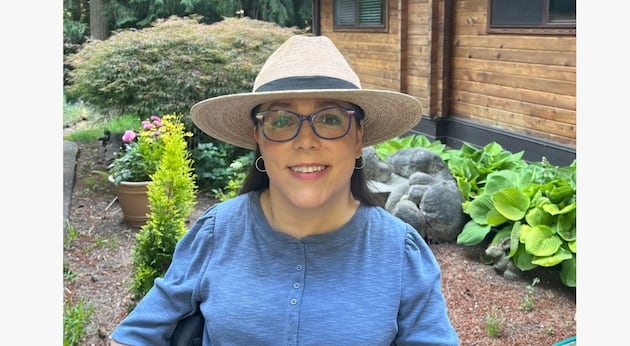
When Jill McCauley spoke about her spiritual growth journey on the Church News podcast last week, she did not hesitate to testify of Jesus Christ. However, there were multiple points in her faith that she called “restored.”
“I may still be physically paralyzed,” McCauley said. “But like everyone, we are in the process of recovering and healing emotionally, mentally and spiritually.”
When McCauley talks about her health, she references the effects of an accident that occurred when she was 18, which left her with lifelong quadriplegia.
“After the accident, I became too reliant and unreliable in my abilities,” McCauley said, adding that she had always had a “natural gift of faith.”
“That’s important, but I was trying too hard to do it on my own. I believed that if I could just persevere, if I could make it all the way, then one day everything would be okay on the other side.”
But relying on her own strengths only got her so far.
“Eventually it became too much for me to bear and push through. I realized that I was denying the gift that Jesus had so generously given me.”
McCauley said she sometimes thinks, “I thought I had already learned this. I thought I had already experienced it.”
She realizes that “there are so many different aspects to those lessons” and sees an opportunity to learn something new.
McCauley calls this the “spiral-ascending effect,” where you learn more spiritual truths.
Ms. McCauley’s spiritual journey has changed her life and changed the way she sees and views her own abilities. She focused on changing perspectives on services.
“When I was thinking about how I could serve others, my mother surprisingly told me that the way I could serve them was by having others serve me.”
After the accident, getting help wasn’t easy, especially for her as a rising adult. “When we turn 18, we start to become independent, self-sufficient, and live on our own.”
She measured the amount of assistance received since then and “came up with a figure of 58,000 hours, which I think is a gross underestimate,” she said.
McCauley became “almost completely dependent on the help of others.”
“This is a real change, because it takes a great deal of humility to graciously accept help from others without feeling resentful of the help you need or the help you are being given. To the wonderful people who do so.”

While receiving a lot of physical help, she wondered what kind of help she could do without having to “bake a casserole or pick up someone’s child.”
“The way I have always envisioned and practiced service has been to use my hands, but I cannot use my hands.”
Still, she gained insight into how to be a “spiritual steward,” a role associated with Jesus Christ. As Ms. McCauley deepened her knowledge of the Lord’s sacrifice, she came to understand that “because of the Lord and His mercy toward me, I am able to pay it back and be incredibly grateful for all the service I receive.”
She recognizes other ways to live up to the baptismal covenant, including “loving others” and “embodying that empathy and giving it generously to others.”
When her physical hands were limited, she “became really attached to her hands, because she couldn’t appreciate her hands until she couldn’t use them anymore.” There, McCauley studied the hands of Jesus.
During her research, she came across a Book of Mormon scripture, 3 Nephi 11:14. I came across the following scripture: “Rise up and come to me, and you will be able to press your hand into my side, and feel the impression of the nails in my hands and in my feet, and you will know that I am the God of Israel, and the God of all the earth, who was slain for the sins of the world.”

Ms. McCauley described her own experience reading this passage. “At that moment, they began to recognize Him even more, because they could feel, see, and experience His scars, and His sacrificial scars became their very identity to Him.”
She felt the Spirit whispering to her: “Your identity is shaped by your scars, your scars, and your sacrifices.”
Despite her physical limitations, McCauley said, “The Spirit told me that at 18 years old, in many ways, I was more limited than I am now, because she was naive, she was short-sighted, and she was inconsistent in her testimony.”
God’s perspective helped McCauley change the way he viewed his physical limitations. “The freedom I have found is actually due to my limitations, which may not seem to make much sense, but my paralysis is the catalyst and motivation for me to pursue freedom.”
“By placing Jesus Christ at the center of my life, I became spiritually free from physical bondage,” McCauley said.
