


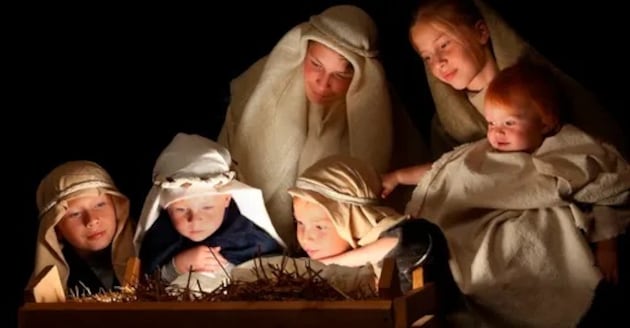
Although the Savior would be born far away in Bethlehem, believers in the Americas believed that God would fulfill His words and looked forward to the promised sign of the Savior’s coming.
For the faithful Nephites and Lamanites who believed the words of the prophets, the years leading up to the birth of Jesus Christ were marked by enduring anxiety, opposition, and fear while looking to heaven in hope and waiting. That moment of anticipation, experienced not in Bethlehem but on the other side of the world, forms the spiritual foundation of the hymn “Star Bright,” which was added to “Hymns — For Home and Church.”
Prophecy of Samuel the Lamanite
The Book of Mormon describes the years leading up to the Savior’s birth as a period of spiritual instability in which many people were “led into foolish things” and turned away from faith, repentance, and righteousness. Believers, those who trusted the words of the prophets and looked forward to the coming of the Messiah, were ridiculed, persecuted, and ultimately received death threats. Some people left, but others continued to believe.
Around 6 BC, God called Samuel the Lamanite to prophesy the birth of Jesus Christ and remind the people to look forward in faith and repent.
Samuel declared: “Five more years shall come, and, behold, then the Son of God will come, and will redeem everyone who believes in his name” (Helaman 14:2). And he foretold unmistakable signs of his birth, including a “new star…such as ye have not seen” (Helaman 14:5).
The appearance of that star, with a light as bright as day all night long, would prove that Jesus Christ was born in Bethlehem.
Hymns inspired by ancient hope
The song, written by Lorin F. Wheelwright, first appeared in an article in The Instructor magazine in 1959. In the article, Wheelwright explained that “Star Bright” was inspired by the Book of Mormon’s account of Samuel the Lamanite. Samuel prophesied the birth of Christ and foretold a new star as a sign of it. He reflected on the joy and anticipation of those who believed Samuel’s words, even though many around them did not.
Wheelwright was born on December 20, 1909 in Ogden, Utah, and became a prominent Latter-day Saint musician, educator, and hymn writer. He served on the church’s Sunday School Board and was an associate editor of The Instructor magazine, where Star Bright was first published in both English and Spanish in October 1959.

Wheelwright’s daughter-in-law, Melba Cundick, recently told Church News that Wheelwright intended to tell the Christmas story from the perspective of the Book of Mormon.
“He talked about wanting to capture the emotions they would feel in the New World,” she said of those who knew the Messiah was coming but would be born far away. “He wanted people to understand not only the meaning (of the Holy Land) but also its expectations through the eyes and hearts of the believers here.”
This premonition is expressed not only in the text but also in the music. Kundic said the melody helps convey the feeling of waiting with hope. “It’s on the earth side,” she said. “It feels like rocking the cradle.”
“Star Bright”
1. A sky full of light
A love story is told.
A new star shines in glory
When Jesus comes and dwells on earth.
Oh bright star, the world is getting anxious
For you to turn night into day.
Oh, star shining in the sky,
Come on, shine inside me on Christmas day
2. Lift your eyes upward and rejoice;
Look at the time in front of you.
The night beacon will soon be ablaze.
He is coming to our Promised Land.
Oh bright star, the world is getting anxious
For you to turn night into day.
Oh, star shining in the sky,
Come on, shine inside me on Christmas day
3. Our Father sends with love
The Christ Child overcomes conflict.
His mercy extends to all things;
He brings eternal life.
Oh bright star, the world is getting anxious
For you to turn night into day.
Oh, star shining in the sky,
Come on, shine inside me on Christmas day
Listen to “Star Bright” here.
After this hymn was written, it quickly found an audience beyond the United States. Kundic recalled that “Star Bright,” published in Spanish as “Estrella de Luz,” was soon sung in Mexico and South America. “They were spreading it like wildfire,” she said. This song has been included in Spanish nursery rhymes since 1995.
Today’s hopes and reflections
In recent weeks, the hymn has also received attention from church leaders reflecting on its message. Sister Tracy Y. Browning, second counselor in the Primary general presidency, recently shared the song on social media, drawing attention to the song’s focus on waiting on Christ in hope and faith. Her post highlighted how sacred music helps believers, including children, to look to the Savior and feel the joy of looking forward to His coming.
In his original commentary, Wheelwright encouraged his audience to consider not only the star that marked Christ’s birth, but also the promise of Christ’s second coming. As written in “About Hymns” on ChurchofJesusChrist.org, Wheelwright encouraged believers to “search their hearts and the heavens” as they look forward to the day when Christ will return in glory.
