


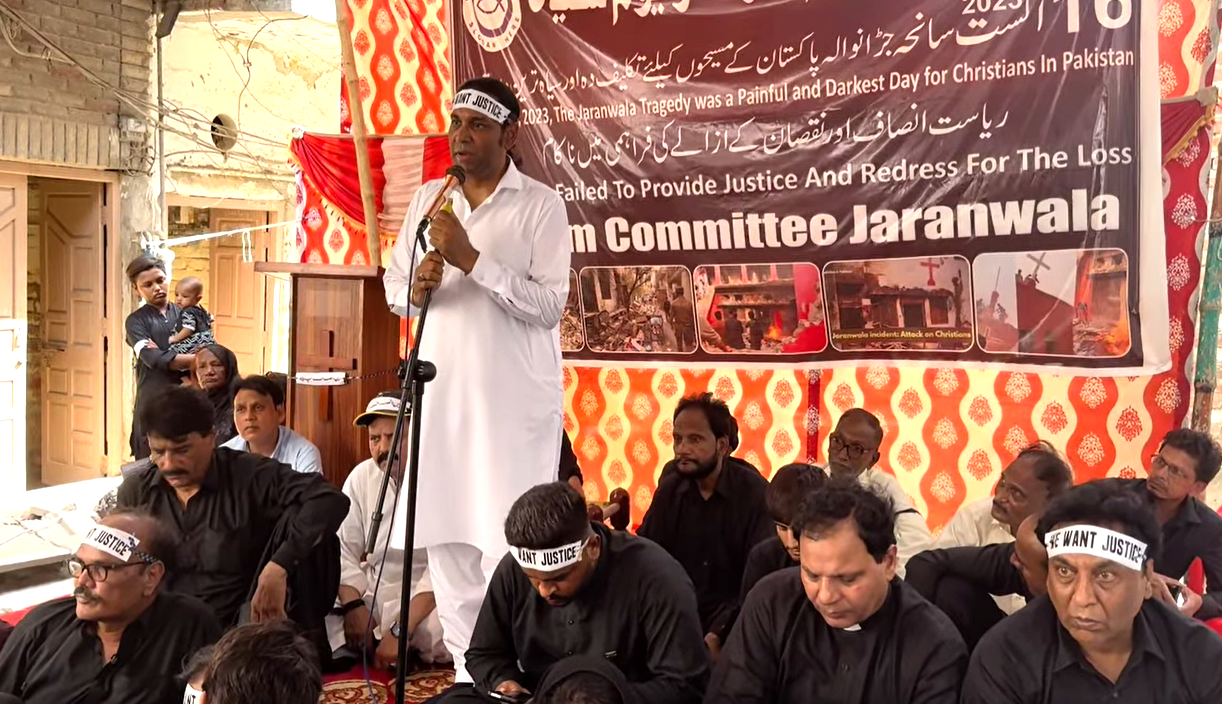
Hopes for justice for victims of the 2023 attack on Christians in Pakistan’s Jaranwala town ostensibly came to an end when the High Court on October 22 rejected all petitions by individuals and Christian groups seeking a judicial inquiry, officials said.
After two years of delay, Justice Asim Hafeez of the Lahore High Court said in his verdict that the high court had no power to order the formation of a judicial commission to investigate the August 16, 2023 religiously motivated attacks on churches and homes of Christians in Jaranwala, Faisalabad Division, Punjab. The incident erupted after two Christians were falsely accused of desecrating the Quran and writing blasphemous content. against the Prophet of Islam.
“In addition to jurisdictional constraints, setting up a judicial commission at this stage in the wake of the submission of the report by the Joint Investigation Team (JIT) would imply redundancy of the efforts by the JIT by issuing directions to constitute the judicial commission, otherwise tantamount to disbelieving, discrediting and invalidating the content of the report by the JIT,” the verdict said.
According to the judgment, government lawyers told the high court that Section 3 of the Punjab Inquiry Tribunal Ordinance, 1969 provides for various options, including but not limited to the establishment of a judicial commission, including the appointment of a tribunal, commission of inquiry, or commission of inquiry. They claimed that the joint investigation team had completed its task and submitted a report that could be used in criminal proceedings against the defendants.
According to media reports, the interim Punjab government formed 10 joint investigation teams on August 24, 2023 to investigate the causes behind the attacks, identify gaps in the government’s response, and recommend measures to address them. However, to date, no reports on JIT have been published.
The judgment also said that in its report to the High Court on October 20, the government had submitted that the caretaker state cabinet in its meeting on January 10, 2024, discussed the report of the committee set up by the Chief Minister and unanimously concluded that “the report covers all possible details and comprehensively covers all the cogent elements of the unfortunate incident.”
According to the report, the caretaker cabinet expressed satisfaction with the progress in prosecuting the case and determined that the establishment of a judicial commission would undermine the efforts made by the government and affect court proceedings.
Almost all of the suspects arrested in connection with the attacks were released on bail or were acquitted due to insufficient police investigation and prosecution. The government has also not released the analysis report of the Prime Minister’s Committee, which claims to have determined the cause of the incident and made recommendations to prevent such incidents in the future.
In the judgment, the judge also noted that the petitioner’s lawyers had not explained how the JIT’s constitution was illegal and how the scope and obligations of section 3 of the 1969 Ordinance had been violated.
“When asked, there is no disclosure whether any personal complaint has been filed by the appellants or whether any action has been taken against the allegations of collusion against the police in exercise of appropriate jurisdiction including but not limited to the allegations under Sections 22-A and 22-B of the Code of Criminal Procedure, 1898,” the verdict said. “We cannot explain why the various remedies were not selected.”
A senior Christian lawyer, speaking on condition of anonymity, said he believed the appellant’s lawyers had failed to effectively interpret in court the fundamental rights of religious minorities guaranteed and protected by Pakistan’s constitution and recognized by high court judgments.
“The violation of fundamental rights, including the looting and destruction of places of worship and scriptures, necessitated the establishment of a judicial inquiry under the 1969 Ordinance to determine the causes of the incident and make recommendations to prevent the recurrence of such incidents in the future,” the lawyer told Christian Daily International Morning Star News. “A Christian had filed an application in September 2023 with the Punjab Chief Minister’s Office seeking the establishment of a judicial commission, but it was not accepted as it failed to adequately highlight the violation of the fundamental rights of religious minorities in the Jaranwala incident.The application was later withdrawn by him, but the rejection of the application should have been challenged in the High Court by framing appropriate arguments.”
He further said that when the government informed the High Court that there was no need for a judicial inquiry in the presence of the JIT, the petitioners’ lawyers should have argued that their case was for a judicial inquiry into the cause of the incident and not an inquiry into the case registered under the Anti-Terrorism Act.
The senior lawyer, who is considered an authority on constitutional law and criminal law, also criticized the appellants’ lack of interest in pursuing their goals.
“While the petition has been pending in the High Court for two years, there has been no serious effort by any party to seek regular hearings or to mount much-needed pressure on the government to force it to reconsider its decision,” he said.
The Christian Daily International Morning Star News reported credible information that some Christian organizations received hundreds of thousands of dollars from foreign donors to pursue the Jaranwala case in the First Instance and Lahore High Courts, but did not use the funds for their intended purposes. Most Christian lawyers in these groups took on cases voluntarily, and many lost interest in the cases after a few months.
Of the 5,213 suspects involved in the attack, 380 have been arrested, while 4,833 remain at large, Amnesty International said.
“Of the arrested suspects, 228 were released on bail and 77 others were not charged,” Babu Ram Pant, Amnesty International’s deputy regional director for South Asia, said in a press statement on the first anniversary of the incident. “Despite assurances of accountability from authorities, grossly inadequate measures created a climate of impunity for perpetrators of the Jaranwala violence.”
Blasphemy charges are common in Pakistan, and those found guilty of insulting Islam’s prophet Muhammad can be sentenced to death. Authorities have not yet carried out any executions on blasphemy charges, but in many cases the accusation alone can spark riots and incite mobs to violence.
Two Christian brothers from Jaranwala have been acquitted of blasphemy charges after an anti-terrorism court found they were framed by another Christian after a personal dispute.
Pakistan ranks eighth on Open Doors’ 2025 World Watch List as the most difficult place to be a Christian.
