


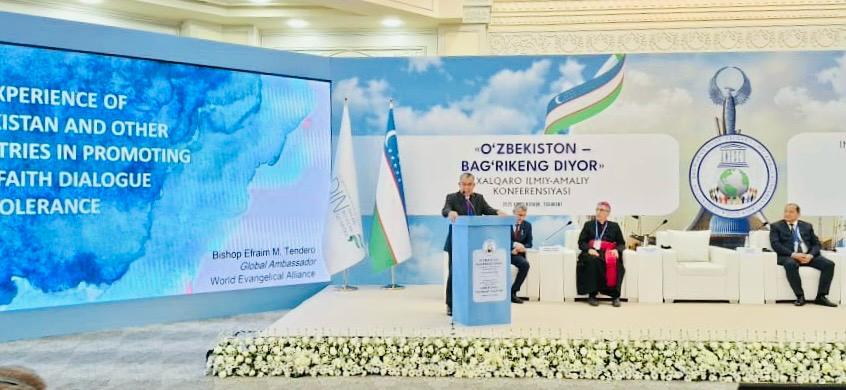
World evangelical leaders stressed the urgency of religious tolerance and interreligious dialogue at a major international conference in Uzbekistan on November 15, calling for a deeper commitment to peaceful coexistence at a time of escalating conflict and violations of religious freedom around the world.
Bishop Ephraim Tendero, World Ambassador of the World Evangelical Alliance, gave one of the talks on behalf of the world evangelical community at the scientific and practical conference “Uzbekistan – A Tolerant Country” held at Zimut Conference Center in Tashkent. Citing data showing that nearly two-thirds of the world’s population lives in conditions where serious violations of religious freedom occur, Tendero said the global situation makes sustained efforts toward greater tolerance “critically important.”
Speaking on behalf of the WEA’s constituency of more than 600 million Christians in 161 countries, he positioned tolerance as a moral and theological necessity. Referring to the United Nations’ International Day of Tolerance, he noted that rising persecution, instability and geopolitical divisions underline the urgency of rejecting discrimination and safeguarding peaceful coexistence.
Mr. Tendero also praised Uzbekistan’s extensive efforts, praising the government for extending observance from one day to an entire week of tolerance. He described this initiative as evidence of institutional commitment to interreligious harmony through cultural, educational and social engagement. “These efforts are especially important in an increasingly geopolitically fragmented world.”
The central theme of Tendero’s presentation was the evangelical theological basis for interreligious dialogue. He said evangelicals base their dialogue on the belief that all people are created in the image of God, adding that Jesus’ engagement across social, ethnic and religious boundaries provides a model for respectful public encounters. He said dialogue fosters “mutual understanding, trust and cooperation” and enables faith communities to maintain their beliefs while contributing to social cohesion.
To illustrate this, Tendero detailed his involvement in peace efforts in the Philippines, including a visit to the Moro Islamic Liberation Front headquarters in 2008. He described leading a delegation of evangelical pastors and Muslim imams into talks with rebel leaders, saying this was a defining moment that helped advance reconciliation efforts that later led to a comprehensive peace agreement. He also highlighted interfaith efforts in the Philippines, Singapore, Indonesia and the United Arab Emirates, where interfaith cooperation has tackled issues such as violent conflict, human trafficking, corruption and climate change. He said Uzbekistan is increasingly recognized for its structured approach to inter-ethnic and inter-religious relations.
Mr. Tendero also expressed his gratitude for the recognition and protection of evangelical Christians in Uzbekistan. He pointed out that the World Evangelical Alliance is represented in the country through the Uzbekistan Evangelical and Protestant Church Center. Although he acknowledged that evangelicals are a minority, he thanked the government for protecting their rights and freedoms. At the same time, he respectfully called for an efficient administrative process for registration and recognition to enable newly established churches to fully contribute to society.
Speaking to Christian Daily International after the event, Tendero praised Uzbekistan’s tolerance policy and welcomed the “great hospitality and generosity” towards international participants. He said the way officials and partners treated visiting religious leaders reflected the spirit of openness emphasized throughout the week’s events.
The conference itself brought together religious leaders of various traditions, scholars, and government representatives. Officials said they aimed to showcase Uzbekistan’s experience in managing religious diversity and provide a platform for international perspectives on coexistence, tolerance and cooperation.
The rally formed a central part of Uzbekistan’s national Week of Tolerance, which was held from 10 to 15 November to commemorate the International Day of Tolerance on 16 November. The week-long event was organized in cooperation with the Religious Affairs Committee, the Committee on Interethnic Relations and Friendship with Foreign Countries, and several ministries and agencies.
Across the country, activities including cultural performances, exhibitions, educational programs, scientific debates and youth-focused initiatives aimed at promoting peace, mutual respect and social cohesion among Uzbekistan’s diverse ethnic and religious communities were held. Institutions hosted essay and art contests, festivals of tolerance, and open discussions to reinforce these themes.
Mr. Tendero said the World Evangelical Alliance looks forward to continued engagement with Uzbekistan and other countries committed to promoting peace through interreligious understanding.
