


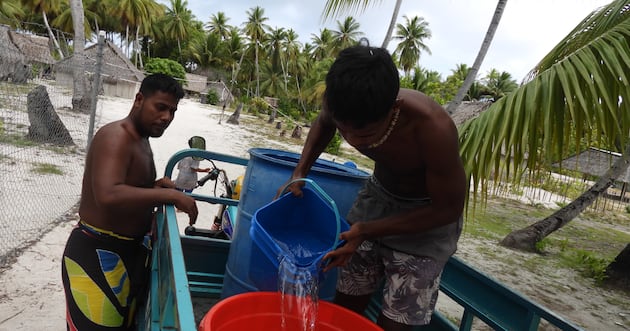
To turn seawater into clean water, The Church of Jesus Christ of Latter-day Saints recently built five solar-panel-powered desalination plants on the atoll of Kiribati. Kiribati is a country consisting of small islands and atolls in the central Pacific Ocean.
According to the church’s New Zealand Newsroom, the church has been working with the Kiribati government to install these plants over the past year, with five more set to be installed in the next phase.
Before the desalination plant was installed on Abatiku Atoll, residents used freshwater wells that were contaminated with seawater. Tokabeti Teeki, a school teacher in Abatiku who works with 7- and 8-year-old children, said the children were forced to miss school because they felt sick after drinking the water.
“It’s so much better now. The children always have fresh water to drink and play with and drink and drink. They just turn on the power and have water right away. This is a really big blessing,” Tieki said.
Another school teacher, Arati Laboia, expressed gratitude for the clean water.
“The water is delicious. It’s like the water we had to buy at the store for our little kids. If we gave them well water, they would get sick. But now this fresh water is free,” Lavoia said.
The atoll also had a huge tank to collect rainwater. However, the tanks were often dry and empty.
Avia Terluai is the manager of the desalination plant on Abatik Island. He gives of his time to keep the water flowing.
“I’m doing this because I’m a member of The Church of Jesus Christ of Latter-day Saints. This is what we do to take care of our neighbors,” Terluai said.
The solar-powered desalination plant is part of the church’s ongoing collaboration with the government of Kiribati to provide clean water to drought-affected areas, according to the church’s 2025 Overview of Care for Those in Need. The Church sponsors efforts around the world to bring clean water to people in need, working with other organizations on 227 WASH (an acronym for water, sanitation and hygiene) projects in 2025.

global efforts
The Caring Report outlined other places where the Church has contributed to providing clean water.
In the village of Vila de Santa Ana Nichi, Mexico, a sustainable drinking water system benefits 2,500 people in neighborhoods, schools, and hospitals. The system includes long-term maintenance efforts to ensure it continues to provide clean water for years to come.
The church’s donation was made to a UNICEF program that provides safe water and sanitation to schools across the state of Chihuahua. This initiative will help more than 1,000 students and teachers in rural and Indigenous communities.
Another area that was provided with clean water facilities was a village in Bolivia. In connection with educational support, the church partnered with the Water for People organization to install restrooms, hand-washing stations, and safe drinking water stations in local schools. This initiative gave school students the opportunity to focus on their education instead of fetching water from the river before going to school.
In northern Tanzania, churches partnered with WaterAid to provide clean water to more than 20,000 people through sanitation facilities in schools and health centers. The impact of these efforts has meant that women feel safer when giving birth and no longer have to fetch water from far away.
According to the Caring Report, the church also supported other parts of Africa, including Burkina Faso, Ghana, Liberia and South Africa.
In Asia, churches responded to the magnitude 7.7 earthquake that struck Myanmar, killing thousands. The church donated to the International Humanitarian Center to provide sanitation and handwashing facilities and hygiene kits to those affected. This facility prevented the spread of the disease and provided a sense of security and security to those affected.
The church partnered with the Samoa Ministry of Health and Vaisigano Second District to provide clean water to 2,000 residents. Two 10,000 liter water tanks were installed at the school and more than 200 water tanks were distributed to each household.
After Europe’s Greek islands were hit by flooding, the church teamed up with mainland suppliers to provide bottled water to those affected.
