


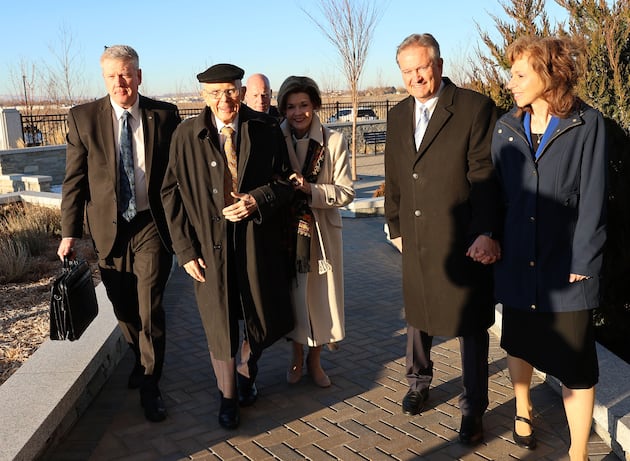
Nearly three months after becoming the 18th President of The Church of Jesus Christ of Latter-day Saints, President Dallin H. Oaks said he feels a responsibility to take on the “mantle of a prophet.”
“It’s a heavy, ongoing, and very sacred responsibility, and I’m trying to grow into that responsibility,” he said in an interview in Burley, Idaho, on Saturday, Jan. 10, the day before he dedicated the city’s new temple.
President Oaks, 93, succeeded President Russell M. Nelson, who passed away on September 27, 2025, but said, “I never had any desire to serve in that office. I never had the impression that I would be in that office.”
He said he found strength in knowing that the Lord had called him and prepared him to lead a worldwide faith of 17 million members.
“All my life, I have wanted to do what Heavenly Father wants me to do,” he said. “I don’t take responsibility for that.”
Sister Kristen Oaks, who sat beside her husband during the interview, said President Oaks has become even more “enthusiastic about his work” and “focused and concerned about the Kingdom” since becoming President of the Church.
President Oaks, who has served as an Apostle to Latter-day Saints since 1984, said he has benefited from his involvement with eight previous Presidents of the Church who he “loved, respected, and learned from.” He expressed special gratitude to President Nelson, whom he has known for more than 50 years.

President Oakes has continued to advance at a pace that rivals his predecessor.
Since taking office as President of the Church, President Oaks has announced the creation of 55 new missions, lowered the minimum age for women’s missionary service from 19 to 18, and announced the construction of a new temple in Portland, Maine.
President Oaks said this temple announcement, made during devotions in the area where the temple will be built, will set the pattern for future temple announcements. “The best place to promote a temple is in its temple district,” he said.
He said this made a strong impression on him soon after he assumed leadership of the church. Maine is the first state to do so, but other states are likely to follow suit.
The First Presidency will continue to make decisions on future temples, but will then “appoint others to make announcements where temples will be built,” he said.
Continuing the focus shared by President Nelson in his first general conference address, President Oaks called on Latter-day Saints to find and stay on the covenant path.
“Sometimes we look at the Lord’s commandments and the experiences we can hope for in this life as a checklist and check off different things,” he said. “I think it’s much healthier to think of our earthly journey as a journey from birth to back to where our Heavenly Father wants us to be.”

President Oaks spoke of a generation of young people who are sharing the message of The Church of Jesus Christ in record numbers. There are currently 83,000 full-time missionaries.
President Oaks said the decision to lower the age for young women to serve missions was to “increase options” for young women.
President Oaks hopes that serving a mission sooner will result in young people marrying younger. “I think it’s part of the Lord’s plan to overcome the tendency to wait until your late 20s to get married for the first time,” he said. “I think (as a result of lowering the missionary age) the marriage age for Latter-day Saints will be lowered.”
President Oakes said that despite war, political polarization and uncertainty, young people can look to the future with optimism.
“Be happy,” he said. “Don’t be discouraged. Trust in the Lord.”
Life is always full of terrifying challenges. “People should not be discouraged just because we are surrounded by hardship, whether it be economic, political, or social. It is part of what we were put here to experience.…We can remain optimistic because we trust in the Lord and know that He loves us and that He is preparing us for success, not failure.”

He said Latter-day Saint temples, including the new one in Burley, Idaho, are powerful symbols of the blessings of the gospel of Jesus Christ.
Before he died, President Nelson went through a list of temples that would need to be dedicated and asked each counselor in the First Presidency to select one.
President Oaks spent five years of his childhood in Twin Falls, Idaho, 40 miles west of Burley, where his father was a practicing physician. His parents had friends in the community. “My earliest memories are here in southern Idaho,” he said. He said he chose Barley because it “reminds me of my youth.”
Like all temples around the world, this temple too will be a blessing to Bari. “When you have a temple in a community, it changes the community,” he said.
