


Legal professionals are known by many different names, including lawyers, solicitors, and paralegals.
But Relief Society general president Camille N. Johnson said one of their “most attractive” titles is “attorney.” She worked as an attorney for nearly 30 years before being called as a general officer of The Church of Jesus Christ of Latter-day Saints.
President Johnson said, “An advocate is someone who intercedes, represents, or defends the cause of another, especially in a court of law or in a court of law.” “Of course, ‘Advocate’ is the name and responsibility given to Jesus Christ. Jesus is an advocate with the Father on behalf of those who confess his name and keep his commandments.”
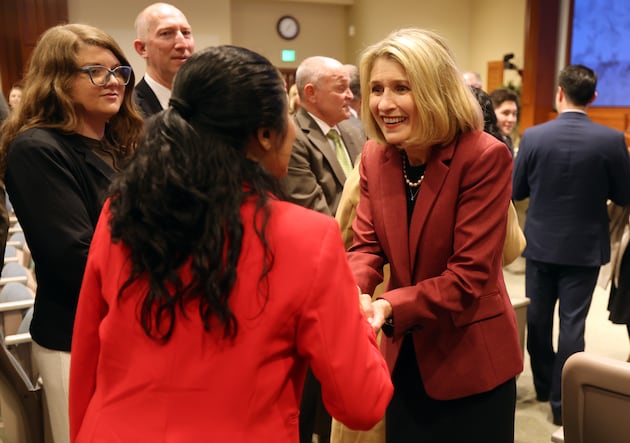
President Johnson’s remarks were made at the J. Reuben Clark Law Society’s annual fireside on Friday, January 16, at the Church Office Building in Salt Lake City. Her keynote address explored the intersection of law, peacebuilding, religious freedom, and the important social role of women.
Church President Dallin H. Oaks and his wife, Sister Kristen M. Oaks, were also in attendance. President D. Todd Christofferson, Second Counselor in the First Presidency, and his wife, Sister Kathy Christofferson. President Oaks is a former attorney and Utah Supreme Court Justice, and President Kristofferson is also a former attorney.

The J. Reuben Clark Law Society is an international, chapter-based association of faith-based attorneys and law students. Although the Society operates as a 501(c)(3) established and maintained by Brigham Young University, it welcomes law students and graduates of faith who support the Society’s mission of defending religious freedom and moral values.
“My friends, you are people of influence,” President Johnson told the fireside audience. “Collectively, we have been blessed with educational opportunities and the gift of association. We cannot assume that that work will be done by legal educators, scholars, and researchers. All of us must play an active role in teaching, inspiring, and helping others.”
“Unique and different” legal profession

President Johnson’s speech emphasized the following four points:
The role that an individual’s religious beliefs must play in guiding legal activity. Peace-building in the legal world as well. Peacemaking and religious freedom efforts, especially those carried out by women. A call to action.
Speaking about the role of religious beliefs in guiding legal practice, President Johnson used a Biblical account to explain how Jesus Christ was strong, active, courageous, and meek, qualities that everyone looks for when hiring a lawyer.
President Johnson said: “In an age where chutzpah is rewarded and acrimony is celebrated, let us be a legal profession that is different and unique.”
This leads to her second point. It is about harmonizing the responsibility of a peace mediator with the duty of a lawyer to persistently advocate his or her position.
But what President Johnson discovered during her 30 years of law practice was that sometimes the best way to settle a case is to litigate it in court, presenting evidence and letting a jury decide, she said.
President Johnson also urged legal professionals to imitate Jesus Christ when situations become contentious.
“Peacemaking requires active engagement,” she said. “We have to be in the arena, not on the sidelines.”

Regarding the third point, President Johnson said that peacekeeping and religious freedom are “soulmates.” But when the nationalization of a culture is hostile to the religious beliefs of minorities, and the secularization of a culture is hostile to religion in general, “history has shown that it has devastating effects on society in general,” including increased social conflict, violence, and family and economic instability.
It would also result in further inequalities, particularly for women and children, Johnson said.
“Simply put, when societies and governments restrict religious freedom, women and children suffer and women are prevented from using their natural talents to foster peace,” President Johnson said.
She continued that women have a special propensity to sense human needs, comfort them, teach them, and strengthen them. Therefore, “communities depend on ordinary women for human flourishing,” and if women are to play a peacekeeping role, they themselves must be inspired, nurtured, healed, empowered, and taught about their divine potential.
“Where will this lead?”

President Johnson concluded with a call to action for legal professionals to consider important issues and ask, “Where will this lead?” She said each person has a choice to speak, act or remain silent.
President Johnson said, “Working to protect the U.S. Constitution, religious freedom, and the family is not just for jurists and academics.” “That includes blue-collar lawyers, Relief Society presidents, non-lawyers and people of all faiths.”
“Let us follow the Prince of Peace and live out his perfect example in our personal and professional lives.…He wants to engage with us, and we will do so as we joyfully share in His great works.”


