


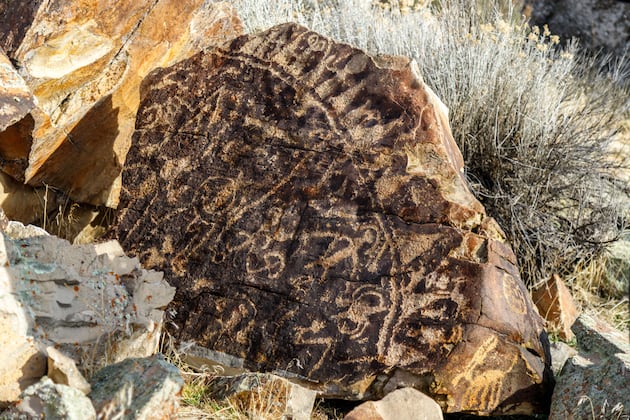
On an unusually warm and sunny day this December, a helicopter airlifted the 2,500-pound rock decorated with petroglyphs to its original location near the Utah-Idaho border.
Once the helicopter hovered, workers manipulated the sacred relic and placed it among other rocks with similar petroglyphs.
The petroglyphs were created 1,200 years ago by the Fremont people, ancestors of the northwestern Shoshone band.
About 80 years ago, the petroglyph was removed by a group of men or Boy Scouts and brought to the meetinghouse of The Church of Jesus Christ of Latter-day Saints in Tremonton, Utah, where it remained outside the building for decades.
The rock revival is the culmination of several years of collaboration between historians and conservators representing the Northwestern Band of the Shoshone Nation, the state of Utah, and The Church of Jesus Christ of Latter-day Saints, according to a news release from ChurchofJesusChrist.org.
For Brad Parry, vice president of the Shoshone Nation Northwest Band, it was a moving experience to see the rock returned to what he described as a “spiritual place” where his family, including his ancestors, gathered and camped.
“This rock was meant to be here,” Parry said. “It’s like this rock knows it’s home.”

Preservation and repatriation
Why the rock was removed from its original location and brought into the church is “a mystery,” said Ryan Saltzgiver, curator of historic sites in the Church History Department.
David Bolingbroke, research and support historian at the Church History Department, said the stone was likely placed in the chapel “not out of malice but out of a lack of proper understanding”.

In 2011, amateur archaeologists discovered the rock at the Tremonton Meeting House using 1937 rock art studies and determined its origins.
“We’ve been working ever since to get everything in place so we could move the stone,” Saltzgiver said.
The church worked with the Shoshone Northwest Band to complete preservation and repatriation plans. Although the church has “no legal obligation” to return relics, “we have a moral and ethical obligation to care for such items in our possession, especially when it comes to returning highly sacred items to their rightful owners,” Saltzgiver said.


For the tribe, the partnership was uplifting.
“For us, putting it back together is like putting pieces of a puzzle back in place,” Parry said. “Our history is so fractured by so many things that have happened to us. The fact that these positive things are coming out now means we’re reshaping our history. And you can’t overstate that.”
The repatriation process spanned several years, during which Chris Merritt of the Utah State Historic Preservation Office played a key role in bringing all partners together.


Cleaning artifacts
The piece’s journey home began when a professional art handler carefully removed it from the concrete.
The rock was transported to Provo, Utah, where conservators selected by church historians carefully cleaned it and removed the lichen that had grown over the years.

The cleaning process used soap and water, bamboo and plastic tools, non-toxic biocide and steam, said Megan Randall, an artifact conservator at the Midwest Art Conservation Center.
“Even if it’s not the cleanest, after a few months or a year, applying biocide will continue to automatically clean it to some degree,” Randall said. “Not many people do this, so our work is very interesting and diverse.[The stones]have designs that have a spiritual connection to the tribe, and we want that to be visible and appreciated by the people who see value in it, which is us.”


go home again
After cleaning and preservation, the sacred relics were returned to their original locations.
The final installation of the stone is said to have been a seminal and sacred moment, arousing strong emotions among those involved.

Megan Emery, chief conservator at the Midwest Art Conservation Center, said it was a team effort and an emotional project.
“It has been extremely gratifying and an honor to be a part of this project, seeing how well all of our team members worked together and how successful they have been, and I am extremely grateful,” Emery said.

Bolingbroke said it was “amazing” to see the rock preserved and revived.
To commemorate this momentous occasion, the tribe’s spiritual leader Rios Pacheco offered a blessing that deeply touched those gathered.
“He prayed that everyone who helped would be blessed,” Parry said. “Hearing him say that in Shoshone…(It was amazing).”
“At that moment, we felt very strongly that the eyes of our Latter-day Saint and Shoshone ancestors were upon us. They were pleased with our efforts to bring this stone (and) put it in its rightful place. This stone is very important because of the Shoshone connection to this stone.”

