


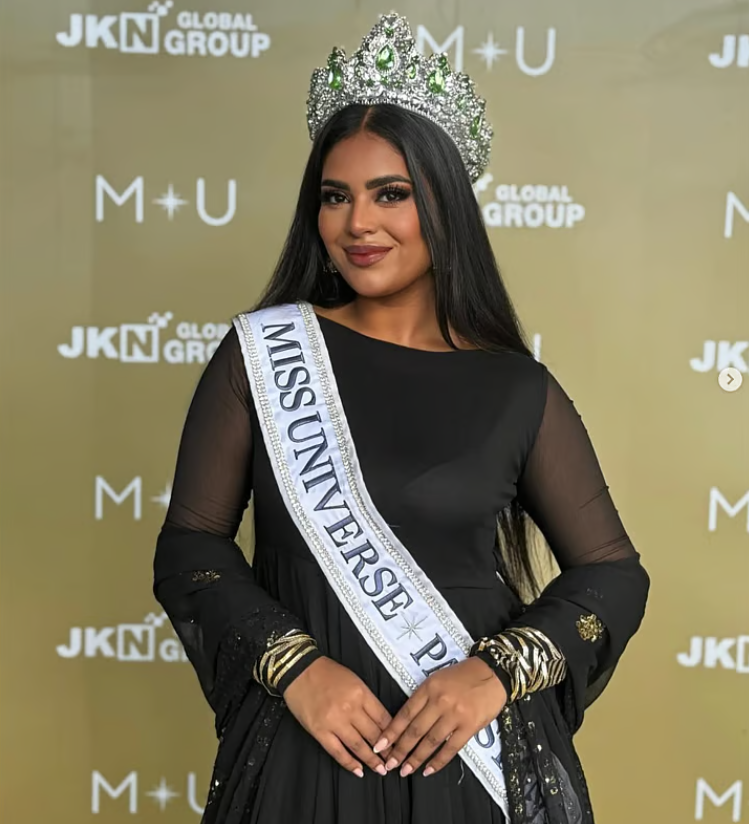
Roman Rias is used to being the “guru”, but she’s not used to the kind of attention she received in the weeks leading up to the recent Miss Universe pageant on November 21st. As the first Pakistani Christian to compete in the competition, the 27-year-old found herself at the center of a heated online debate.
What was supposed to be a moment of national pride sparked a debate about beauty, expression and identity, with trolls targeting her skin color, body type and even her faith. However, Riaz made it clear that he would not remain silent.
Rias, who was born into a Punjabi Christian family and raised in the UK, was crowned Miss Universe Pakistan 2025, sparking mixed reactions at home and abroad. Her appointment challenged long-held beauty ideals in South Asia, where fair skin and certain body proportions have historically been treated as indicators of attractiveness.
Critics, often hiding behind anonymous accounts, accused her of being “too dark”, “too curvy” and “not representative of Pakistani beauty”, while others questioned whether someone who grew up abroad could represent Pakistan on such a global stage.
Riaz faced the backlash head on. In a statement and a widely shared Instagram reel, she said the comments were not just a personal attack, but a reflection of deeper societal prejudices.
“I’m not going to apologize for being similar to my fellow countrymen,” she said, stressing that criticism often stems from the harmful belief that fairness equals beauty. She reminded critics that colorism teaches people to “celebrate fairness and forget where we come from.”
“I am Pakistani in my roots, my values, and all my skin tones,” she said. “My skin is the same color as the women who built our homes and families and carried our country in their hearts.”
She added that she is proud to represent not just Pakistan, but “a new generation of South Asian women who don’t fit into the narrow boxes of what society thinks we should be.”
Riaz switched her message to Pakistanis into Urdu, questioning why some people are so quick to disrespect the women of their country. She said she always tells the world how beautiful Pakistani people are, only to be asked why the same people spread so many negative opinions about her.
Rias appealed to critics not to interfere with the image she is trying to build. “Everyone is entitled to their own opinion, but if you have nothing to say, please don’t say anything for the sake of Pakistan’s honor.”
In a direct message to young girls, she added: “Girls who are labeled ‘too dark, too foreign, too bold’ represent Pakistan just like any other girl.”
“This pageant was about more than just being Miss Universe Pakistan,” she said. “This is the answer to everyone who has ever questioned my identity.” She stressed that beauty cannot be limited to a single type and that Pakistan’s diversity in culture, skin color and tradition deserves to be noticed and celebrated.
Her response resonated widely, especially among South Asian women who rarely see their features expressed without hesitation or apology.
For many observers, the online criticism highlighted Pakistan’s long struggle against colorism, a social problem shaped by class structures and colonial history. From marriage proposals to job prospects, skin color has often been used as a measure of worth.
Riaz’s refusal to conform has reignited debate about how deep this prejudice runs and how destructive it is to young people who grow up in its shadow.
Riaz also uses her platform to advocate for girls’ education, calling it “the greatest form of empowerment.” She hopes her profile will encourage young Pakistani women, especially those who have been labeled as “too dark,” “too different,” or “too bold,” to embrace their identities instead of shrinking to fit society’s expectations.
Rias’s stance is more than just looks. After wearing a sari at a Miss Universe event, she hit back at critics who questioned whether it was “Pakistani enough” and insisted the garment was as much a part of the region’s cultural heritage as the shalwar kameez.
Rias’ message as she stood on the global stage in Thailand was clear. Pakistan is not defined by one skin colour, one culture or one body type. And women who represent our country should not be criticized for being similar to where they come from.
