


Thirty years ago, The Church of Jesus Christ of Latter-day Saints reached a significant milestone. On February 28, 1996, there were officially more members of the Church living abroad than in the United States.
The number continues to grow. And the Church has adjusted accordingly to meet the needs of its members around the world.
The Deseret News Church Yearbook reported that as of February 28, 1996, there were 4.72 million Church members living outside the United States, compared to 4.719 million within the United States. As of December 31, 2024, the latest numbers available, there were 10.58 million people living outside the United States, compared to 6.93 million people within the United States.
Elder Hugo E. Martinez of the General Authority Seventy sees this as a fulfillment of Daniel’s prophecy of a worldwide kingdom that will stand forever and will never be destroyed in Daniel 2:44-45, and a fulfillment of the Abrahamic Covenant in which God declared, “You shall be a blessing: … and in you shall all the families of the earth be blessed” (Genesis 12:2-3).
“The Restoration of the gospel began in the United States as a promised land where all the blessings of God would be poured out on the rest of the world,” he explained.
Elder Martinez said that he and his wife, Sister Nuria Alvarez de Martinez, were taught the restored gospel of Jesus Christ in 1982 and were blessed to be able to teach it to their children, grandchildren, and others.
“Seeing the growth of the church in our assigned Caribbean, Central America and West Africa is beyond anything we could have imagined,” he said. “Around the world, the Church is growing, blessing each person and family as they come to Christ.”
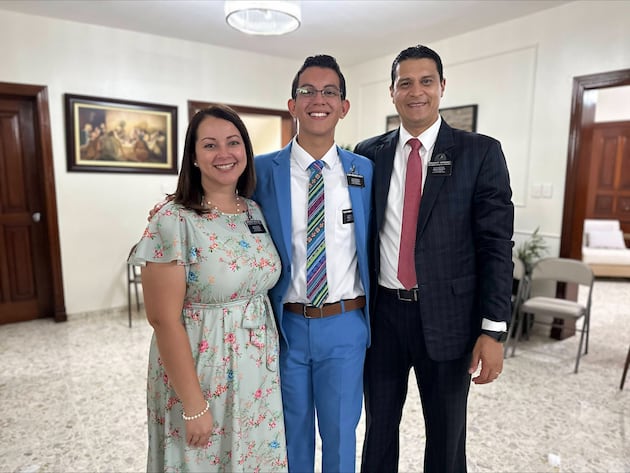
When President Hector David Hernandez and Sister Emma Hernandez, mission leaders of the Dominican Republic Santo Domingo West Mission, were planning to get married 20 years ago, they had to travel 14 hours from their native Honduras to Guatemala to be sealed in the house of the Lord.
Currently, there are two dedicated temples in Honduras and six temples in Guatemala that have been dedicated, announced, or are under construction.
“It’s amazing to see the hand of the Lord,” Sister Hernandez told Church News.
In addition to an increase in the number of temples, they are also seeing an acceleration in missionary activity. The missionary effort has recently split into two, with more missionaries serving and more people joining The Church of Jesus Christ of Latter-day Saints in the Dominican Republic.
“We witnessed a special spirit of conversion,” President Hernandez said.
“The Lord knows how to run His kingdom.”
Saints Volume 4: A Sound in Every Ear chronicles the history of the Church from 1955 to 2020. It records not only the milestone of 1996, but also the events leading up to it and what has happened since.
In 1955, most Latter-day Saint converts were of white Anglo-European descent. By 2020, most of them came from Latin America and Africa, said Jed Woodworth, the church’s historian for the saints.
The temple “comes wherever the saints are, meets the saints there, and helps build Zion wherever they live,” Woodworth said.

Expanding activity in the church’s correlational department is also a major part of this growth, he said. Until the 1960s, church curricula were written primarily by academics, primarily for literate and even university-trained audiences. However, with the help of Correlation, the text became simpler and more clearly defined the gospel around the basic commands.
And this accelerated in the 1990s, Woodworth said. “It served the valuable function of bringing knowledge and testimony to the saints around the world.”
Also in 1996, the Church began operating its first Internet address, LDS.org, which later became ChurchofJesusChrist.org.
“The Lord knows how to run His kingdom, so the moment we cross this tipping point, we will also be able to communicate on a large scale,” Woodworth said.
The internationalization of the church’s membership “has sharpened the church’s sense of fairness,” he said. Better meeting places, increased translation efforts, employment centers, more local leaders and regional authorities, introduction of ministering and two-hour Sunday meeting blocks, increased humanitarian work, and FamilySearch have all come to fruition since 1996 as well.

Education in the International Church
Over the past 30 years, as education has become more accessible and the church has focused on increasing self-reliance, disparities among church members around the world have continued to narrow, Woodworth said.
Relief Society made literacy a major initiative in the 1990s and continues to do so today. The Church Education System has grown to include BYU-Pathway Worldwide, reaching approximately 89,000 students in 180 countries in 2025.
Approximately 60% of Ensign College’s 2025 graduates are from outside the United States, representing 80 countries.

BYU-Hawaii Vice President for Academic Affairs Isaiah Walker said the university’s 3,000 students represent 60 countries, and in some ways they are a microcosm of the larger church, with a strong sense of unity on campus of “brothers and sisters in the gospel.”
The example of Hawaii’s early church leaders set their vision of what the church would be like in the world, he said.

President Hernandez and Sister Hernandez are two examples of Latter-day Saints whose lives have been changed by the Perpetual Education Fund, which celebrates its 25th anniversary this year. Their story is told in “Saints, Volume 4.”
With the financial support of the Perpetual Educational Fund, both young couples started families and achieved their educational goals, always serving in the church. Details are provided in Chapter 38.
They are now seeing EnglishConnect and BYU–Pathway transform the lives of their missionaries.
Nurture, strengthen and transform each other
In 2024, when Woodworth’s son Benjamin Woodworth was a freshman at Brigham Young University, he met another student and they became close friends. They lived right down the hall, attended the same church meetings, shared a common passion for computer science, and went on double dates.
This friend was named Oscar Hernandez from Honduras.
Jed Woodworth realized that this person was the son of Hector David and Emma Hernandez, and was learning about him and writing for “Saints.” They could only have one child and sent him to BYU.
The Woodworths began inviting Oscar to family dinners. Jed Woodworth told him: “Oscar, I believe you were sent to see our son so we can take care of you while you are far away from your parents.”

But the Lord’s hand was more involved than Woodworth first realized.
At the time, Benjamin, who had grown up in Utah with church-loving parents, had no interest in religion and didn’t want to talk about things like evangelism.
Oscar was then called to serve a mission in Nicaragua.
Seeing Oscar excited to serve inspired Benjamin. “Right away my son comes up to us and says, ‘You know, Oscar is the most spiritual person I’ve ever met,'” Woodworth said.
Benjamin currently serves a full-time mission in Nevada as Elder Woodworth.
One might think that the gospel would spread from the church headquarters in Utah and convert others internationally, but in this case the opposite was true. A young man from Central America helped ignite a spark in the life of a young Utah man.
As we see throughout this story, in the grand scheme of things, Woodworth knows that the church is coming together more closely than ever.
“The more we investigate, the more we find that saints around the world have much in common. The beliefs that unite us are much stronger and more powerful than the beliefs that divide us,” he said. “This familiarity helps Saints around the world to nurture one another.”
“The best is yet to come.”
In early 1996, not long after the milestone marking the addition of more international members and just months after releasing “The Family: A Proclamation to the World,” President Gordon B. Hinckley spoke to a Coliseum filled with 35,000 Latter-day Saints in the Philippines and said that people sometimes ask why the Church is growing so rapidly.
“The answer is simply this,” he said. “This Church stands as a solid anchor, an anchor of truth in a world of changing values.”
President and Sister Hernandez truly believe in what President Russell M. Nelson taught in October 2024 general conference: “The best is yet to come.”
And while there are challenges today and no doubt there will be more, they said they know there will be many more miracles in the future as the Lord is involved in the work.
The First Presidency’s message in English, “Preach My Gospel,” speaks of having “a renewed commitment.” But in Spanish, President Hernandez pointed out, the Lord is translated as “the Lord wants us to reach a new level.”
“With the Lord’s help, we can reach new levels,” he said.
“Jesus Christ’s clear direction through the First Presidency and the Quorum of the Twelve Apostles for all members of all ages to participate in the work of salvation and exaltation allows us to joyfully participate in growth,” Elder Martinez said.

As more temples are built and dedicated, more of the Lord’s covenant people are receiving the blessings promised on both sides of the veil. “It’s awe-inspiring,” he said.
The emerging generation attends FSY conferences and enrolls in seminaries and institutes. More missionaries and church members are spreading the gospel of Jesus Christ in person and through social media. This leads to growth and retention, Elder Martinez said, “one person per family.”
“We invite everyone to come to Jesus Christ,” he said.

