


Muntinlupa City, Philippines — Aquilino Andaka Jr. was 7 years old in 1970 when his parents baptized him at the Makati branch of The Church of Jesus Christ of Latter-day Saints. The church met at the Buendia Chapel in Metro Manila, Philippines. The following year, Aquilino also turned eight years old and was baptized.
A few years later, it became a district. In an interview with Church News, Andaka recalled that when she was young, her ward split.
As the church grew other wards were organized. And the region had its own interests. Currently, there are multiple interests in this field.
“I don’t know how it happened so quickly,” said Andhaka, 63. He listed the wards and stakes where he and his wife, Elizabeth Andaka, have lived and where the congregation has expanded and split many times.
“Right now, the church is growing so fast you can’t see the grass growing,” he said.
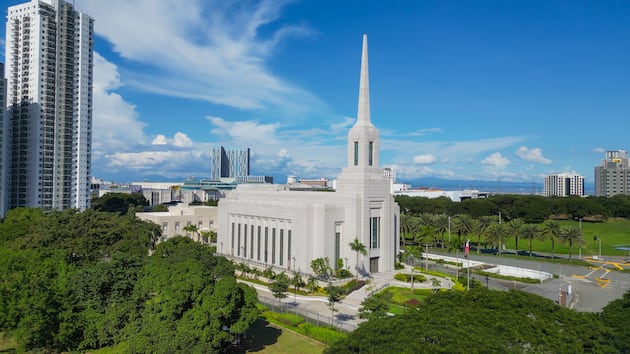
Andaka and his wife, Elizabeth Andaka, have been serving as temple servers in the Manila Philippines Temple for the past year. They reside in Dan Halliward in the Bacoor Philippines Stake, which is one of the stakes that will be part of the Alabang Philippines Temple District when the House of the Lord is dedicated on Sunday, January 18 by Elder David A. Bednar of the Quorum of the Twelve Apostles.
The Alabang Temple in Muntinlupa City will be the fourth House of the Lord in the Philippines, the second in Metro Manila, and one of a total of 14 temples operating, under construction or planned in the country. It is the 213th operating temple in the world.
The Lord’s operating facilities are the Manila Temple (dedicated in 1984), the Cebu City Temple (2010), and the Urdaneta Temple (2024).
But it won’t be long before Alabang Temple remains the country’s newest temple. Two more Lord’s Houses, Davao and Bacolod, are scheduled to be consecrated on May 3 and May 31, respectively.
Two more temples are under construction. Ground was broken in August 2024 in Cagayan de Oro and January 2025 in Tacloban City.
Six projects are being planned: Naga (to be announced in 2022), Santiago (2022), Tuguegarao City (2023), Iloilo (2023), Laoag (2023), and San Jose del Monte (2025).
“I’m very happy that there are so many temples,” Aquilino Andaka said.

“Heaven is closer to home”
Metro Manila (officially Metro Manila) has 16 cities and one municipality and is located on the eastern shore of Manila Bay in northern Luzon. Manila Temple is located in Quezon City, north of Metro Manila. The home of the Lord of Alabang is located in Muntinlupa, the southern tip of Metro Manila.
Manila Temple and Alabang Temple are approximately 15 miles apart. However, coming from Southern Luzon, you will have to pass through several cities in Metro Manila.

Belmin E. Misalucha, president of the Philippine Parañaque Stake, said it can take more than two hours to get to the Manila Temple from Parañaque City, south of Metro Manila.
“With Alabang Temple nearby, you will feel like heaven is closer to home. Distance and transportation struggles will be alleviated, making it a quiet refuge from the crowded streets of Metro Manila,” he said. “It is a beautiful reminder of the Lord’s love for us.”
Elizabeth Andaka said it takes about an hour to an hour and a half in heavy traffic to get to the Manila temple from her home just west of Metro Manila. “If there’s heavy traffic, it could take more than two hours,” she says.
She said she and her husband will begin work as temple servers at the Alabang Philippines Temple on Tuesday, Jan. 20, which will take about 30 minutes. They also volunteered during the public open house.

Bacoor Philippines Stake President Wilfredo Lerola said he is already seeing the blessings of the temple near people in the stake.
“We are very grateful to be located in a prime location south of Manila that is easily accessible to all member states,” President Lerola said.
Their stake reportedly had about 12 temple workers in the Manila temple. “We set a goal to increase that number to 50, and we accomplished that goal in just a few months. The members rejoiced to have their own temple, the house of the Lord.”
President Misalucha also said that although the Alabang Philippine Temple is located in a major business district, “the contrast between the quiet and sacred temple and the bustling city around it reminds us to be still.”
The Lord’s House is decorated with white jasmine flowers, or sampaguitas, the national flower of the Philippines, “giving the temple a uniquely Filipino feel.”

“This shows the true maturity of the church in Metro Manila South,” he said.
President Lerola also said that opportunities for young people to attend temples have increased. Youth must make an appointment several months in advance to be baptized.
“Rather than just twice a year at the Manila Temple, young people will be able to visit the temple every weekday or weekday night and do temple activities,” he said.
Elder Brian G. Borella of the Area Seventy spoke about how temple attendance can help youth strengthen their testimonies. “The new temple will be a great blessing to the young people we now serve in leadership, their families, and our communities,” he said.
President Misarcha said he hopes that young people will be able to make temple service a part of their daily lives, as Alabang Temple is a more accessible place for people in the region.
Referring to the Book of Mormon compass that guided Lehi’s family, he said temple attendance “serves as a ‘Liahona’ that helps us understand our identity as children of God and gives us a sense of purpose in serving our ancestors.”

church in the philippines
2026 marks the 65th anniversary of the Church’s legal recognition in the Philippines in 1961. That same year, Elder Gordon B. Hinckley, then assistant of the Quorum of the Twelve Apostles, rededicated the country to missionary work in April.
The future President of the Church’s prayer included, “May thousands receive this message and be blessed by it.”
The first missionary in this country of over 7,100 islands dates back to 1898. At this time, two soldiers, Willard Cole and George Seaman, were commissioned as missionaries before being sent to this country during the Spanish-American War. After World War II, Maxine Grimm traveled to the Philippines with the Red Cross in 1945 and introduced the gospel to Aniceta Pavilona Fajardo, the first Filipino to join the church on the island.

Conferences for military personnel were organized in the 1950s. On August 21, 1955, at Clark Air Force Base, then Elder Joseph Fielding Smith of the Quorum of the Twelve Apostles (later President of the Church) dedicated the Philippines to the evangelization of the United States. Later, in 1961, when the church was legally recognized, full-time missionaries were allowed to enter the country.
At the time, it was part of an East Antarctic mission with other countries. When it was partitioned in 1967, the Philippine Mission was established. The first stake in this country was organized in 1973, and the 100th stake was organized in 2010.
There are currently 26 missions in the Philippines. Of the 55 new missions to be created in July, five will be in the Philippines.
The country is currently home to approximately 900,000 Latter-day Saints in more than 1,300 local congregations. The Philippines, with its large number of Church members, has the fourth largest Latter-day Saint population in the world.
Elder Borela said the addition of temples in the Philippines is a blessing to all Filipino members.
“It will also be an opportunity for members to increase their dedication to the temple, to better understand God’s plan, and to strengthen their faith in the Lord Jesus Christ,” he said.

