


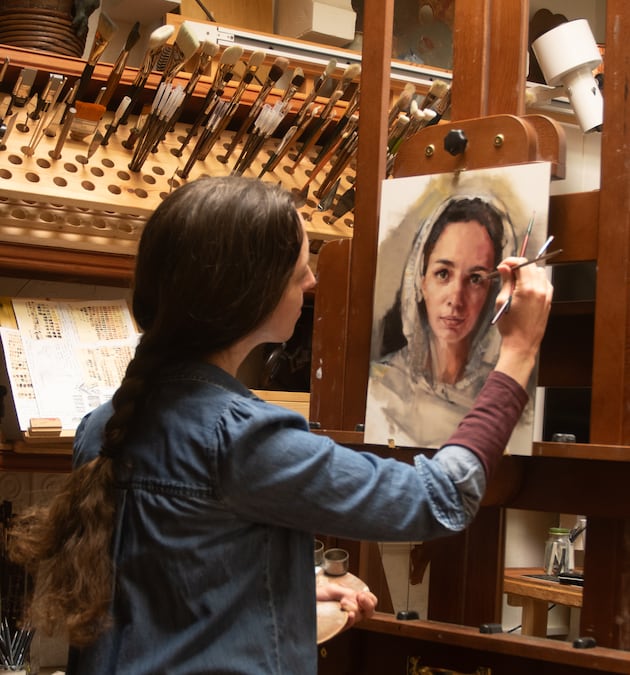
For the past 23 years, Elspeth Young has been painting women from the scriptures, many of whom appear in the Old Testament.
Through an art process that included hours of historical and cultural research, Young came to see each woman as a real human being, with challenges and emotions similar to those faced by people in the 21st century.
“I love telling that: Hannah is you. Hannah is me. Eve is you. Eve is me,” Young said. “For I believe that what the Lord wants us to feel about the scriptures is to feel that their story is our story and that their courage can be our courage.”
Young has been drawing since she was seven years old, but her journey to depicting women in the scriptures began in 2002 at Brigham Young University. There, she attended a presentation on women in scripture by Camille Fronck-Olson, former dean and professor emeritus of the BYU Department of Ancient Scripture.
During her talk, Olson said artistic talent should create more visual representations of lesser-known women in the Bible. Young said the invitation resonated with her.
“I really feel that the Spirit brought these words back to my heart because I think they were a message meant just for me,” she said.

By the end of that semester, Young mustered up the courage to approach Olson, asking for insight into her study of scripture in order to begin painting Old Testament women. Eventually, Young and Olson arranged a supervised study course, with Olson teaching Young to familiarize himself with the historical and linguistic aspects of the Bible.
Since then, Young has created numerous paintings of women in the scriptures, including illustrating Olson’s books Women of the Old Testament and Women of the New Testament.
Young said it was difficult to use Bible accounts to bring real people to life, but she saw the Lord guiding her as the people were depicted in her paintings.
“I can truly testify that the Lord loves us and always loves His children. Our generation is no different than the Old Testament,” Young said. “Our challenge is still exactly the same, and the challenge is to find the Savior, focus on the Savior, and enter into a covenant with the Savior.”

The value of a woman’s perspective
Mr. Olson, who holds a PhD in Middle Eastern sociology and a master’s degree in Ancient Near Eastern studies, spent many years immersed in the world of the Bible.
“The Old Testament is a completely different culture. It’s a different world. I think trying to make it similar to today’s world cheapens the message,” Olson said. “It gives us a new witness from another time in another culture, but the same gospel applies.”
She spoke about the value of reading the scriptures from different perspectives, including the perspective of women in Biblical times.

“If we can broaden our horizons and get different perspectives, we will see that there is more to the gospel and that it is much bigger, grander and more wonderful than we usually think,” she said. “Knowing how it affects different cultures and how it fits men and women only expands our love for God and our awe for what Jesus Christ has offered us. If we only see it through the eyes of a few people, our ability to understand it diminishes.”
Throughout her career, Olson has taught “Women in the Bible” institute courses at several universities. She said she has noticed more men taking the course in recent years, including young men who said the principles they learned in the class helped them better serve the sisters in their assigned wards.
On an episode of the Latter-day Saint Women Podcast, Olson said that one of the “amazing truths” found in the Old Testament is the power that comes from working collaboratively with others.

“The greatest achievements occur when men and women work together and appreciate each other’s contributions,” she said.
“The purpose of the Bible is to lead us to Jesus Christ. It is to bear witness to Jesus Christ. And the Bible tells us that we cannot do that without including the voices of men and women. Collectively and individually, they help us see Jesus Christ as our Savior and Redeemer.”
Stories to watch in 2026
As church members prepare to study the Old Testament as part of the 2026 “Come, Follow Me” curriculum, they can expect to learn about some of the women Olson and Young have come to love through their study. In fact, Olson says that of the more than 170 women who appear in the canonical books, the majority appear in the Bible.
“I think the women of the Old Testament normalize women’s participation in the work of God and the salvation of God’s children,” Olson said.

Olson said she has been thinking lately about the story of Rahab, who is described as a prostitute in the Old Testament. Rahab had a testimony of the Lord despite her lower-class status. In Joshua 2, she relayed it to the spies sent to Jericho by the prophet Joshua. Rahab hides and protects the spies in her home and asks them to save her and her family when the city is destroyed. The spies agreed, and Rahab and her family were the only ones to escape destruction in Joshua 6. Centuries later, Jesus Christ was born through Rahab’s lineage, as recorded in Matthew 1:5.
For Olson, Rahab’s story shows that good can come from imperfect people.
“The people of the Old Testament are imperfect, but it’s very easy to see that in them,” Olson says. “You see weaknesses, but it’s so refreshing to see God use people with weaknesses to do incredible things.”
The story of the widow whose oil was multiplied by the prophet Elisha sticks with Young.
In 2 Kings 4, Elisha invites the widow to bring him a vessel of oil, and he multiplies the oil and sells it to her. Young said it has been suggested that Elisha would have given more oil to the women if he had brought more vessels.

Young compared a vessel of oil to a personal spiritual preparation.
“For example, when I go to general conference, when I really prayerfully think and ask questions, the answers always come flooding in,” she explained. “But if I’m not paying enough attention, I may not receive all the messages the Lord wants me to receive.”
Kaylee Westhola, who took the “Women in the Bible” class at the Logan Institute of Religion in 2024, said she initially felt sad and even angry after learning about the many women in the scriptures. Because so many great women don’t seem to get the attention they deserve. Then she realized that many similar stories were happening around her.
“There are incredible modern women who are doing so much good and have so much to offer this world. We will never know all of their stories,” Westra said. “But God sees. He sees all our efforts. Through His Son, Jesus Christ, He knows us perfectly and is proud of our work, even when we are unknown or unknown to others.”
Making the Most of the Old Testament
To truly get the most out of the Old Testament, Olson advised church members to slow down, ask questions, and learn more than what is covered in Sunday school.

Ms. Young described the process she goes through before starting a new painting, and said this process can be adopted by anyone to enhance their enjoyment of scripture.
First, Young reads this story in as many translated Bibles as possible. She then reads what Biblical scholars, both inside and outside the church, have said on the subject. She also reads what Church leaders teach about this story in general conference talks and books. She concludes her research by studying archaeological discoveries related to the period and geological location of the paintings’ subjects.
Following these steps brings the scriptures to life for Young.
“I think it’s all about relevance, making sure that scripture is accessible and doesn’t feel like a foreign artifact that you don’t really know what to do with,” she said. “I think it’s much easier for us to actually go inside and learn from it and believe in the things that we can apply in our lives.”

