


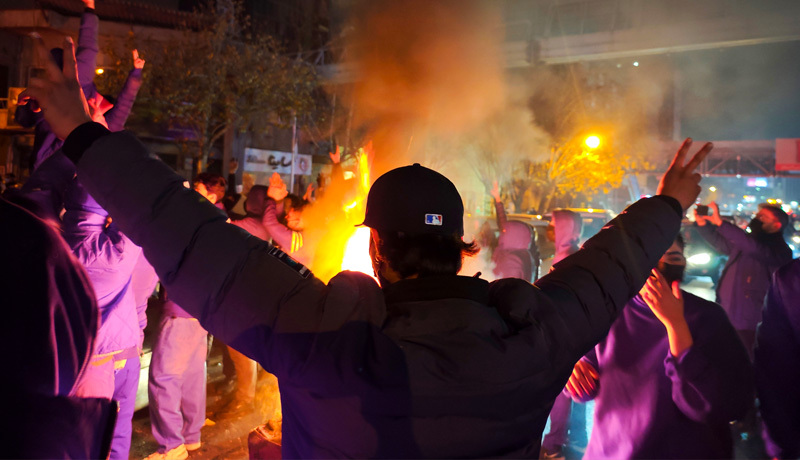
Over the past 20 years, the two most common prophecies I have heard in the worlds of geopolitics and faith are: “The communist government in Cuba will soon fall,” and “the rule of the Islamic clergy in Iran will definitely be wiped out by 2030, because everyone hates the clergy.”
But is this imminently about to happen in Iran, nearly a month after the country’s most extensive grassroots protests against its failed and ruthless clerical leadership’s appalling economic management began?
Perhaps, although social scientific insights seem to suggest otherwise.
Revolutions only succeed if they kick down rotten doors.
It is often said that revolutions only succeed if they kick down rotten doors. And while it is true that the Iranian regime is rotten to the core, revolution is about more than just kicking down a door.
The great Christian sociologist Jacques Ellul, in his book Anatomy of a Revolution, agrees that revolutions begin with “a people who felt that if the situation continued, they were bound to perish in some way,” which is consistent with what is happening in Iran today.
With nothing to lose but their lives, protesters turned their guns on them, killing thousands. The important thing is that the merchant class was the first to take to the streets. A 40% devaluation of the currency has crushed their chances of economic survival, and as a group they are not traditionally the first to protest.
Iran’s problem is a divided opposition with no plan.
But Ellul was careful to add that for the revolution to succeed, the rebels must plan to “change the fate that has led to repression.” He said that Spartacus was a rebel without a plan. His revolt was initially successful, but failed because “he had no concept of government or governance…his revolt introduced no new principles into Roman society.” Similarly, Iran’s problem is a fragmented opposition with no plan.
The latest analysis of the causes of success and failure of protests to overthrow unpopular and authoritarian regimes comes from scholars Stephen Levitsky and Lucan Way. In their 2022 book Revolution and Dictatorship, they argue that authoritarian governments can survive if society has the following three elements:
A cohesive ruling elite that sticks together even in times of crisis. strong and loyal coercive mechanisms, such as strong and loyal armies and police; A weak and divided opposition party is unable to actually mount any sustained political action against the government.
They conclude that “autocratic regimes that are able to create a united elite and a strong but obedient army and police while leaving opposition movements weak and fragmented are likely to be resilient.”
Most observers do not believe that we are about to witness the collapse of the Iranian regime.
This is why most observers do not believe that we are now about to witness the overthrow of the Iranian regime. The clerical elite seems tight and knows how to get the wagon around. The Islamic Revolutionary Guards Corps (IRGC) is a powerful and loyal organization that numbers one million people and has even submissively pointed its guns at protesters.
As for the protesters themselves, they do not constitute an organized movement. If all they can offer is the return of the 65-year-old son of the former shah (who is not a democrat and ran a horribly corrupt regime), this is a problem because he is far from a charismatic counter-revolutionary figure.
Can an intervention backed by the US and Israel make a difference? perhaps. They have four instruments, all of which are dull.
First, it could bomb key military targets and reduce the Revolutionary Guards’ ability to continue the massacre. Last June, 12 commanders of this unit were killed by a US bomb. Second, Starlink connections could be flooded across the country, allowing protesters to coordinate and circumvent internet blackouts. Third, cyberattacks can be launched, especially against surveillance technologies that disrupt protests. Fourth, it could provide weapons to warring Kurdish and Baluchi rebels.
No one wants a civil war after the regime collapses.
The problem, however, is that no one, especially other Middle Eastern powers such as Saudi Arabia and Turkey, wants a civil war after the regime collapses.
Even so, the trigger for the collapse of the government is full of mysteries. After all, no one predicted the fall of the Berlin Wall in 1989 and the subsequent collapse of the Soviet system in 1991. For that matter, few thought the shah would fall.
There is an infamous CIA memo dated August 1977, five months before the start of the revolution. “The Shah will remain an active participant in Iranian life until the 1980s…There will be no fundamental changes in Iranian political behavior in the near future.”
A mysterious trigger could include the Revolutionary Guards concluding that it is no longer willing to serve the clergy and suing for changes that would protect its vast economic interests. Or the Iranian military intervenes to stop the massacre of the people.
Importantly, information about the unity of the dominant clerical caste has always been vague, and there is ample evidence that the network of mosque mullahs that once supported Khomeini and extremist ex-president Mahmoud Ahmadinejad does not today bother to strengthen the regime.
In the last 100 years, there have been three major movements from Islam to Christianity.
But religiously, Iran has extraordinary importance on another level. In the past 100 years, there have been three major movements from Islam to Christianity. In Indonesia in the 1960s, more recently in non-Arab Algeria, and now in Iran, many Muslims believe that the Islamic revolution was a violation of a deeper Persian identity that should be restored.
Many are excited that this movement reaches hundreds of thousands, perhaps millions, of people. In particular, far more of the population than is conceivable can be said to be in a “post-Islamic” state, defined as “people born into Islam or converted to Islam who no longer believe in its fundamental truth claims.”
No one knows what will happen to society after the collapse of Iran’s clerical elite. It may not be a democracy, at least not in the short term, but it will be a democracy that was less enthusiastic about the previous administration’s deep funding of jihadist proxies around the world. That will be amazingly good news for people of all faiths, but it won’t be good news for everyone after 2026.
This kind of Islamic theocracy has no credibility in the 21st century world.
But even if the regime survives, it will remain a striking example that this type of Islamic theocracy has no credibility in the 21st century world. Because this type of Islamic theocracy cannot feed its people, provide basic stability and peace to its society, or take its place in the international world as a positive influence for good.
All it can offer is an oppressive, backward and ignorant version of the grand religion that once had so much to offer the world. Protesters chanted “mullahs go back to their mosques” and “the best clerics are dead clerics”.
No other country has experienced such a profound shift toward Islam in recent years. Shiite leaders around the wider world are perplexed and frustrated. They are usually quiet and apolitical in their stance, and some even consider Khomeini’s teaching that the “protection of jurists” should also apply to the political realm to be an apostate.
Iranian clerics have tied Islam too closely to the state.
As one Ayatollah in Iraq confessed: “Iran’s foolish clerics have tied Islam so closely to the state that the people feel they must reject the religion while rejecting an unpopular and incompetent regime. This is a disaster.”
“Post-Islam” has never had a bigger sponsor than today’s Iranian regime, with its grim-faced clerics and gun-toting guards. Whether it survives or disappears, millions of people will continue to find freedom from the yoke of Islamic extremism.
Originally published on Five4Faith Substack. Republished with permission.
Dr. Ronald McMillan has spent 40 years supporting persecuted people as a journalist, academic and activist. He co-founded News Network International, the world’s first news agency focused on religious conflicts, and in 2006 wrote the definitive book on persecution, Faith That Endures: The Essential Guide to the Persecuted Church. He is currently the president of a public speaking class company that enables leaders to change the world for the better through their words, and is also the president and global analyst of the International Religious Freedom Institute, the world’s first think tank focused on religious freedom. He is based in the UK.
The International Institute for Religious Freedom (IIRF) was founded in 2005 with the mission of promoting religious freedom of all faiths from an academic perspective. IIRF aims to be an authoritative voice on religious freedom. These go beyond anecdotal evidence to provide reliable and unbiased data on religious freedom to enhance academic research on the topic and inform public policy at all levels. IIRF research findings are disseminated through the International Journal of Religious Freedom and other publications. IIRF’s particular focus is to encourage the study of religious freedom in higher education institutions by integrating religious freedom into the educational curriculum and supporting graduate student research projects.
