


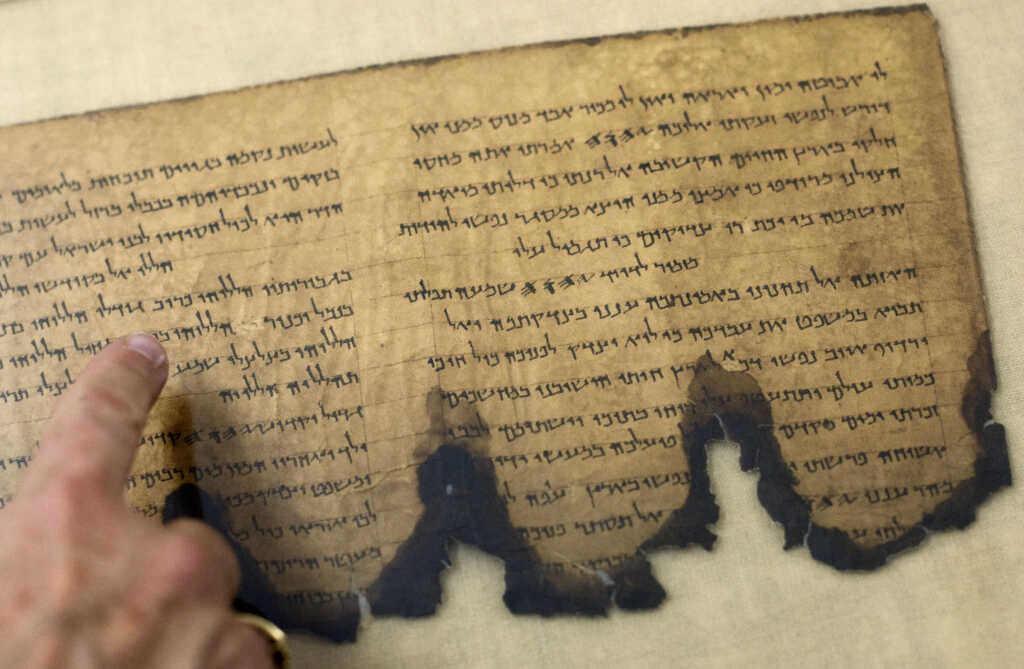
Dr. Bobby Duke, chief curator at the Museum of the Bible in Washington, D.C., previews a new exhibit coming to the museum in November: a powerful exploration of the Dead Sea Scrolls.
Listen to the latest episode of “Quick Start” 👇
Duke spoke to CBN News about the importance of the Bible manuscripts and why this discovery revolutionized our understanding of the Bible.
“Before 1947, our best Hebrew manuscripts were from about 1,000 AD,” he said. “And when the first cave was discovered at Qumran in 1947, it scraped away 1,000 years of manuscript transmission and showed us what the Hebrew Bible was like, what the scrolls were like in the time of Jesus and his disciples.”
This scroll was discovered by chance in the 1940s, and the discovery changed the understanding of the original Bible text.
“In late 1946 or early 1947, Bedouin teenagers were tending goats and sheep near the ancient settlement of Qumran, located on the northwest shore of the Dead Sea in what is now known as the West Bank,” History reported. “One of the young shepherds threw a stone into an opening in the side of the cliff, and was surprised to hear a crashing sound.”
Inside the cave was a clay jar filled with scrolls. Other scrolls were subsequently discovered in additional caves nearby, and all Old Testament books except Esther were among the finds. The dates on the scrolls prove that the texts were well preserved over a long period of time.
Duke, a Bible expert, said his personal study of the Dead Sea Scrolls has given him “more confidence in the Bible,” especially regarding the importance of the English translations that many people read today.
“The English translations we read today give us the sense that they are based on great manuscripts that date back to New Testament times,” he said.
Duke said visitors to the Museum of the Bible will have the opportunity to explore the Dead Sea Scrolls as part of a 75th anniversary tour organized by the Israel Antiquities Authority. In addition to the scroll fragments, people will also see other elements of Jerusalem.
“It’s going to have a piece of wood from what’s called the Jesus Boat,” Duke said. “This is a first-century boat, likely very similar to the boats that Jesus and his disciples would have used on the Sea of Galilee. And one of the real highlights is the Magdalene Stone, which was discovered for the first time on the East Coast at the site of Magdala, the home of Mary Magdalene.”
There are other highlights as well. It’s a piece of the archaeological puzzle that helps people better understand the Bible and the early church.
“This scroll gives us a clue as to how dynamic society was 2,000 years ago,” Duke said. “We sometimes think of the Sadducees and the Pharisees, but there were much more groups than that, and even this group at Qumran was probably the Essenes of Josephus. We see this dynamic, and it was in that world that Jesus and his disciples were spreading the news of the coming of the Messiah.”
The enormous influence of the Dead Sea Scrolls in particular was not lost on Duke, who said the Book of Isaiah was one of the most influential documents.
“This big scroll…contains the entire book of Isaiah, all 66 chapters,” Duke said. “But I often zoom in on the first column. Isaiah 1:17 talks about things like caring for orphans and widows.”
“That message written by Isaiah in the eighth century, found in the Dead Sea Scrolls 2,000 years ago, is a message we still have today. So if you think about it, even the Christian practice of doing good in this world can be found in the Dead Sea Scrolls 2,000 years ago, just as we can read it in the Bible today.”
Dead Sea Scrolls: The exhibition opens on November 22, 2025 and runs until September 7, 2026.
As the number of voices facing censorship from big tech companies continues to grow, sign up for FaithWire’s daily newsletter and download the CBN News app developed by our parent company to get the latest news from a distinctly Christian perspective.
