


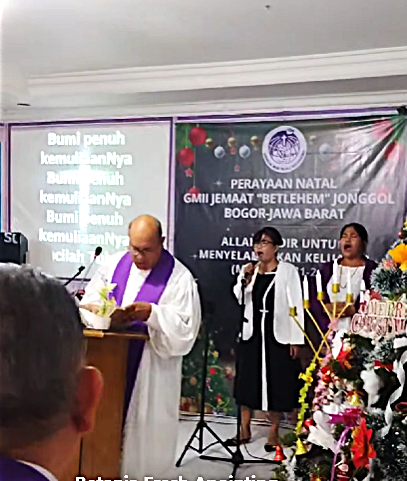
Officials say an Indonesian pastor announced on Christmas Eve that he would cancel Christmas services despite pressure from local Muslims, even though the church had received approval to hold celebrations.
The Christmas Eve and Christmas Day services of the 70-member Indonesian Evangelical Missionary Church (Geleja Misi Indjiri Indonesia, GMII) went ahead as scheduled in the village of Sukashirna in Jongor District, Bogor Regency, West Java province, despite the pastor’s announcement, which only served to calm the anger of Islamists.
On December 24, Pastor Irianto Budi was invited to a gathering organized by a Muslim organization made up of local government and religious leaders.
During the meeting, organizers said Christmas services in churches should be prohibited due to the possibility of attacks from outside Islamic hardliners, but they did not provide information about the nature of the expected attack or the identity of the assailants.
“We were asked to refrain from Christmas celebrations due to possible attacks from outside and from hard-liners,” Pastor Irianto told Morning Star News. “Therefore, they asked us to refrain from worshiping on December 31, 2026 and January 1, 2026. But Sundays are allowed.”
However, the ban was met with opposition in public statements from local religious leaders, including representatives of large Islamic organizations such as Muhammadiyah and Nahdlatul Ulama (NU) in the Jongor region. Nahdlatul Ulama is the largest Islamic cultural organization in Indonesia with approximately 150 million members, while Muhammadiyah is the second largest organization with approximately 60 million members.
“Our Muslim brothers and sisters came to support us,” Pastor Irianto said. “This proves that the spirit of religious unity and brotherhood of Indonesians remains strong. We are not afraid of threats against us because God and the spirit of unity of our Muslim friends strengthen us.”
Pastor Irianto said the opposing Muslim groups did not expect support from larger Islamic organizations.
“They certainly did not expect that the Christmas celebrations would take place with such extraordinary support from our fellow believers and the authorities.” “Those who opposed the actions of the intolerant group condemned the actions of the intolerant group, spread information on social media, and received great criticism from the public.”
Faced with an unexpected reaction, opposing Islamic groups forced Pastor Irianto Budi on December 24 to say that the church had agreed with village officials, security officials and the local Indonesian Ulema Council to refrain from holding Christmas services.
“I was definitely under pressure in the video, so I tried to be less emotional and get my message across in a slightly more diplomatic way,” he said, according to Wartapenariau.com. “I don’t want to say I was forced, but I was asked to deliver it. I intentionally used kind words in the video.”
Pastor Irianto said the spirit of religious solidarity remained strong among believers of different religions.
“Our Muslim brothers and sisters came to support us,” he said. “This proves that the spirit of religious unity and brotherhood of Indonesians remains strong. We are not afraid of threats against us because God and the spirit of unity of our Muslim friends strengthen us.”
He added that his congregation frequently faces pressure and threats from Muslim groups.
a letter to the wrong address
Pastor Irianto said the conflict likely began after he sent a letter to the Suka Silna police chief on Dec. 24 asking for the safety of his congregation, which he said is common when Indonesia’s ethnic minorities hold large religious events.
“We have experienced social pressure and threats,” he says.
However, he said two church messengers instead delivered the letter to the nearest Skasilna village hall, in the hope that it would be forwarded to the appropriate police the same day.
“Apparently, this letter was published by an irresponsible person who disseminated information about Christmas celebrations to the residents of Jongol village,” Pastor Irianto said.
He said the person who leaked the letter and Muslim groups opposed to Christian worship later held a meeting attended by security officials, village officials and members of the local Indonesian Ulema Council. During the meeting, Pastor Irianto admitted that he was under pressure to cancel the services scheduled for Christmas Eve and Christmas Day.
Then the news of the ban on the service spread widely. Contrary to the expectations of the Muslim opposition, local interfaith communities, including Muslim groups, condemned the pressure.
“Those who opposed the actions of the intolerant groups condemned the actions of the intolerant groups, spread information on social media, and received great criticism from the public,” Pastor Irianto said.
Rights group Indonesian Movement for All (PIS) said the pastor’s talks with Islamic opponents and officials lacked transparent legal mechanisms, court rulings, and alternative state solutions for believers. The group argued that the case was a constitutional issue, not just an administrative one.
“The 1945 Constitution explicitly guarantees all citizens the freedom to practice religion and worship,” the group said. “Neither village officials nor security authorities have the authority to prohibit individuals from visiting the shrine.”
The Indonesian Union for the Defense of Religion and Worship called on the Ministry of Religious Affairs to assist in intervention and resolution of the conflict.
Pastor Irianto said that following the community’s reaction, the village head of Skasilna met with him on the afternoon of December 24 and assured him that the Christmas celebrations would be held safely. Police met with him on Saturday (December 27) and assured him that all religious events, especially New Year and Lunar New Year events, would be closely monitored.
“The police chief has promised to strictly ensure New Year’s prayers,” the pastor said.
According to Open Doors, Indonesian society has taken on a more conservative Islamic character in recent years, putting evangelistic churches at risk of becoming targets for Islamic extremist groups.
