


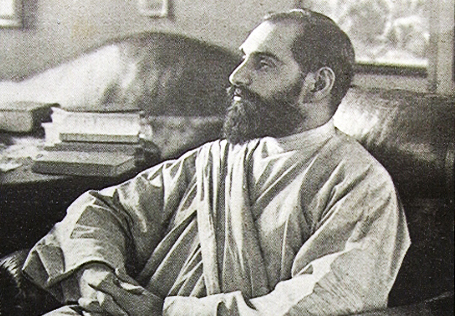
Sadhu Sundar Singh, a barefoot Indian evangelist who remembers bridged Indian spirituality with Christian disciples, continues to speak in relation to churches around the world almost a century after his death. It was the central message of a two-day international webinar when scholars and church leaders from various regions of the world revisited his theological heritage and what it offers to Christians today.
The online gathering, held from September 5-6, organized by the Sadhusundarsing Global Forum, in collaboration with the Indian Evangelical Fellowship, Caleb Church, Caleb Institute, Asian Church Missionaries Association and Indian Church Historical Society, attracted participants from India, Asia, Europe and Africa.
This was the second international webinar following the first gathering in 2022. The procedure is a reflection on Sadhusundarshin’s mission, theology and spirituality, edited by Vinod Victor and Samuel Richmond Saxena and published by ISPCK and Asia CMS.
The presenter emphasized that Singh’s life resists simple classification. He was a mystic who insisted on the vision of Christ and Angels, but he was not lost in the Bible. It is a still-worldly travelling ascetic who abandoned his possessions, a contextual theologian who wore the gospel in Indian form without diluting its content.
Singh’s life agreed that when churches around the world struggled with consumerism, interfaith tensions, ecological crisis, and credibility issues. His ascetic lifestyle, inter-fiction engagement, and Christ-centric devotion were offered not as curiosity of the past, but as a living challenge of the church today.
Born in 1889 to a Sikh family in Punjab, Singh experienced the vision of Christ at the age of 16, which changed the course of his life. Rejecting both the wealth of his family and the Western Christian trap, he adopted the Sadhu saffron robe and moved barefoot across India to Tibet. He often disappeared and prayed to the Himalayas for several weeks, returning with parables and visions that combined biblical imagery with the rhythm of Indian storytelling. His writings were translated into multiple languages, and after his trip in the early 1920s he became a famous figure in England and continental Europe. He disappeared during his journey to Tibet in 1929, but his memory lives on through stories, prayer writings, and the communities in which he influenced him.
The webinar began by positioning Sing in the context of Singh. The Punjabi man was deeply shaped by Sikh and Hindu traditions who believed Christianity was a real Indian. “The Indians don’t want doctrine. We’re tired of it. We need a living Christ,” Singh said, a line that once appeared repeatedly in the presentation. For participants, this statement crystallized his role. He is not a theologian of the system, but a theologian of life, and he argued that Christ can be known for his way of resonating with Indian culture.
Contextual disciples and credibility
Much of the discussion focused on examples of Singh’s contextual disciples. He believed that Indian Christians should not abandon their cultural identity, but follow Christ in a way familiar to their people. His choice to live as a sadhu was not a mimicry of Hindu ascetics, but the assertion that Christian disciples could take the form of India.
This belief remains a challenge today, especially in societies where Christianity is still considered foreign. The speaker emphasized that Singh’s life demonstrates how contextualization is strengthened, rather than weakening church witnesses. His radical simplicity, rejection of possessions, and his kind lifestyle were described as a critique of not only colonial patterns but also of the gospel of prosperity and consumer culture. “His life is a challenge to sermons today’s prosperity,” observed one participant.
At the same time, scholars were careful not to idealize him. Several people noted that Singh had not directly addressed the issue of caste suppression or gender injustice. One presenter warned that “a spirituality without justice risks escapism.” They said the challenge was to extend Sin’s Christ-centric devotion to his involvement with the structural issues that shape society today. Thus, his witnesses can be supplemented by a stronger prophetic voice.
Singh’s ministry also emphasizes the power of storytelling and embodied faith. His parables were often drawn from village life and nature, allowing access to the gospel without abstraction. His story, still remembered in Punjab, shows how faith, passed down in familiar forms, can remain faithful and transformative.
Mysticism that leads to missions
Another theme was Shin’s mystical spirituality. The description of his visions of Christ, Angels and the heavenly realm has made him famous and is controversial in several circles. However, the presenter argued that Singh’s mysticism was never a fugitive. Rather, it was the well of his mission. “He prayed in the cave, but with love he returned to the village,” one speaker said, emphasizing the integration of contemplation and service.
His long retreat in the Himalayas produced experiences interpreted through the lens of the Biblical, often in silence and loneliness. He presented them not as a Bible alternative, but as a confirmation. His writings, such as visions of the spiritual world, presented Christ-centered mysticism, which resonated far beyond India.
Modern scholars have drawn creative similarities between Singh’s mystical experiences and modern psychology. One paper compares his spiritual life with the hierarchy of Abraham Maslow’s needs, suggesting that Singh embodied both personal wholeness and deep fellowship with God. This argued that mature spirituality demonstrates the integration of emotional health with dedication.
Singh’s example opposes two distortions. It is a mission to forget about spirituality and prayer that is retreating from the world. His life combines both to show that intimacy with Christ burns into society.
The cost of the cross and the disciple
The speaker also revisited Singh’s theology of suffering. His barefoot traveled through the rough terrain, and family refusal and persecution shaped the vision of his disciple, characterized by endurance. He understood suffering not as a failure, but as a way of the cross.
Several papers highlighted this “cross-shaped” life as a victory or a remedy of consumer Christianity. Singh’s vulnerable willingness, living without protection or wealth, and facing rejection was in contrast to modern approaches that equated faith with success. One scholar suggested that Singh’s example is particularly relevant to younger generations looking for authenticity.
Singh’s perspective also resonates with persecuted Christians in India and elsewhere. By accepting suffering as essential to witnesses, he provided a framework of endurance to avoid despair. His joy in the midst of difficulties continues to encourage followers who are facing pressure on their faith.
Authority, Bible, “Water of Life”
The role of authority in mystical traditions was another subject of discussion. Singh cherished his vision, but he insisted that the Bible remains the final measure. He described Christ as the “water of life.” This is a phrase that frequently appears in webinars, claiming that true mystical experiences must flow from him and point him to him.
This balance was described as the key to Singh’s reliability. Unlike some mystics who present their vision as independent authority, Singh eradicated everything in Christ and the Bible. “He combined the mystical ideas of India with the waters of Christ’s theology of life,” one paper explained. For today’s churches, to navigate various spiritual expressions, his example provides a model: openness to experience, but fixed on Bible witnesses.
Participants suggested that this had global significance. In a pluralistic society where spirituality is often privatized or separated from tradition, Singh’s Christ-centered mysticism shows that experience is both authentic and accountable.
Nature as God’s first book
The ecological spirituality also attracted a lot of attention. Singh frequently used images from nature in his teachings, not only as illustrations but also as theological truths, including rivers, birds, mountains, flowers. He testified his creation alongside God’s “first book,” the Bible.
One paper argued that Singh lived an ecological disciple before the term of office existed. His ascetic lifestyle, which is nothing more than a robe, staff, and the New Testament, was described as a model of materialism criticism and sustainable living. His respect for nature reflected the perception that creation took part in God’s purpose.
In an age of climate change, the presenter proposed that Singh’s ecological spirituality provides resources to the church. It reminds Christians that care for creation is not an option, but is essential to disciples. His life provides examples of simplicity and respect that can inspire the ecological practices of the Church today.
Bhakti’s dedication and Indian roots
Finally, the webinar examined the location of Singh in the Indian prayer tradition. His prayers, poetry and visions reflect the Hindu and Sikh prayer movements that emphasize Bhakti’s spirit, and love for God. Singh reoriented this spirit towards Christ, showing the continuity between Indian spirituality and Christian disciples.
By adopting familiar languages and forms, Singh showed that the Gospel fulfilled the spiritual longing of India, not foreigners. He often said that the water of life was provided on the “West Ship” when it was to be presented in the “Eastern Bowl.” For scholars and pastors, this continues to challenge how the church thinks about contextual theology in its environment.
The speaker concluded that Singh’s witnesses will bring lessons not only for India but for the whole world. His simplicity criticizes consumerism. His cross-shaped disciple challenges comfortable Christianity. His mysticism provides depth without separation. His ecological vision speaks to today’s environmental crisis. And his dedication shows that faith is genuinely rooted in local culture without losing universal truth.
One participant said, “Singh was mystical yet missionary, contextual yet universal, personal and prophetic.”
The webinar served as a reaffirmation that remains a relevant voice in modern Christianity almost a century after he disappeared into the Himalayas. His life continues to remind the church that the gospel is not a doctrine that is defended by the Lord, but a life to live.
The next prominent group of church leaders, scholars and practitioners spoke during a two-day webinar. The first speech was given by Pastor PK Samantaloi with greetings from Rev. Vijaish Lal, Rev. Shivraj K. Mahendra, Rev. Jang Nam Chen, Rev. and Rev. Howell. Rev. Kayleem John and Archbishop Rowan Williams (video). Pastor Joseph Masi shared the vision for the Sadhu Sundar Singh Global Forum. Keynote speaker, Rev. Raymond Larsen, set the tone for the session moderated by Rev. Lana Khan, Rev. Samuel Richmond, Rev. Sho John, Rev. Pratek Pirarai, Rev. Albert Lalamzau and Rev. Sunil Caleb. Presenters include Mrs. Samalpita Patra, Dr. Plack Samantaloi, Rev. Rijure Zoe Alfred, Rev. Richard Howell, Rev. Ash Choker, Ranjit Choudhary, Gadda Diviya, Dr. Jai Knox, Dr. Binodo Peter Senapati, Anthony, Rev. Ram Pal and Dr. Ivan Satyabrata. The event ended with a closing address by Rev. Michael Beale, a reflection from Rev. Joseph Masi, and a thank you vote by Rev. Vinod Victor. The prayers were provided by Dr. Limassangra Lemthur, Bishop Patrick Augustine.
