


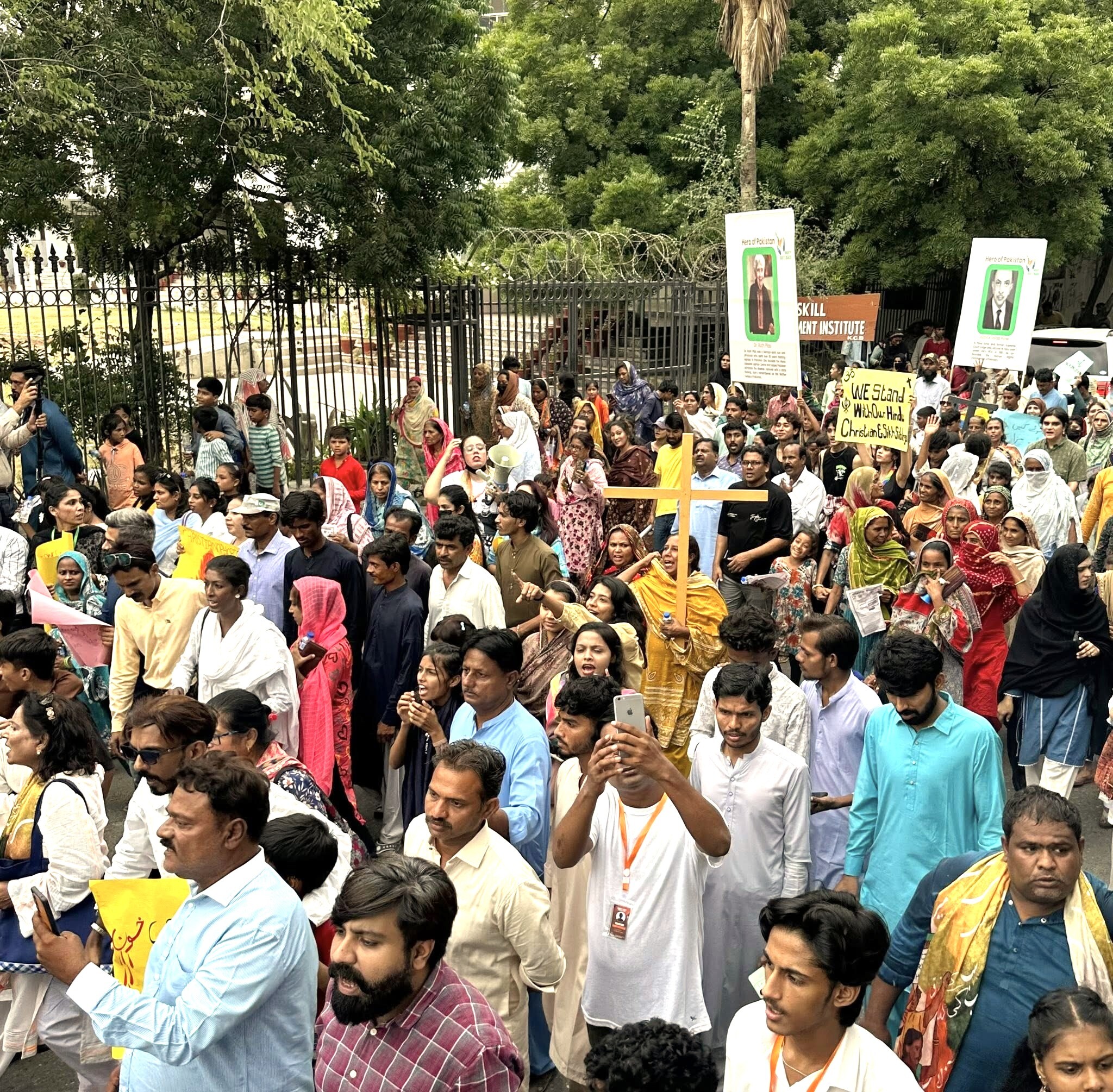
Human rights activists have called on the European Union to investigate widespread human rights violations in Pakistan, including the persecution of religious minorities, ahead of an investigation from Monday (24 November) by the main EU delegation monitoring Pakistan’s eligibility for preferential trade terms.
The EU mission will regularly assess Pakistan’s implementation of 27 UN conventions related to GSP+, which reduces or eliminates tariffs on exports of award-winning countries to the EU in return for pursuing “sustainable development and good governance”.
With this status, governments must implement 27 international conventions on human rights, labor rights, good governance, and the environment. Pakistan has benefited from GSP+ status since 2014 and has seen a 108% increase in textile exports to the EU due to reduced or zero tariffs.
The EU delegation plans to meet with government agencies, civil society, human rights organizations, workers and the private sector. The inspection mission was originally scheduled for June but was postponed due to the Iran-Israel conflict.
“The government of Pakistan has not fully fulfilled its constitutional responsibility to protect the fundamental rights of the people of Pakistan as guaranteed by Pakistan’s constitution and protected by international treaties and protocols,” said Akmal Bhatti, chairman of the Pakistan Minority Alliance (MAP).
Bhatti, the High Court lawyer, said religious minorities, particularly Christians, continue to suffer from religious discrimination and systemic hatred in Pakistan.
“The blasphemy law continues to be abused and the main perpetrators of false accusations are colluding with state institutions,” Batty told Christian Daily International. “Clear evidence of this sinister nexus was exposed during proceedings conducted in the Islamabad High Court by Justice Sardar Ijaz Ishaq. The judge directed the government to set up a judicial commission for a fair and transparent investigation, but the verdict was stayed by the High Court’s Appellate Bench. It is the federal government’s first duty to investigate these cases, and the international community must monitor its progress.”
Sociopolitical leaders also criticized the government’s inaction against those involved in the August 2023 attacks on several churches and Christian homes in Jaranwala Town, Faisalabad Division, Punjab.
“While the government has now imposed a ban on the militant group Tehreek-e-Labbaik Pakistan (TLP) and launched a crackdown on its leaders, it has failed to arrest the TLP leaders who led the violent attack on Christians in Jaranwala, including the group’s local chief named in at least two cases related to the incident,” he added.
Similarly, the Punjab government failed to pass a law criminalizing child marriage despite introducing it in Parliament in April 2024, he said.
“We have been demanding the enactment of a law criminalizing forced conversion and raising the marriageable age for boys and girls to 18 to curb false conversions, but the Punjab government remains silent on this issue as the reasons for this are unknown to the people,” he said. “The EU delegation must ask questions about the status of the bill when it meets with government leaders.”
Among other issues, he said EU delegations should also consider demands to recognize religious minorities’ constitutional right to elect their own representatives.
“We have also called for the removal of constitutional restrictions on non-Muslims being elected president or prime minister,” he said. “If all citizens are equal in terms of the constitution and law, this restriction on non-Muslims must be abolished.”
Pakistan Masih Millat Party leader Aslam Pervaiz Sahotra also echoed Bhatti’s concerns about the situation of minorities in Pakistan.
“There has been no improvement in the human rights situation in Pakistan and, in fact, it has only worsened over the years,” Sahotra told Christian Daily International.
He rejected the government’s claims that the situation of minorities had improved.
“Continuing to expand trade interests despite continuing rights violations sends a dangerous message that economic interests outweigh human rights,” Sahotra said. “The EU must ensure that its trade policy upholds its core values of accountability, rule of law and justice for Pakistan’s persecuted minorities.”
In an interview with Dawn News this week, EU Ambassador to Pakistan Raimundas Karoblis said Pakistan needs to push harder on its international commitments to maintain its eligibility for the GSP+ preferential trading system.
He said the EU panel will examine Pakistan’s compliance in areas such as human rights, protection of minorities, capital punishment, blasphemy laws, enforced disappearances, women’s rights, child labor and forced labor.
Regarding enforced disappearances, the Ambassador said that this issue remained a priority concern for the EU. He confirmed the establishment of a committee to investigate such cases, but said the committee would assess whether existing mechanisms are adequate.
Although Pakistan’s GSP+ status was extended until 2027 in October 2023, the next monitoring cycle is expected to impact Pakistan’s re-application under the new regime, which will take effect in 2027. According to a 2022 report by the Ministry of Commerce, Pakistan enjoys duty-free or minimum tariffs on exports to the European Union, including apparel, home textiles, and surgical instruments, among others, in exchange for implementation of 27 treaties. Ministry.
Export earnings to the EU rose to $3.17 billion in the July-October period, up from $3 billion in the same month last year, according to figures released by the State Bank of Pakistan on Monday (17 November).
The EU monitors countries granted GSP+ status to ensure that they continue to comply with and effectively implement international treaties. Countries must also comply with reporting requirements and accept regular monitoring in accordance with the Convention.
Countries hold conferences on the implementation of the 27 Conventions and public reports are submitted to Brussels for review every two years.
According to the EU’s GSP Convention Compliance Database, Pakistan has ratified 27 international conventions, most recently the International Covenant on Civil and Political Rights (1976) and the Convention against Torture and Other Cruel, Inhuman or Degrading Treatment or Punishment (1987) in 2010.
Regarding EU surveillance of Pakistan, the agency prioritized 13 key areas. Prevention of torture. the death penalty; freedom of expression and religion, and minority rights. Violence against women, transgender people, and minorities. Right to Information. Labor inspector. Freedom of association and the right to collective bargaining. Child labor and forced labor. Combating climate change and environmental degradation. fight against corruption. Drug management. And report.
