


August 7, 2025, 5:45pm MDT
When Joseph Smith and others stood near independence in Jackson County, Missouri, he received a revelation that became doctrine and contract.
“This is the promised land, the place of the city of Zion. And… the place now known as Independence is the centre. And the temple location lies west, not far from the court.”
Alex Beau, a BYU professor of Church History, said the Prophet approached Jones H. Fullnoy, a local landowner and businessman who was an early Jackson County resident who acquired the property in 1826, with the help of Edward Partridge, the church’s first bishop.
They purchased the property, and Joseph dedicated the temple grounds on August 3, 1831.
Two bricks from the structure of Furunoy’s property (from his home, the other from the original foundation of a nearby trading post) are one of five historical items from an early church in Missouri, donated by Latter-day Saint Historian R. jean Adams to the Church History Department of Latter-day Saint Jesus Christ on Thursday, August 7th.
“The (Trading Post) bricks are important artefacts, not just because they came from the trading posts that Partridge used until the saint was expelled from Jackson County in 1833,” Beau said. “But perhaps more importantly, the trading post was the first, although it was actually a small building “owned” by the church. ”
Elder Kyle S. McKay, 70 presidents, who serve as historians and recorders of the church and as executive director of the church history department, thanked the church for their contributions.
Elder McKay said these artifacts, records and history have an inclusive purpose.
“When you look at them, you somehow look and find Jesus Christ and hope that how he works in places represented by those bricks,” he said. “This is all about bringing us to Christ, and I hope we can do that.”

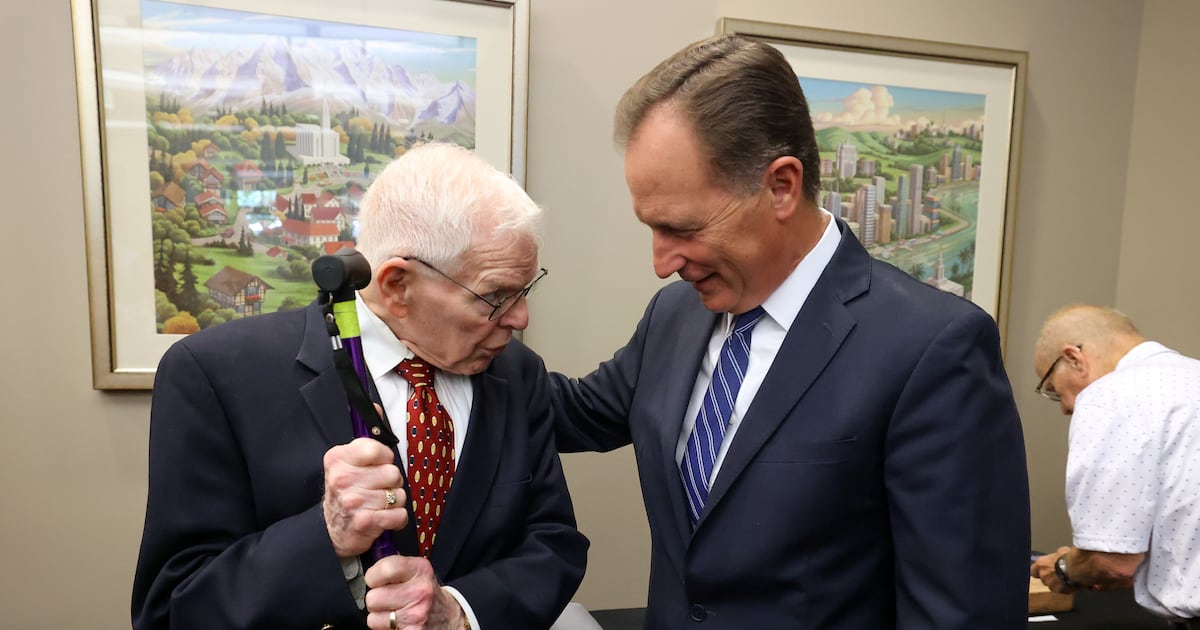
Adams’ donations were made in a room full of family, friends and acquaintances at the church’s history library.
Adams, who joined the church in 1958, was not a trained historian, but for the past 20 years he has built a passion for history by attending conferences between the Mormon Historical Society and the John Whitmer Historical Society. He presented articles with other people of faith and built the bridge, Beau said.
In addition to the two historic bricks, Adams donated the original bronze mold used to produce historic markers for independent embedded bronze walkways. A massive, bound amount of history related to communications of the Church’s Central Nation Mission from 1934 to 1948. A Mormon book printed in 1948 by Zion printing and publishing.

“This volume is unique in that it has a lot of variance from other editions of the Book of Mormon,” Beau said.
Adams, who turned 83 in September, expressed his gratitude and said it would make a great deal of sense to donate these items, which he has owned for 10 to 15 years. He knew that one day he would donate to the church.
“I am grateful to my many blessings and to the association that I was able to make with our friends who are so kind and kind in search of knowledge,” he said.

“Missouri will always be an important focus of our theology and history,” Beau said. “One day, the Savior will come back to Zion, not far from the courthouse in Jackson County, Missouri. And it will be a glorious day. So, the future for Missouri is still in the future, and it is great to think about the importance of this wonderful place.
The program was run by Richard E. Turley Jr., who previously served as an assistant church historian.

“The church relies on generous donors to help fulfill the commandments to keep the church records,” he said. “Jean’s contributions will help bridge the gaps in the records and enable future generations to better understand Missouri’s sacred past and future.”
Alan Morell, an artifact curator for the Church History Department, said items like donated provide “the power to connect with the past.”
“To consider these to be witnesses to history,” he said. “Preserving these concrete things can lead to that history. If you lose the story of an artifact, you lose the meaning of that artifact.”


