


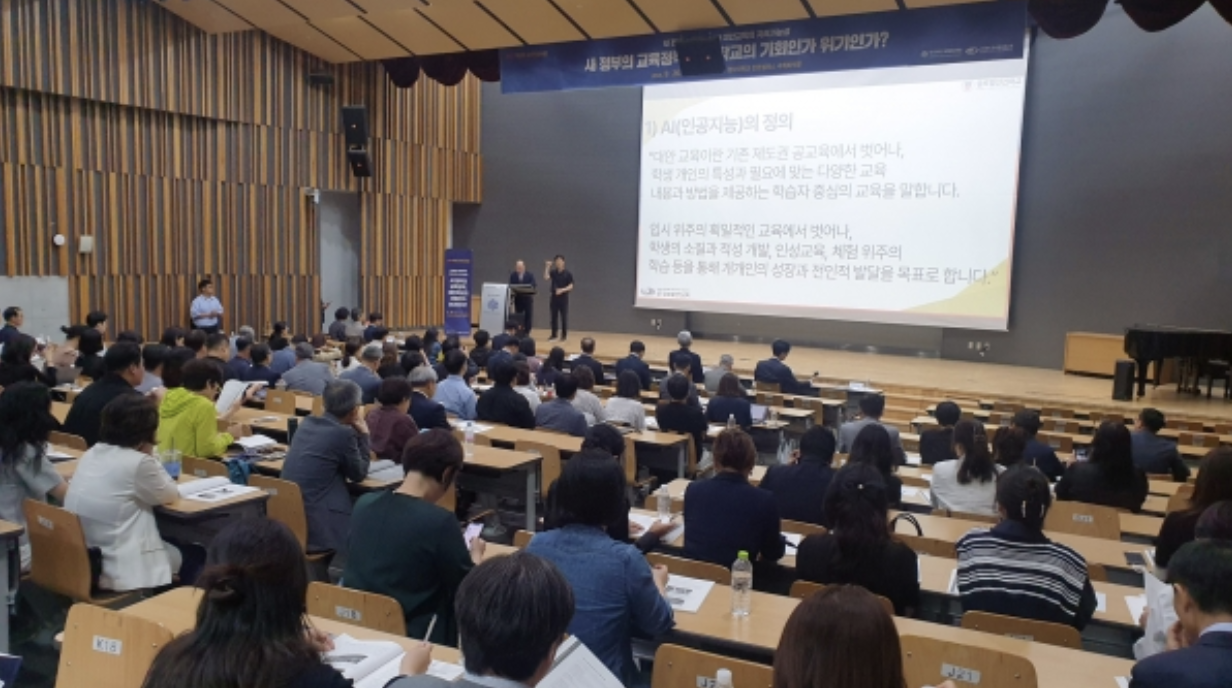
Korean education leaders met on September 26 to discuss ways to maintain alternative schools and highlight the need for stable financial support while maintaining the school’s unique identity.
The 3rd Education Mission Forum, held at Miyano University in Seoul, was organized by the University’s Education Mission Centre and the Global Vision Christian School under the theme of “New Government Education Policy and Sustainability of Alternative Education,” according to a report by Christian Daily Korea.
Alternative schools, often founded by Christian groups, operate outside the mainstream public system and aim to provide education tailored to the individual needs of students. The Christian community, which first introduced and supported modern education in Korea, plays an important role in the movement and continues to implement “Christian education” through many alternative schools.
Despite recent legal awareness, participants said challenges remained, including unclear funding and restrictions on accreditation and registration.
Professor Ham Seung-Soo of the Graduate School of Education at Myongji University, who leads the Education Mission Centre, said the legal framework has secured the status of alternative education as part of the public system and laid the foundation for its operation. However, he said, “After legalization, the open issues remain, including unclear financial support and practical constraints on accreditation and registration. A specific and systematic support policy is required.”
Ham said the most pressing task is to ensure long-term sustainability through financial measures. He highlighted the proposed education voucher system as a practical solution, allowing institutions to maintain autonomy while ensuring stable funding. Vouchers are given directly to students, which allow students to use to attend alternative schools and channel financial support through parental choice.
“Alternative education leaders see the voucher system as an important policy that ensures sustainability, provides parents and students with more learning options, and preserves the school’s unique educational identity,” Ham said. He added that voucher-based support differs from direct state funding, allowing schools to remain independent while increasing stability.
The forum also featured keynote speeches from Nam Jin Sok, founder of Global Vision Christian School. The presentation and responses were given by Dream School principal Lee In Hee. Jang Han-Seop, Principal of Story School and Adjunct Professor at Chongshin University. Lee Eun-Sil, professor at Handong Global University.
The opening remarks were made by President Lim Yeon-Su of Myongji University. Rev. Kim Joseph, chairman of Yonggan Christian School and director of the Miyano Education Foundation, provided words of encouragement, and Congressman Cho Jung-Gu-hoon of People Power Party, a member of the National Assembly Board of Education, gave a congratulatory speech.
“Diversity in education is not a choice, it’s a responsibility,” Cho said. “If only one path is imposed, society will stagnate and the possibilities for children will be narrowed. Alternative education is a creative experiment, a public good that enriches society while complementing public education.”
He added that when alternative education becomes a central pillar of Korean education rather than a “special option,” children can learn freely and grow responsibly.
