


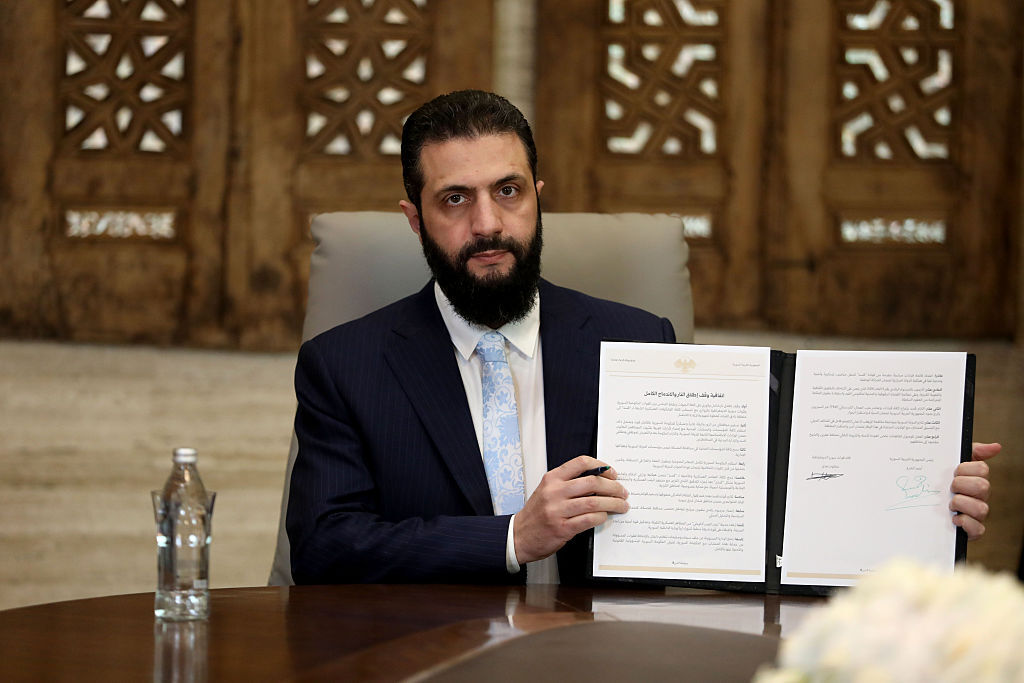
Syria has announced an immediate nationwide ceasefire with the Kurdish-led Syrian Democratic Forces (SDF), ending nearly two weeks of conflict despite concerns from Christians and other minorities that the deal will do little to allay fears of continued persecution and instability.
Syrian state media said the ceasefire was part of a broader 14-point agreement that would see the SDF integrated into Syria’s military and security structure. President Ahmed al-Sharah said the deal would allow Damascus to reassert control over the northeastern and eastern provinces of al-Hasakah, Deir Ezzor and Raqqa, which account for much of the country’s oil and gas resources. According to the BBC, the agreement follows a meeting in Damascus between al-Shallah and the US special envoy for Syria, Tom Barrack, who described it as a step towards a “united Syria”.
Under the agreement, Syrian authorities will take over control of civilian facilities, border crossings and energy facilities previously controlled by the SDF. SDF personnel will be vetted and integrated into Syria’s defense and interior ministries, and Damascus will be responsible for prisons and camps housing tens of thousands of foreign Islamic State fighters and their families.
The agreement also renews commitments to recognize Kurdish cultural and linguistic rights, including granting the Kurdish language official language status and recognizing the Kurdish New Year as a national holiday. According to the BBC, this is the first formal recognition of such rights since Syria gained independence in 1946.
SDF commander Mazloum Abdi confirmed the agreement in comments broadcast on Kurdish television, saying the ceasefire was aimed at preventing a widespread war and that the recent fighting had been “imposed” on his forces. Abdi said he would explain the agreement to the Kurdish community upon his return from Damascus. Kurdish media reported that he emphasized the SDF’s commitment to preserving what he described as the gains in Kurdish autonomy established during the Syrian civil war, when the United States helped fight Islamic State.
While international reports have highlighted the ceasefire as a stabilizing step, Christian Syrian Kurdish refugees living in Europe told Christian Daily International that the deal does little to ease fears among the minority, which has faced escalating violence since the regime change.
“I have long been afraid of Syrian minorities, more precisely the various components of Syrian society: Kurds, Alawites, Druze and Christians,” said the refugee, speaking anonymously for security reasons. “Over the past year, we have witnessed a wave of genocidal violence against these groups.”
The refugees cited attacks on Alawite communities on the Syrian coast, violence against Druze in southern Syria, explosions at churches in Damascus, and more recently attacks on Kurdish areas. He said celebrations marking the anniversary of what authorities called “Syria’s liberation” had heightened fears, with armed fighters chanting Quranic verses and making threats linked to the Islamic State group.
“There was no message of inclusion or protection for minorities, only a dream of an Islamic state,” he said, adding that videos showed fighters aligned with the new authorities wearing ISIS insignia and committing abuses reminiscent of the group’s atrocities in 2015.
The refugees also warned of security risks arising from the transfer of control of detention facilities previously held by the Self-Defense Forces. He said new authorities recently took over a prison in Raqqa that is holding about 5,000 ISIS prisoners captured since 2015, raising concerns about possible releases and a resurgence of the militants.
“Such a development would put all non-Muslims, and even many Muslims, at grave risk,” he said.
He pointed to discussions in Germany about the return of Syrian refugees and diplomatic engagement with the new leadership, and criticized simplistic reports in some European media that portray Syria as safe.
“As a Kurd and a recent convert from Islam to Christianity, I can never return to Syria,” he said. “Even if I knew, I would always be at risk if the government knew my identity or my beliefs.”
The refugee acknowledged what he described as cautiously positive signals in the cease-fire agreement, including promises to recognize the rights of the Kurdish language and protect Kurdish culture, but said such commitments had not yet been proven. “These are still just promises and we are still waiting for real changes on the ground,” he said.
As reported by Christian Daily International, concerns about the safety of Christians in Syria are consistent with the findings of a recent Open Doors survey, which ranked Syria 6th on the 2026 World Watch List, published on January 14th. Syria moved up from 18th place last year due to a sharp rise in violence against Christians, with the country’s violence score jumping from 7 out of 16.7 to 16.1.
Open Doors has announced that Syria’s overall persecution score has risen to a record high of 90 points, due to killings, attacks on churches and forced closures of Christian facilities. The organization estimates that there are about 300,000 Christians left in the country, hundreds of thousands fewer than a decade ago, leaving communities increasingly vulnerable without reliable state protection.
The group said at least 27 Christians were killed for their faith during the reporting period, noting that the real number was probably much higher. In June 2025, a suicide bombing attributed to an Islamic State cell at the Mar Elias Greek Orthodox Church in Damascus killed 22 worshipers and injured dozens more, prompting many Christians to scale back their public religious activities.
After the fall of Bashar al-Assad’s regime in December 2024, Syria’s interim constitutional framework concentrated power in the president and established Islamic jurisprudence as the main source of legislation, according to Open Doors. The group warned that political divisions and growing Islamist influence continue to put Christians and other minorities under intense pressure.
“All we can do is pray,” the Christian refugee said, referring to the Bible’s account of Saul’s transfiguration in Damascus. “It means that just as God changed Saul’s life in Damascus, he may change this new ‘Saul’ in Damascus today.”
