


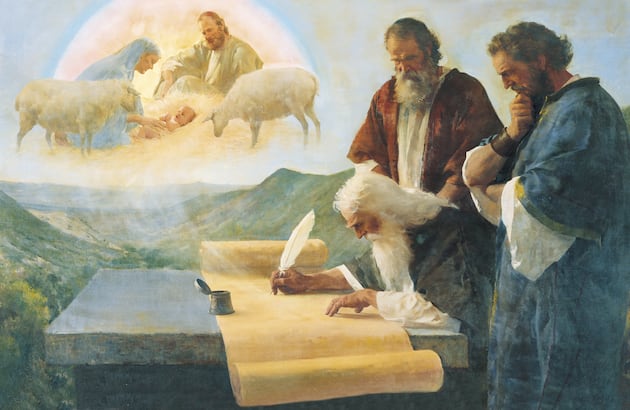
I don’t know if there is just one “favorite Old Testament story.” Because that book of the Bible is filled with writings and teachings that have meaning and memories for me at different times in my life.
For example, the account of Elisha and his bald head and she-bear in 2 Kings 2:23-24 always puts a smile on my face because my children laughed at the outrageousness of the story (one of my sons later ended up painting this account, and I think I still have it hanging on my office door).
The stories of Creation and the Garden of Eden continue to be profound in their importance, both in understanding the nature of God’s work and in my own spiritual growth.
Still, if I had to choose, I would probably choose Isaiah 7-8. These chapters detail Isaiah’s interaction with King Ahaz of Judah. This story is placed in the historical context of the so-called Syro-Ephraimite conflict, which itself relates to the larger context of the Neo-Assyrian Empire and its expansion into the Levant. Assyria’s strength was such that no small nation could withstand the Assyrian onslaught on its own, and so they believed that their survival depended on creating a confederation to match Assyria’s power.
According to the Biblical accounts in 2 Kings and 2 Chronicles, one such confederation, the kingdoms of Syria and northern Israel, led by Rezin and Pekah, respectively, attacked Judah under Ahaz, perhaps with the intention of installing a new king willing to join the confederation. This is where Isaiah’s account begins.
Isaiah chapter 7
Isaiah 7 begins with Ahaz being informed that “Syria is in league with Ephraim,” which caused him and the “heart of the people” to tremble and tremble “as the trees of a tree are moved by the wind” (v. 2). To deal with this crisis, the Lord tells Isaiah to take his son Sialjashub to meet Ahaz “at the end of the channel of the Upper Pool on the highway of the field of Hurrah” (v. 3). Unfortunately, the exact location of Jerusalem is unknown, but wherever it was, when Isaiah got there with his son, he gave the following prophetic advice: “Be careful and be still; do not be afraid, and do not be fainthearted” (v. 4). Of course, the threat of Syria and Israel was envisioned in the background, but what I think is important is how applicable that teaching is today.
Like ancient Judah, we are often overwhelmed by crises that seem insurmountable and inevitable. But if we “pay attention, be quiet, (and) fearless,” our challenges may prove to be less formidable than they seem.
Like Syria and Israel, which the prophet called “brands of fire that breathe fire” (v. 4), these situations may be more like smoke than fire. However, it can be difficult to tell the difference between the two. This is where teaching comes into play. To “pay attention” means to carefully observe, perceive, and even discern, all of which can be strengthened by the Spirit, who James says “says things as they are, and as they really will be” (James 4:13).

In the context of Isaiah 7, it would have been comforting for Ahaz to realize how small the threat from Syria and Israel actually was compared to the “smoke” they emanated. Similarly, we can all receive God’s perspective and see the big picture and recognize the long game to put challenges in proper perspective.
By doing so, you can have peace, or “quietness”. Although it is less clear in English, the original Hebrew for “be still” is in the causative rather than the passive voice, and can be translated as “be still” or “find rest,” and this can be done by truly discerning one’s situation in relation to God’s will.
Regarding God’s command to “do not be afraid,” throughout the Old Testament we often find this command immediately followed by a promise that God knows and will watch over and care for the individual. In Isaiah 7, God promises Ahaz that Rezin and Pekah’s plans “will not stand and will not come to pass” (v. 7). Similarly, we are promised that we need not fear because God is with us.
Of course, trusting such promises is not always the easiest, especially if you do not know when the promise will be fulfilled. Although Ahaz was told that the threat would end within “thirty-five years and five years” (Isaiah 7:8), the Lord apparently knew that this would not address Ahaz’s immediate concerns. So, to give him a reason to trust God, God told Ahaz that he could ask “in the depths or in the heights” for signs that would prove that God’s promises were fulfilled (v. 11).
In this respect one will be able to recognize the principles of faith. Faith is very often understood as a lack of knowledge. But faith may be better understood as the knowledge that God will fulfill His promises because He has fulfilled them in the past. In other words, the “sign” would have immediately let Ahaz know that God was with him and would have enabled him to trust God for what He said He would do. In the same way, we often receive our own signs, tender mercies, that reveal that God is still with us, even if His promises have not yet been fully realized.
Unfortunately, Ahaz did not accept God’s offer, so God instead gave him a sign of his own: “Behold, the virgin shall conceive and bear a son, and shall call his name Immanuel. . . . Before you know that he rejects evil and chooses good, the land you hate will be deserted by both her kings” (verses 14, 16).
Most Bible readers are familiar with the fulfillment of this prophecy in the New Testament, and Matthew interprets the birth of Christ to Mary through these passages. But it also seems to have been intended to be a modern-day prophecy against Ahaz (Hebrew for “virgin” and simply a “young woman” of marriageable age). From this point of view, Ahaz was told that within his lifetime a child would be born, and within the first ten years of that child’s life, the kings of both countries who had caused the trouble would be gone. The child’s name, Immanuel, means “God with us” and emphasizes how God’s signs show promise. The importance of a child is best understood through the name of the next child.
Isaiah chapter 8
Isaiah 8 begins with God revealing to Isaiah the name Maher Shalal Hash Baz. This means something like “The plunder is swift, the spoil is hasty” and is clearly a reference to the imminent threat of Assyria. “Father and mother, before the child comes to knowledge, the riches of Damascus and the spoils of Samaria will be taken before the king of Assyria” (verse 4).
Although this account clearly refers to the more pressing problems of Syria and Israel, it is also said that because Judah did not “keep quiet” (kept quiet?) and “rejoiced” at the destruction of Rezin and Pekah, the Assyrians would invade Judah like a flood: “The waters of the river are strong and many, even the king of Assyria…will pass through Judah, and he will cross over in flood” (verse). 6-8). And just like in previous crises, God promised that if Judah would trust in Him, He would be there for them.

A few verses later, the Lord tells Isaiah that he and his sons have been given “from the Lord of hosts for signs and wonders in Israel” (v. 18). Indeed, Isaiah’s prophetic responsibility blessed Israel, but the reference to “sons” suggests that Isaiah’s sons may be identified by all three names, and that the name itself may function as a full prophetic promise.
In other words, all three names can be read as part of a prophecy. Starting from the youngest, we might read “Maher shalal hash baz,” or “bad things may happen and happen quickly,” but we might also read “immanuel” (“God is with us”), or “shere jashub.” Often forgotten given the importance of his younger sons, the name of Isaiah’s firstborn son may be the most important. It is a simple but profound promise of salvation: “A remnant will return.”
God’s promise, reflected in the names of Isaiah’s sons, is as true today as it was in the 8th century B.C. We all have fires and floods to face. Sometimes they are unexpected. Sometimes we, like Ahaz, involve them ourselves. And sometimes it’s hard to tell the difference between flame and smoke. But in such cases, we may know that God is with us, and by putting our trust in Him, we may know that salvation is near and will come. So, in light of this promise, all we have to learn is how to “be careful, be quiet, (and) be fearless.”
― Dan Belknap is a professor of ancient scripture at Brigham Young University.
