


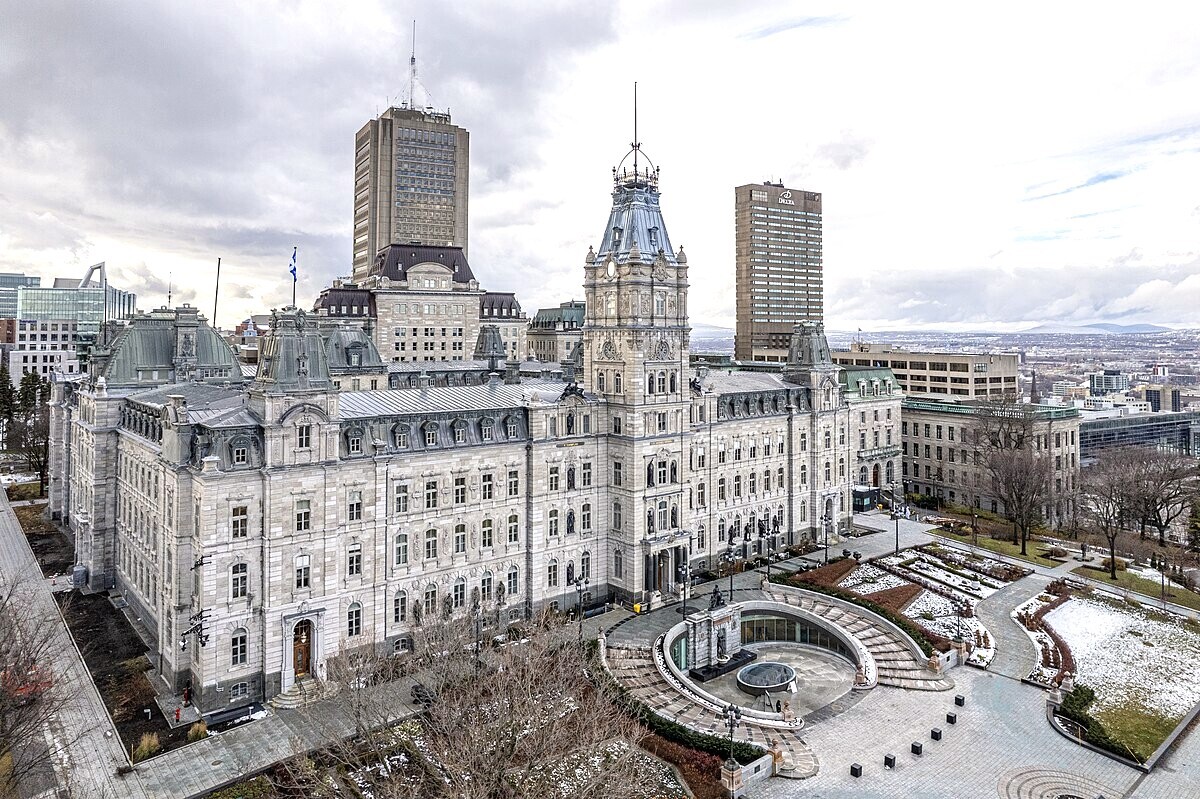
A proposed ban on all religious practices in certain public places and institutions in the Canadian province of Quebec reflects an escalation of religious repression, Christian rights groups say.
The Christian Legal Fellowship (CLF) claimed in a Dec. 2 press statement that Bill 9 “intensifies the legal repression of religion in cities in the name of laïcité (secularism).”
The bill, titled “Bill Strengthening Lay People in Quebec” and introduced in the provincial parliament on Nov. 27, “deeply troubles” the CLF, the group said, saying the ban on religious activities also includes universities.
The bill broadly defines religious practice as any act that “may reasonably constitute, in fact or in appearance, a religious belief or expression of belief,” including prayer. The only exception allowed is the wearing of religious symbols, which is already prohibited under other laws.
The bill expands on the state’s ban on religious symbols by Bill 21 in 2019 and Bill 94, which was signed into law on Oct. 30. The CLF said it prohibits “collective religious practices” in public parks and on public sidewalks and sidewalks without prior municipal permission.
The CLF said the ban could affect university prayer rooms, adding that the ban “appears to go further.” The group said the bill would appear to prohibit students from gathering anywhere on college campuses to pray, worship or even study the Bible, with some limited exceptions.
Quebec’s Minister of Secularism, Jean-François Roberge, introduced the bill and reportedly said at a press conference on Nov. 27 that Quebecers want a change in the law to close university prayer rooms.
“CEGEP (General and Professional Colleges) and universities are not temples or churches or places like that,” Roberge said.
The bill allows exceptions in some circumstances for rented space, subject to government regulations, but the government has not yet announced this. CLF noted that the bill only allows for this exception if the organization “does not directly or indirectly fund religious practices.”
“CLF is concerned that this rule unfairly targets religious students and limits their campus activities solely on the basis of their religious affiliation,” CLF said.
Bill 9’s blanket ban on collective religious practices in public parks, public sidewalks, and sidewalks is a “drastic measure,” CLF said. The only exception is if we obtain prior permission from the city council on a “case by case” basis. Still, the CLF stressed that certain restrictions apply, including the “short-term” nature of religious practice.
“This provision appears to potentially prohibit two or more co-religionists from carrying out any kind of religious activity together on sidewalks or in parks, which may include evangelism, outdoor worship and prayers, and the distribution of religious literature, without prior permission from the municipality,” the CLC said.
The bill would also extend the state’s ban on religious symbols to employees of daycare centers and subsidized private schools. Under the bill, school service centers cannot be used for religious activities such as “public prayer,” and it would be illegal for churches to rent school buildings for worship.
Another concern about Bill 9 is the repeal of Quebec’s long-standing freedom of worship law. This law provides legal protection for worshipers to enjoy worship without discrimination.
According to CLF, Bill 9 would revoke the accreditation of private Christian schools.
“This appears to cover all religious schools,” CLF said. “While Bill 9 does not in any way negate the existence of such religious schools, the lack of accreditation and funding risks harming these institutions and their ability to operate, especially if they have received such funding in the past.”
According to the CLF, the proposed ban on public religious activities drew widespread criticism.
“CLF is deeply concerned that this bill would unfairly censor certain types of public expression and outdoor gatherings for no other reason than the fact that they are religious,” CLF said. “These types of laws date back to the mid-1900s, when certain provinces and municipalities sought to restrict missionary activities. The Supreme Court of Canada at the time ruled that such restrictions were ultraviral (beyond the authority of municipalities and provinces).”
The CLF expressed concern that other laws reflected the decline of religious rights in the state to establish “laïcité,” a concept of secularism in the state. It began with Bill 21 of 2019, which “enshrines” the “paramount of the province’s faith in Quebec’s legal order.”
“Since Bill 21 was enacted in 2019, the state has continued to expand its scope,” the CLC said. “Bill 94 now requires ‘any person’ providing ‘services’ to students in an educational setting to refrain from wearing religious symbols.”
The Quebec Constitution Act of 2025 on October 9 strengthened the push for secularism over religious rights. It claims that the law is the “rule of law” and that it “takes precedence over any conflicting rule of law.” It also touts laïcité as Quebec’s “founding idea” and “fundamental characteristic,” the CLF said.
CLF Executive Director and General Counsel Derek Ross said the concept of laïcité “purports to promote religious neutrality, but it promotes the exact opposite: it promotes a public square that is not neutral but closed to religion and, by extension, to those who openly hold it.”
Even more worrying is Bill 94, which was approved on October 30th and prohibits students and others from engaging in “religious acts, such as public prayers and other similar acts” on public elementary and high school grounds. CLF filed a legal challenge, but new legislation halted this.
The CLF pledged to continue to advocate for the legal right of individuals to religious rights in public life.
“These proposed laws represent a marked departure from the constitutional national religion framework articulated by the Supreme Court of Canada, which prohibits the categorical exclusion or disadvantage of religion, and represent an embrace of insular secularism that effectively facilitates the activities and expression of non-believers in public spaces and institutions and excludes individuals who profess their faith,” the CLC said.
