


In a landmark move to protect children, especially girls, from forced child marriage, Pakistan’s provincial parliaments on Friday (November 14) passed a bill against child marriage.
The Balochistan Child Marriage Restriction Act, 2025 sets the legal age of marriage in Balochistan at 18 years and introduces severe penalties for those involved in child marriage. The governor is expected to sign the bill this week.
Under the law, adult men who enter into child marriages and those who facilitate them face two to three years in prison and fines of 100,000 to 200,000 Pakistani rupees ($353 to $707). If the fine is not paid, the court may impose an additional three months’ imprisonment.
Those who solemnize marriages, known as nikah hawans, along with the nikah registrar and union council secretary, will be legally required to verify the Computerized National Identity Card (CNIC) of both parties before solemnizing the marriage. Failure to do so is a criminal offense, punishable by up to one year in prison and a fine of up to 100,000 Pakistani Rupees (US$353).
All offenses under the Act are cognizable, non-bailable and non-compoundable. This means police may act without a warrant, bail cannot be easily granted, and cases cannot be resolved privately. Only first-class judicial judges can try crimes.
The law also declares child marriage invalid if the minor is abducted, sold, seduced, forced, or trafficked for marriage or immoral purposes. Children born in such a marriage are considered legitimate and their upbringing is the responsibility of the father.
The law defines a child as anyone under the age of 18 and declares all child marriage illegal. Also, in some situations we declare it void ab initio, that is, void from the beginning. This law repeals all conflicting laws in force throughout the state.
The law officially repeals the colonial-era Child Marriage Restriction Act of 1929 in Balochistan, but ongoing litigation under the old law will continue until its conclusion. Under the new law, state governments will have to come up with detailed rules within six months.
“Un-Islamic”
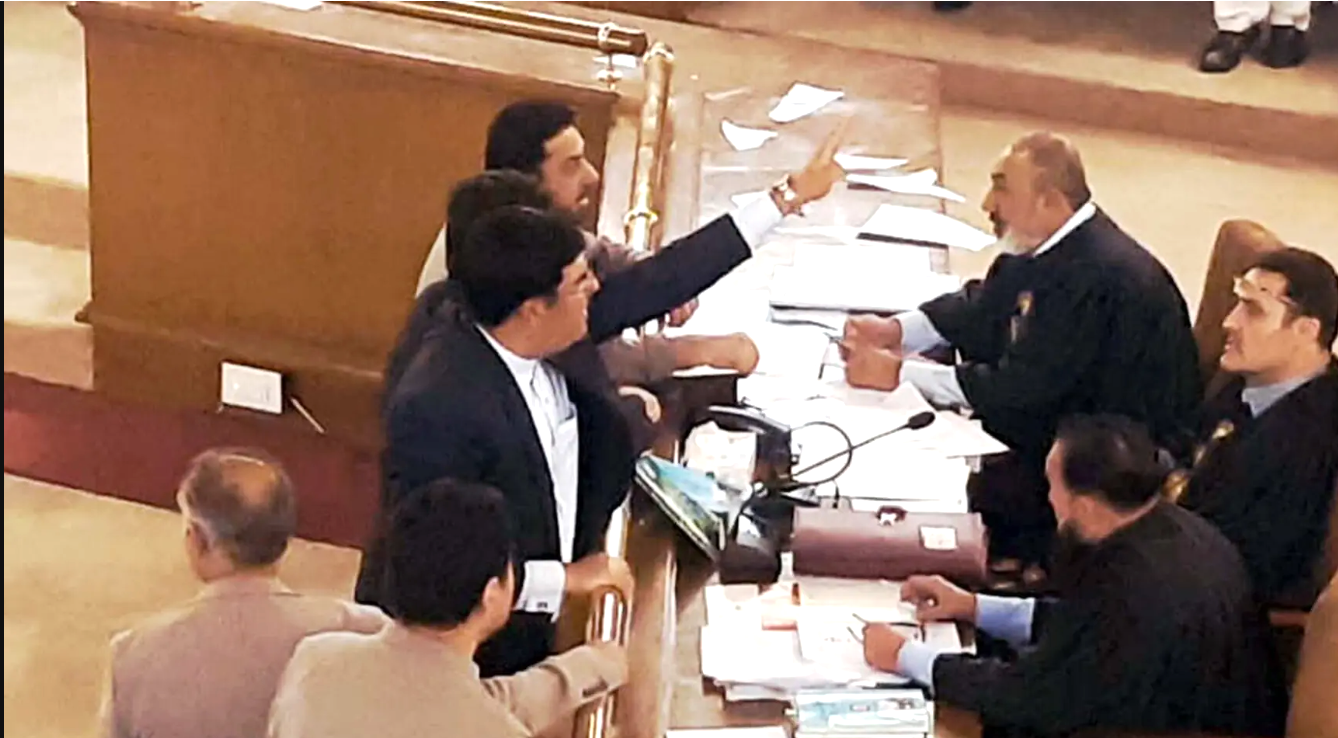
The introduction and passage of the bill sparked heated scenes in the state parliament, with opposition members shouting slogans and creating a commotion. Amid the chaos, opposition lawmakers surrounded the speaker’s chair and tore up copies of the bill, claiming it violated Islamic law.
Opposition leader Yunus Aziz Zehri, speaking on the floor of the House of Representatives, criticized the bill and reiterated that his party, Jamiat Ulema-e-Islam-Fazl (JUI-F), will not support any law that it deems to be in violation of Islamic teachings.
“This law was passed solely to please non-governmental organizations,” he said.
Opposition lawmaker Asghar Tareen said that although the bill had been passed, the opposition intends to challenge it in court. Following the protests, opposition members went on strike, shouting slogans against the newly adopted bill.
Balochistan Chief Minister Sarfraz Bugti told the media after the bill was passed that a majority of parliamentarians supported it, reflecting the strength of the democratic process. He pointed out that the bill had been scrutinized by relevant parliamentary committees over the past six months and approved by the Cabinet before being submitted for a vote.
“While disagreements are an essential feature of democracy, laws are always enacted with the best interests of the people in mind,” Bagti said.
new law praised
UNICEF and human rights activists praised the bill and called for similar legislation to be enacted in the remaining two provinces, Punjab and Khyber Pakhtunkhwa, where marriage of 16-year-old girls is allowed based on customary or Islamic practices.
Sindh province raised the minimum age of marriage for both men and women to 18 for the first time in 2013 in a bid to curb child marriage in the province.
In a Facebook post, UNICEF Pakistan said, “We congratulate the Balochistan Parliament and all the tireless champions who made this possible: women parliamentarians, civil society champions, and partners whose leadership and commitment drove this historic change. This milestone is about more than just passing laws, it protects children’s rights, protects childhoods, and helps build a safer, healthier and more hopeful future #ForEveryChild.”
Ejaz Alam Augustine, a Christian member of the Punjab Assembly, said he hoped the passage of the child marriage ban bill would help pave the way for a similar bill in Punjab, which has been pending approval since April 2024.
“This law is critical to protecting underage Christian girls from the scourge of forced conversion, as perpetrators exploit religion to kidnap and marry underage girls,” Augustine told Christian Daily International Morningstar News.
On May 19, Pakistan’s parliament passed a major bill aimed at raising the legal age of marriage for men and women to 18, with the aim of curbing, preventing and ultimately eradicating child marriage in the federal capital, Islamabad.
The bill, which has been pending in the Punjab Assembly since April 25, 2024, aims to raise the legal age of marriage for men and women in the state to 18 years. Until the bill is approved, the minimum age for marriage for girls will remain 16. Nationally, the Christian Marriage (Amendment) Act 2024 sets the marriageable age at 18 for Christians only. If girls convert to Islam, they are considered Muslim and are subject to sharia (Islamic law), which allows them to marry young.
Advocacy groups say girls abducted in Pakistan, usually as young as 10, are forced to convert to Islam under the cover of Islamic “marriage,” raped, and then pressured to record false statements in favor of their kidnappers. Judges routinely ignore documentary evidence regarding children’s ages and hand them over to kidnappers as “legal wives.”
Pakistan, where 96 percent of the population is Muslim, was ranked eighth on Open Doors’ 2025 World Watch List as the most difficult place to be a Christian.
