


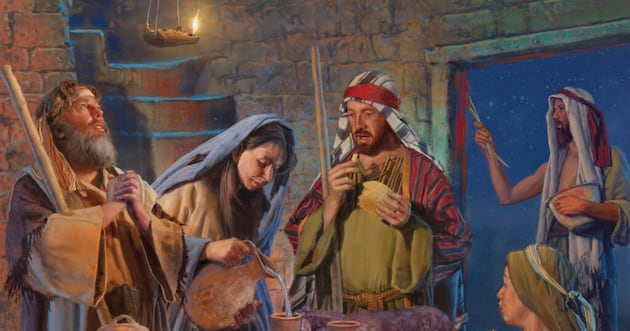
This week’s Come, Follow Me study guide covers Exodus chapters 7 through 13, including the origins of the Passover tradition.
Below are quotes from past and present leaders and scholars of The Church of Jesus Christ of Latter-day Saints regarding these chapters of the Bible.
passover festival
“Let us resolve to never forget what Christ endured to redeem us, and let us never lose the overwhelming joy we once again feel at Easter as we contemplate his victory over the grave and the universal gift of resurrection.
“On the eve of the trial and crucifixion that awaited him, Jesus joined his apostles in the Passover meal. At the end of this last supper, in the sacred intercessory prayer, Jesus petitioned the Father with these words: ‘Holy Father, keep your own name (my apostles), which you have given me, that they may be one as we are’ (John 17:11).
“Then the Savior graciously expanded His petition to include all believers.
“I pray not only for them, but also for them who will believe in me through their word.
“‘That they may be one in us, even as you, Father, are in me, and I in you'” (John 17:20-21).
— President D. Todd Christofferson (then member of the Quorum of the Twelve Apostles), April 2023 General Conference, “One in Christ”
“This week, as we study Exodus chapters 7 through 13, we learn how the Lord delivered the children of Israel from centuries of Egyptian captivity. We read about the nine plagues that Pharaoh witnessed, nine impressive manifestations of God’s power. Pharaoh witnessed them without softening his heart.
“Then the Lord spoke to the prophet Moses about the tenth plague and how each household in Israel could prepare for it. As part of a ritual called the Passover, the Israelites were to sacrifice a male lamb without blemish. They were then to mark the doorframes of their houses with the lamb’s blood. The Lord promised that every house that was marked with that blood would be protected from the terrible pestilence that was to come.”
“The Bible says, ‘The children of Israel did as the Lord commanded Moses’ (Exodus 12:28). There is great power in this simple statement of obedience.”
“Because the children of Israel followed the counsel of Moses and acted in faith, they were saved from the plague and eventually released from captivity.
“So what has the Holy Spirit taught me in these chapters this week? Here are some thoughts that have stuck with me.
“The Lord works through prophets to protect and save His people. “Faith and humility in following the prophets preceded miracles of protection and deliverance. The blood on the door frame was an outward sign of inward faith in Jesus Christ, the Lamb of God.”
— Brother Mark L. Pace, then Sunday School General President, April 2022 General Conference “Conversion is Our Goal”
“By voluntarily taking on the sins of all mankind, being brutally nailed to the cross, and triumphantly overcoming death on the third day, Jesus gave a more divine meaning to the Passover ordinance given to ancient Israel (see Exodus 12-13). In fulfillment, Jesus offered His body and His precious blood in a great final sacrifice, justifying the traditional symbols used in the celebration of the Lord’s Passover. In doing so, He experienced physical and spiritual suffering that is incomprehensible to the human mind.
“Jesus was the only one who could make this eternal and perfect sacrifice for all of us.”
— Elder Ulises Soares of the Quorum of the Twelve Apostles, April 2021 General Conference “Jesus Christ: Caretaker of Our Souls”
“Also, let’s briefly recall what Passover means. Passover reminds us that the children of Israel were delivered from 400 years of bondage. The Book of Exodus tells us that this deliverance included a plague of frogs, lice, and flies, dead cattle, boils, brains, and flies.” It describes how after fire, locusts, and deep darkness, the last plague threatened death not to the house of Israel, but to the firstborn of the land: the blood of the firstborn lamb without blemish was on the door lintel (see Exodus 7-12).
“The Angel of Death passed in front of a house marked with the symbolic blood of the Lamb (see Exodus 12:23). Its passing, or passing, represents Jesus Christ’s final victory over death. In fact, the atoning blood of the Lamb of God gives our Good Shepherd the power to gather his people from all places and situations into folds of safety on either side of the veil.”
— Elder Gerrit W. Gong of the Quorum of the Twelve Apostles, April 2020 general conference, “Hosanna and Hallelujah—The Living Jesus Christ: The Center of the Restoration and Easter”
“After receiving the commission from the Lord, Moses returned to Egypt to lead the children of Israel out of captivity. Plague after plague failed to secure their freedom, leading to the tenth and final plague. “For this night I will pass through the land of Egypt, and I will kill all the firstborn in the land of Egypt” (Exodus 12:12).
“To protect themselves from the ‘destroyer’ (v. 23), the Lord instructed the people to sacrifice a lamb ‘without blemish’ (v. 5) and collect the blood from the sacrifice. They were to ‘take the blood’ and put it on the entrance to each house, on the ‘two sideposts and…on the upper doorpost’ (v. 7)” (v. 7). The following promises were made: I will not destroy you” (verse 13).
“‘The children of Israel departed and did as the Lord had commanded them’ (verse 28). They offered sacrifices and gathered blood and smeared it on their houses. ‘And at midnight the Lord slew all the firstborn in the land of Egypt’ (verse 29). Moses and his people were kept according to the Lord’s promise.
“The blood used by the Israelites to symbolize the Savior’s future atonement was the product of the sacrifices they offered. However, the sacrifice and blood alone were not enough to obtain the promised blessings. Without the blood on the doorpost, the sacrifice would have been in vain.”
— Presiding Bishop W. Christopher Waddell, then a General Authority Seventy, October 2011 General Conference “Once in a Lifetime Opportunity”
Exodus 10
“Moses had a hard time convincing Pharaoh to let the Israelites leave Egypt. A series of plagues finally brought the Egyptian ruler to his knees. After being threatened by a swarm of locusts, Pharaoh agreed to free the men if Moses would leave behind the women, young men, and old men (see Exodus 10:3-11).
“But Moses insisted that all should go. He said, ‘We go with the young, and with the old, and with the sons, and with the daughters, and with the herds, and with the herds.'” (Exodus 10:9) Moses refused to divide God’s people.
“All ages will share adventure and danger together, just as our pioneers did in the Great Exodus. Uniting people of all ages is God’s way. Because it is God’s way, it is our way.”
—The late Elder Hugh W. Pinnock, then a General Authority Seventy, October 1979 general conference, “‘We are with the young and we are with the old.’”
Exodus 13

“Of course, in this day and age, every disciple of Jesus Christ faces tremendously difficult problems. The leaders of this church dedicate their lives to seeking the Lord’s guidance in solving these challenges. If they are not resolved to everyone’s satisfaction, then perhaps They will form part of the cross that Jesus said we would have to take up in order to follow Him, which God promised we would do from a cloud by day and from a pillar of fire by night (see Exodus). 13:21-22) Guide the prophets, give us a rod of iron, open the strait gate that leads to the strait way, and above all, give us strength to complete the way.”
—The late President Jeffrey R. Holland, then a member of the Quorum of the Twelve Apostles, April 2022 general conference, “Do Not Fear: Just Believe!”
“The children of Israel, like many people today, struggled to remember the Lord and His commandments, and often suffered painful consequences for their forgetfulness. That is one reason why the Lord used the word ‘remember.'” For example, the journey from Egypt to Israel began with the commandment, “Remember this day when you came out of Egypt out of the house of bondage.” for the Lord brought you out of this place by the power of his hand” (Exodus 13:3).
“The English word “remember” comes from the Latin “memor,” meaning “to keep in mind.” In this context, the word “remember” means having in mind or being able to remember someone or something you saw, knew, or experienced in the past. There is a strong correlation between felt emotions and the resulting memories. Therefore, the stronger the emotion, the more vivid and impactful the memory. In the Hebrew context, the word “remember” includes knowledge accompanied by appropriate action. Therefore, doing is an essential part of remembering. ”
— Elder Ulises Soares of the Quorum of the Twelve Apostles, Liahona, April 2022, “Remember the Lord Always”
“When the children of Israel were wandering in the wilderness, the Lord guided their journey each day as they looked to Him for direction. In the book of Exodus we read: “And the Lord became a pillar of cloud by day. He led the way before them and gave them light in the night.” (Exodus 13:21) The Lord’s guidance has never changed, and I humbly testify that He will do the same for us.
— Elder Carl B. Cook, General Authority Seventy, October 2011 General Conference “It’s Good to Look Up”
