


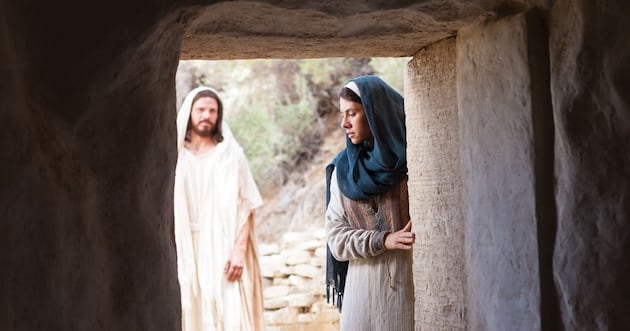
Jesus Christ appeared to hundreds of believers during the 40 days between His Resurrection and Ascension, and one group was blessed to be the first to see the Risen Christ.
The morning after His resurrection, Jesus appeared to Mary Magdalene and the other female disciples at the tomb. Amazingly, this group of people did not immediately recognize Jesus when He appeared to them. This shows that there was and remains an important difference between seeing a person and recognizing that person.
Mary and the other female disciples actually saw and spoke to the man who was Jesus Christ. However, they did not recognize Jesus’ true identity until He opened their spiritual eyes.
The actions of the disciples after the Savior’s death show that they had certain expectations of the Lord. They expected Jesus to continue teaching them until they understood the fullness of the gospel and to lead them as the head of the new earthly church.
However, three days after the crucifixion, the disciples went to the tomb hoping to find the body of the deceased Jesus. These conflicting expectations caused feelings of sadness, disappointment, and confusion.
Only the appearance of the Risen Christ to Mary and the other disciples corrected their false expectations and enabled them to recognize the Risen Savior and respond with feelings of happiness and peace.
As disciples of Christ, we have much in common with Mary and the other disciples. We all have certain contradictory expectations of the Lord and His Church, and if they are not met according to our limited earthly understanding, our view of the Savior may be hindered and we may not truly recognize Him even when He comes close enough for us to “see” Him.
However, by studying how Jesus Christ opened the spiritual eyes of his disciples, we may be able to correct our own false expectations. Recognize his true identity as our Savior. And I feel the same feelings of joy and hope.
“Why do you seek the living among the dead?”
The morning after the resurrection of Jesus Christ, Mary Magdalene, Mary the mother of James, Salome, Joanna, and other female disciples went to the tomb to anoint the body of the Lord with oil and spices.
They looked for Jesus with righteous intentions, but mistakenly expected that his body was still in the tomb. When they realized it was empty, their expectations were not met, causing feelings of sadness and confusion.
Soon angels appeared and corrected these false expectations by asking, “Why do you seek the living among the dead?” (Luke 24:5)

The angels continued, “He is not here, but he has risen. Remember that he spoke to you while he was still in Galilee, saying, ‘The Son of Man must be delivered into the hands of sinful men and crucified, and on the third day rise from the dead'” (Luke 24:6-7).
The women remembered those words of the Lord. But their focus was so focused on the trial and the cross that they lost sight of the most important truth: Jesus will be resurrected.
The angels explained that Jesus would continue His work among the living. The angels promised the disciples that they would soon see Jesus if they looked for him in the right place.
Physically “seeing” and mentally “knowing”
The Gospel of John details Mary Magdalene’s experience at the tomb.
After her interaction with the angels, she turned around and “saw Jesus standing there, but she didn’t realize it was Jesus.” He demonstrated that there is a difference between “seeing” Jesus physically and “knowing” him spiritually (John 20:14).
The Greek word translated “saw” (theorei) in this verse is associated with the word for watching a play in a theater. Mary was a bystander to this appearance of the Lord, watching passively, but not fully understanding what she saw.
Then Jesus said to her, “Mary,” and she actually turned to him and addressed him by the honorific title raboni, which means “teacher” or “teacher” (John 20:16).
At this moment, Mary changed from a passive spectator to an active performer. She did not recognize the Lord until she physically confronted Him, which symbolized the transition necessary to develop a personal relationship with the Savior.

Later, when Mary told the other disciples about this experience, she used the Greek word for “saw” (heoraka) and declared, “I have seen the Lord.” This refers not only to seeing with physical eyes, but also to seeing with a spiritual understanding that leads to understanding (John 20:18).
However, Mary still recognized Jesus as her raboni, or teacher, according to her earthly expectations of him. She expected Jesus to be physically present in her life and teach her and the other disciples about the gospel until they fully understood it.
However, the Lord commanded Mary to “touch me not” (mē mou haptou), and the Joseph Smith translation changed the verse to “thou shalt not embrace me,” making it clear that this Greek word meant not just touching, but a stronger “clinging” or “grasping” (John 20:17).
The Savior did not mean to be physically present all the time, but spiritually as Mary grew in knowledge. The Lord remains her Raboni teacher, but she must seek His presence through the Holy Spirit for further understanding.
joy beyond sadness
Jesus also spoke one word to the other female disciples. He addressed them with “Greetings” (chairete). The word is related to a Greek root meaning “joy” or “joy” (Matthew 28:9).
These disciples then went to the Lord, fell down at His feet, and worshiped Him, demonstrating the connection between recognizing, worshiping, and rejoicing in the Savior.
These feelings of joy, hope, and jubilation have changed significantly from the previous feelings of sadness, fear, and confusion associated with false expectations.

Sister Reina I. Aburto, second counselor in the Relief Society general presidency at the time, testified, “Through the Atonement and glorious Resurrection of Jesus Christ, broken hearts are healed, suffering is replaced by peace, and suffering is replaced by hope. The Lord embraces us in His arms of mercy, comforting, strengthening, and healing each of us” (“There Is No Victory in the Grave,” April 2021 general conference).
recognize the savior
As disciples of Christ, we sometimes have false expectations about the Savior, His Church, or our spiritual path in life, leading to disappointment and confusion.
Often, like the female disciples searching for Christ in the tomb, we see “missing the mark” (James 4:14) and fail to recognize the true identity of the risen Christ.
But just like those disciples, we have angels all around us, including modern day prophets and apostles, who remind us where to look for God. This includes seeking the Lord in the Lord’s house, the Lord’s house. There we not only feel the Lord’s presence, but learn how to recognize Him in our lives.

Like Mary, we too need to actively turn toward the Lord and actively participate in our own gospel learning. And we may also experience the hope that comes from cultivating a personal relationship with the Savior.
— Crystal VL Pierce is an assistant professor in the Department of Ancient Scripture at Brigham Young University.
