


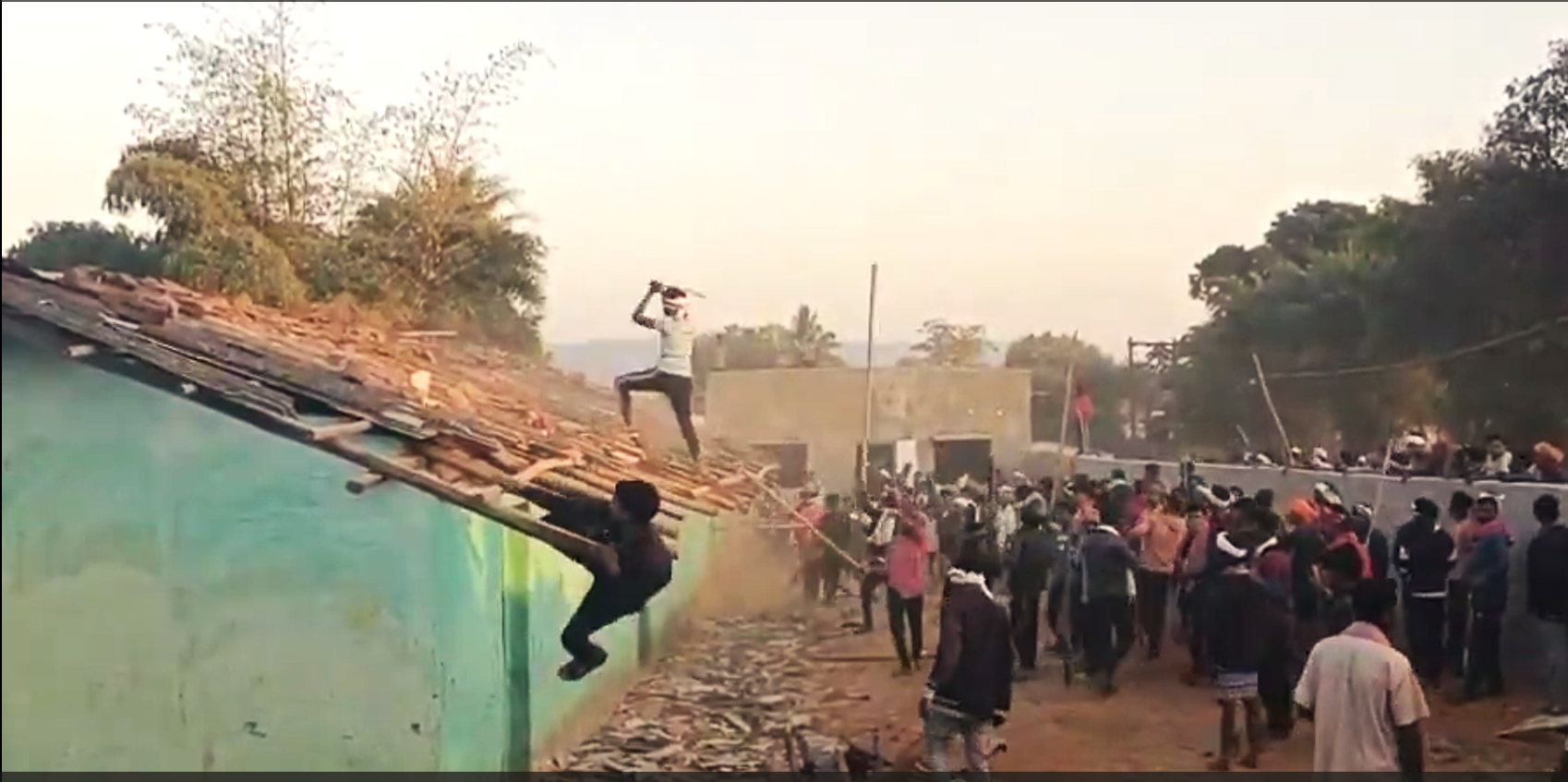
Indian authorities exhumed the body without the consent of his sons after villagers attacked Christians for burying the body of a tribal man on the land of a Christian relative, officials said, claiming it would be an insult to their God.
A body was exhumed without the family’s consent in Chhattisgarh’s Kanker district last month, forcing the family to frantically search for the body and eventually go to court for answers. The government then considered him a Christian and buried him in a Christian cemetery, sources said.
Relatives of the late Chamul Ram Salam, a follower of a traditional tribal religion, are awaiting a final verdict after the Chhattisgarh High Court in an interim order recognized the deceased and the petitioner as Christians to justify burial in a Christian cemetery. According to officials, the non-Christian petitioner denied that he or his father followed the Christian faith.
After the December 16 burial (which took place according to tribal customs), more than 500 tribal villagers attempted to destroy Chamru Ram Salam’s grave, attacked his family and about 150 Christians visiting them in the village of Bedetebuda, and then set fire to his home and three church buildings.
The mob claimed that the burial site was a sacred site dedicated to the village’s god, and that half of Salam’s family was Christian, so the burial would be an affront to God, said the source, who requested anonymity.
A larger attack was planned for December 18, and local police exhumed the bodies on the same day. Rajman Salam, the deceased’s son, said he and his family fled for their lives on December 18 and only returned last week.
He said he had no choice but to go to court to find out where his father’s body was.
Rajman Salam, a Christian and head of Bedetebuda village, said: “The administration did not get permission from us, his next of kin, before exhuming his body.” “They dug up his body and just took it away. We didn’t know where they kept it, and we didn’t know if they buried him somewhere else.”
According to the petition, Salam’s younger brother Ram Singh Salam, a follower of a tribal religion, approached the state high court in Bilaspur on December 20, demanding that the Kanker government return his father’s body so that it could be buried according to tribal customs.
“The Additional Attorney General falsely stated in court that the government buried the body of my late father at Damtari Christian Cemetery (100 kilometers from Salam village) because my father and brother believe in Christian faith,” Rajman Salam said.
The Additional Chief Justice had also submitted to the court that the burial of the body at the Dharmtali Christian cemetery took place in the presence of Rajman Salam’s mother and his brother’s wife.
“After my brother filed a lawsuit, the administration forcibly took my mother and sister-in-law to Damtari Christian Cemetery and buried my father,” Rajman Salam said.
In a video interview that went viral on social media, Ram Singh Salam clarified that neither he nor his wife nor his mother believe in the Christian faith and neither does his father.
“Why would they be willing to attend the burial when they are a tribe themselves?” Rajman Salam asked, alleging foul play.
Before exhuming his father’s body, Kunkel’s government forced his mother and sister-in-law to put their thumbprints on documents without telling them the contents, “so they could tell the court that they had obtained the family’s permission before exhuming the body.”
A hearing scheduled for Jan. 5 and then Jan. 9 was postponed as the family awaits the verdict.
House and three churches in flames
Three of Chamul Ram Salam’s five sons have faith in Christ, and did so for the first time 20 years ago.
After Chamul Ram Salam passed away at the age of 65 on the night of December 15, Rajman Salam called the village’s prominent elders and asked them to come in the morning to bury his father in accordance with tribal custom.
“My father was not a Christian, so we decided to bury him according to tribal customs,” Rajman Salam admitted to Morning Star News.
In the morning, six villagers showed up and Rajman Salam asked them to bury his father with the help of the deceased’s eldest son Ram Singh Salam, who also followed the tribe’s religion. Rajman Salam said he requested that his three Christian sons be allowed to put their fists of mud into the grave after all the tribal rituals are completed.
Rajman Salam said his political rival Sukhdu Ram, who lost to him in the last panchayat election, mobilized the villagers.
“Sukhdu Ram grabbed the opportunity to settle the score with me,” he said. “He incited the villagers to revolt.”
The family had already decided to bury the father on their own private land, so they decided to proceed with the burial without any help or support from the villagers. They buried the bodies according to tribal customs, Rajman Salam told Morning Star News.
The next day, December 17, about 150 pastors and Christian leaders from the Kanker area and surrounding areas visited his parents’ home to pay their condolences. While they were all in the house, a mob of 500 to 600 people attacked them with thick wooden sticks, slingshots, and stones.
“Sukhdu Ram and others called right-wing Hindu groups and asked the family to work with the villagers and exhume Chamul Ram’s body,” Rajman Salam said.
The mob began attacking the family and the Christians visiting them. A pastor who was present said on condition of anonymity that they beat him with wooden sticks, causing him to jump over a wooden fence and twist his ankle as he ran for his life.
“I managed to get on a motorbike and headed into the jungle to escape the wrath of the mob,” he said. “We drove four miles down a narrow road through the jungle before hitting the highway.”
He said the attack lasted for two hours before police arrived and managed to restore order. Anticipating tensions and further violence, authorities called for more troops.
Rajman Salam’s sister-in-law Lalita and brother Ram Singh suffered severe head injuries, as did pastor Siddhunath Chandra and several other Christians who attended to pay their condolences.
That same night, Hindu nationalists and villagers jointly planned a larger attack the next day, December 18, sources said.
“They sent messages to each house in 45 nearby villages, threatening each household to send at least one adult, if not more,” he said. “Villages and communities will ostracize families who do not fulfill their obligations.”
Sources said some pastors who had paid their respects to the families during the attack the previous day fled, but many remained.
On the morning of December 18, more than 3,000 rioters from 45 villages gathered, armed with sharp tools, sticks, stones, and slingshots. After pressuring the police to exhume the body, the mob went to Rajman Salam’s house and attacked the pastor, who was visiting with his family.
They destroyed his entire house, looted his belongings, and destroyed a year’s worth of grain in his barn.
“The mob stole an estimated $3,000 in cash, Mr. Salam’s business, gold ornaments from Mr. Rajman’s home, and everything else that was looted and property destroyed,” said Rev. Salim Haq, a Christian leader from Jagdalpur in Bastar district, who sheltered Mr. Rajman Salam and other Christians in the weeks after the attack. “The mob then set fire to Mr. Rajman’s house, then moved on to a church built on Mr. Rajman’s property adjacent to his home, destroyed it, and set it on fire.”
Rajman Salam said the agitated mob set fire to and damaged a church building and burned a Bible before running about two miles to another church building in Majibada village and then to another church building in another village, both under the jurisdiction of Amaveda police station, and setting them on fire.
A large number of police officers reportedly worked hard to control the mob.
“The mob attacked Christians and police using slingshots and threw huge stones at us,” Rajman Salam said.
Local media reported that the mob also violently assaulted police officers who tried to quell the violence.
After Rajman Salam submitted a written memorandum to Amaveda officials on December 22 to take action against the culprits, another incident occurred on December 28, when a mob attacked and destroyed 15 Christian houses six miles from Badetevda in Pusagaon village.
According to Pastor Haq, there are 36 Christian families in Badetevda village, and about 150 residents fled their homes and fled for their lives because of the attack. Some of the people who evacuated with him are gradually returning to their villages, including Rajman Salam, who returned to his home last week.
“Due to opposition, fear and pressure, all but four members of the family recanted their Christian faith,” Pastor Haq said.
More than 100 Christians usually attend Sunday services at the now-closed Bade Tevda Church, but only a few of them traveled to Jagdalpur on January 11 to attend pastor Haq’s service. Other families who had evacuated and stayed with Pastor Huck also attended the service.
Tensions have been high since the Hindu nationalist Bharatiya Janata Party (BJP) came to power in 2023, anonymous sources said.
“The current situation in Chhattisgarh is alarming,” he said. “Ever since the Bharatiya Janata Party came to power in the state and the government was already at the center, things have become scary for Christians.”
He said that apart from a few mainstream churches, few meetings were held in the Kanker area.
“It became impossible to leave the house without anyone noticing,” he said. “As soon as you enter the house, you will receive a call from the police station asking why you came to the house.”
Haq said attacking religious sites is against India’s constitutional norms and authorities should take strict action against those who spread violence and hatred in this way.
“Destroying our churches and setting them on fire will not stop us from worshiping,” he said. “We don’t need a building to worship our God. We can sit under the shade of any tree and pray.”
Since Prime Minister Narendra Modi came to power in May 2014, religious rights advocates say the Hindu nationalist Bharatiya Janata Party’s hostile attitude toward non-Hindus has fueled attacks on Christians by Hindu extremists across the country.
India was ranked 12th on Christian advocacy group Open Doors’ 2026 World Watch List as the country in which it is most difficult to become a Christian, up from 31st in 2013, before the Modi government took office.
