


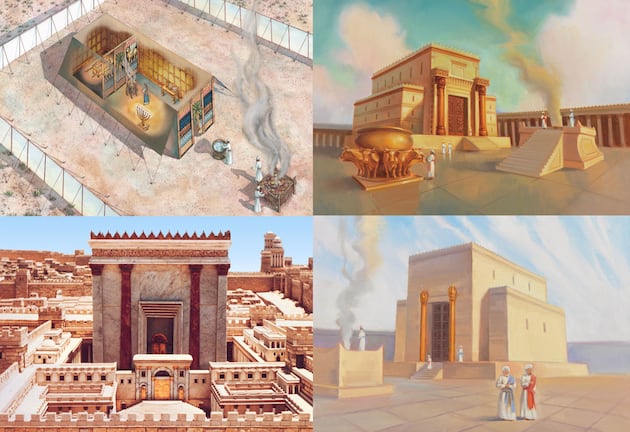
Long before today’s many church members made frequent temple trips and annual temple announcements were made around the world, the house of the Lord began with God lovingly reaching out to his newly delivered people in their desert home.
“Temple ordinances and covenants are ancient,” then-Church President Russell M. Nelson said in October 2021 general conference. “Temples throughout the ages have emphasized the precious truth that those who make and keep covenants with God are children of the covenant.”
The entry for “Temple” in the Bible Dictionary explains: “Each time the Lord has had a people upon the earth who obey His Word, they have been commanded to build temples in which the ordinances of the gospel and other spiritual manifestations relating to exaltation and eternal life were to be performed.”
Next year, members of The Church of Jesus Christ of Latter-day Saints will discover connections between ancient and modern covenants, ordinances, and temples as they study the Old Testament in Come, Follow Me—For Home and Church.
Here is an overview of the four most important houses of the Lord to look for in your study of the Old Testament.
1. Moses’ Tabernacle
After God delivered the Israelites from slavery in Egypt into the wilderness (see Exodus 14), He did not leave them without His guidance. And the Tabernacle of Moses, the portable temple, is unmistakable evidence of that.
The Lord manifested His presence over the tabernacle as a cloud by day and a pillar of fire by night (see Exodus 13:21). Numbers 9:17 even says that a cloud guided the Israelites on their journey.


At Mount Sinai, the Lord instructed Moses how to build a tabernacle and asked the Israelites to be willing to offer their finest and most precious materials (see Exodus 25:1-7).
However, the cost of these supplies paleed in comparison to the rich purpose such a structure would serve. In Exodus 25:8, the Lord exhorted, “Make me a sanctuary unto them, that I may dwell among them.”
This sanctuary stood “in the midst of the camp” (Numbers 2:17), and the tribes of Israel had built tents around the tabernacle.

So how was the tabernacle constructed? It consisted of three areas.
Outside Courtyard: This outdoor area contained a sacrificial altar and a water sink, allowing access to God’s presence as well as symbolic cleansing from a fallen world. Aaron and his sons were washed, anointed, and clothed here (see Exodus 40:12-15). Holy Place: In the first room of the tabernacle there was a table of shupan (see Exodus 25:23-30), a seven-branched candlestick for light (see Exodus 25:31-37), and an altar for burning incense each morning and night (see Exodus). Passing through the tabernacle led to the holiest part of the tabernacle where the Ark of the Covenant was kept (see Exodus 26:33-34). Only the high priest could enter here, and only once a year, on the Day of Atonement, Yom Kippur, could he ritually atone for the sins of the Israelites (see Leviticus 16:29-34).
2. Solomon’s Temple

Some centuries after the Israelites wandered in the desert, Israel’s second king, David, expressed to the prophet Nathan his desire to build a permanent temple structure. “I live in a house of cedars, but the ark of God dwells behind curtains,” David explains in 2 Samuel 7:2.
The king began gathering materials for this house of the Lord (see 1 Chronicles 22:14), which was to be built by his son Solomon, who would later become Israel’s next king. His temple was built on the design of the tabernacle, doubling the dimensions of each part.
When Solomon built this temple, the Lord gave him the following promise: “If you walk in my statutes, and keep all my commandments, to execute my judgments and walk in them…I will dwell among the children of Israel, and will not forsake my people Israel” (1 Kings 6:12-13).
During the seven-day dedication of the temple, “fire came down from heaven and consumed the burnt offerings and sacrifices, and the glory of the Lord filled the house” (2 Chronicles 7:1).
Solomon’s Temple took seven years to complete and was completed in Jerusalem around 1005 BC. It was then burned by King Nebuchadnezzar of Babylon in 587 BC (see 2 Kings 25:9).
3. Temple of Zerubbabel

The Babylonians held the people of Judah captive for 70 years. Then the Persian king Cyrus conquered Babylon and allowed the Jews to rebuild the temple in Jerusalem (see Ezra 1:1-2).
Governor Zerubbabel, appointed representative of the Jewish royal family, directed the rebuilding of the temple with the assistance of Haggai and Zechariah (see Ezra 5:1-2).
Elder James E. Talmage of the Quorum of the Twelve Apostles wrote in his 1912 book, The House of the Lord, “Although this temple was much inferior in finish and richness to the magnificent Temple of Solomon, it was nevertheless the best that men could build, and the Lord accepted it as an offering symbolizing the love and devotion of His covenant children.”
Herod, king of Judea, captured Jerusalem in 37 BC, and part of the Temple of Zerubbabel was destroyed in a fire in the process.
4. Herod’s Temple

In 17 BC, King Herod proposed rebuilding the Temple of Zerubbabel in order to gain popularity among the Jews. The priests began construction of this structure, which was not completed until 64 AD. A short time later, in 70 AD, the Romans destroyed the structure.
Although the site was expanded and divided into courts, Herod’s Temple itself was placed on the exact location of Solomon’s Temple. It was visible from anywhere in the city.
The site of Herod’s Temple was a prominent setting in the earthly life of Jesus Christ, from his infancy to his final days of mortality. As a baby, the Savior was dedicated in the temple according to Jewish custom (see Luke 2:22-33). After Jesus cleansed the temple during his last mortal week, “blind and lame people came to him in the temple, and he healed them” (Matthew 21:14).
And after the crucifixion on Calvary, “the veil of the temple was torn in two from top to bottom” (Matthew 27:51). This symbolically shows that the Lord is opening the way for His children to return to Him.
