


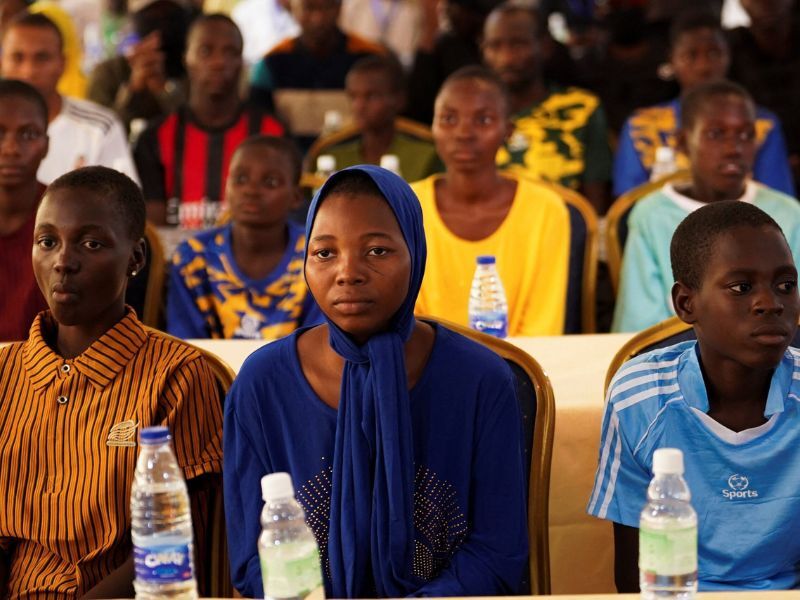
Nigerian families received an early Christmas present this week as 130 children and teachers abducted from a Catholic school a month ago were released on Sunday, government and church officials said.
Terrorists kidnapped 303 children and 12 teachers.
Late on Saturday, November 22nd, armed assailants from an anonymous group attacked St. Mary’s Catholic Primary and Secondary School in Papiri, Niger State. According to authorities, the terrorists kidnapped 303 children and 12 teachers and forced them into the forest. Dozens of people are said to have fled immediately after the kidnapping, and security forces reportedly rescued 100 people two weeks ago.
It is still unclear whether all students and staff have been released. The horrific ordeal has been complicated by conflicting reports about the initial number of students and staff, which was originally more than 300 but later lowered by government, church and other representatives. Still, families are delighted this week to be reunited with 130 loved ones in time for Christmas.
130 children were released.
This week, media outlets including The New York Times highlighted discrepancies in the numbers and whether any students or staff remained in custody. It is also unclear how the 130 children were freed, whether a ransom was paid, and whether the children were rescued by security forces or otherwise secured.
“The rescue of the remaining 130 children and staff of St. Mary Catholic School in Papiri, Niger State is a fitting end to this year,” said Mohammed Idris, Nigeria’s Minister of Information and National Orientation, who was appointed by Nigeria’s President Bola Tinubu in 2023. “At this time, the federal government can confirm that all of the students who were abducted from Papiri Catholic School are safe.” 230 people have been released and no students are in custody.
Happy family reunions, good healing processes, seasonal compliments, and Merry Christmas.
“The 130 students who have just been released will be handed over to the Niger State Government and subsequently reunited with their families. This gallant effort by our security forces reaffirms our nation’s resolve to protect our people. The Federal Government sympathizes with the parents of the students for the pain caused by their abduction and wishes them a joyful family reunion, a successful healing process, seasonal tributes and a Merry Christmas.”
The school, owned by the Diocese of Kontagora and run by the Sisters of Our Lady of the Apostles, only announced in a statement on Monday that a “second wave” of students had been released as of Sunday, Dec. 21, Fr. Jatau Luka Joseph Parish Secretary.
“We are deeply grateful to the Federal Government of Nigeria, the Niger State Government, the security agencies and all other partners whose efforts and interventions contributed to the safe release of the victims,” Joseph said in a statement. “We also express our deepest gratitude to parents, guardians, clergy, religious and humanitarian organizations, and the wider public for their prayers, support, and solidarity throughout this difficult time.”
The local diocese said the church would promptly share further updates and information with the public to ensure “the accuracy, transparency and clarity of all public statements.”
May the Lord quickly release those who are still in captivity.
Joseph concluded his statement by saying: “May the Lord quickly release those still in captivity and continue to protect His people from all danger.”
Media outlets noted that if 130 students were confirmed, the total freed would be 229 (plus one teacher), significantly lower than the number of students and teachers originally abducted, but government officials did not explain this discrepancy.
Although no group claimed responsibility for the kidnapping, there were clear signs that the terrorist group Boko Horam used tactics to terrorize the community. International Christian Concern (ICC) President Sean Wright called on authorities in Nigeria and the United States to act quickly and work on short- and long-term solutions to secure their release.
We thank the Lord for the release of our children and teachers this week.
“We thank the Lord for releasing our children and teachers this week just before Christmas,” Wright said. “We will continue to fight for our persecuted brothers and sisters in Nigeria, praying with them, serving them, and doing whatever we can to end their long-term suffering, whether that is through the many ICC aid projects in Nigeria, telling their stories, or fighting for them on Capitol Hill.”
The Trump administration recently designated Nigeria as a country of particular concern (CPC) for failing to protect Christians. Nigerian authorities have failed to respond effectively to the violence and protect vulnerable communities, including in the southern state of Kaduna, where Islamic extremists have attacked Christians.
Boko Haram is one of several extremist groups operating in Nigeria with ties to Islamic extremism. The terrorist group not only targets Christians, but also the government and Muslims who do not join its cause.
Boko Haram declared allegiance to Islamic State in 2015, and a year later parts of the group split into a separate terrorist organization, Islamic State West Africa Province (ISWAP).
The ICC has served persecuted Christians in Nigeria for decades, documenting countless attacks through news articles and special coverage. To help persecuted believers, the ICC launched aid projects such as communal farms and Christian schools in Nigeria, and supported legislation by the U.S. government to pressure Nigerian authorities. Nigeria also ranks as one of the worst places to be a believer in Christ in the ICC’s annual Global Persecution Index.
Originally published by International Christian Concern. Republished with permission.
Since 1995, International Christian Concern has worked to bring relief to persecuted and needy Christians. They work with trusted partners on the ground to develop and implement both immediate and long-term support projects. and oversees projects to ensure fidelity to Biblical principles and wise management of funds. They continue to work in Nigeria, helping local brothers and sisters in Christ overcome continued attacks from Islamic extremists.
For nearly 30 years, the ICC has developed a unique approach focused on advocacy, advocacy, and awareness. They exist to bandage the wounds of persecuted Christians and build churches in the most difficult parts of the world. Download the ICC Primer to explore and share an overview of their ministry and the phenomenon of global persecution. here.
