


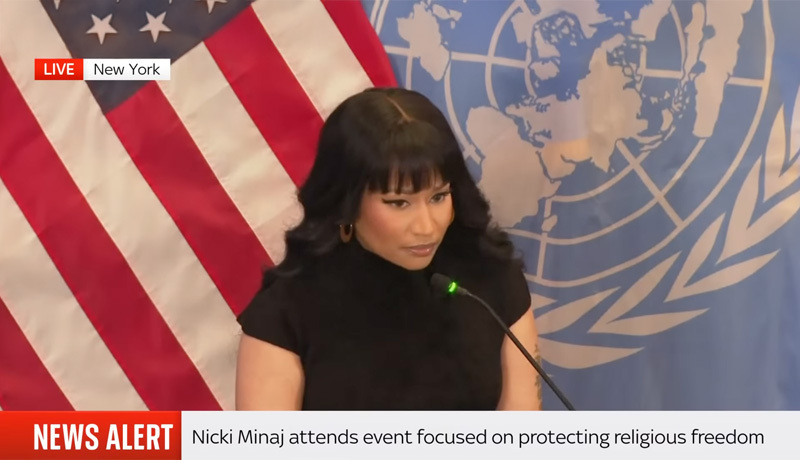
Nigeria has been in the spotlight in the last month after the US government designated it a “Country of Particular Concern” (CPC) due to serious threats to religion in the country.
Nigeria…leads the world in the number of Christians killed in religious-related conflicts.
This designation is not surprising. Nigeria ranks seventh on the Open Doors Global Watch List and leads the world in the number of Christians killed in religious-related conflicts.
The bipartisan United States Commission on International Religious Freedom (USCIRF) has been urging the United States to designate Nigeria as part of the Chinese Communist Party since 2009. USCIRF alleges that the Nigerian government is condoning “systematic, ongoing and egregious religious freedom violations.”
On November 18, popular singer Nicki Minaj headlined a United Nations panel discussion hosted by the United States to draw attention to the crisis in Nigeria. I attended this event on behalf of the International Institute for Religious Freedom (IIRF).
Reinforcing the panel’s message, the following week saw three more major attacks in northwest Nigeria. In one of them, more than 300 students were reportedly kidnapped.
Misrepresenting or politicizing problems will not move us towards solutions.
What has happened and continues to happen in Nigeria is an unspeakable tragedy. This is primarily a security issue and the world should put pressure on the Nigerian government to address it. But we cannot move towards solutions by misrepresenting or politicizing the problem.
Meanwhile, the Nigerian government still appears to be in denial at times. I recently saw an interview in which a government representative said that in the past five years, 102 churches have been attacked, 177 Christians have been killed, and 7 people have been kidnapped.
One of the students in the course I teach is a Catholic priest from northern Nigeria. When asked about that claim, he replied: “That’s unthinkable. We recently buried hundreds of people in mass graves in our region alone.”
Other narratives treat this conflict as primarily due to competition for resources amid climate change. It is true that there is a conflict between Fulani herders (mostly Muslims) who want to graze their cattle and Christian farmers who want to protect their crops.
You should not assume that there is only one factor in conflict.
Economic factors often drive violence. However, you should not assume that there is only one source of conflict. Religious and ethnic differences are also contributing to the escalation of conflict.
Meanwhile, some religious freedom advocates are sensationalizing the situation, calling it a “genocide.” Such claims overlook important facts. Muslims are also being killed and kidnapped. Christians may be a favorite target for some Islamist terrorist groups, but moderate Muslims are also often targeted.
We must work for peace, mutual understanding and reconciliation.
Unbalanced and sensational stories can be very damaging in tense situations like Nigeria. They exacerbate anger on both sides and lock people out of reasonable compromises, which are desperately needed in this case. We must call on the Nigerian government to take stronger action to control the chaos, but we must also strive for peace, mutual understanding and reconciliation to achieve a long-term solution. Otherwise, the attack would resume as soon as the police left.
Please join us in defending religious freedom and peace in Nigeria. We also ask that you help us reject actions that exacerbate the situation through denial or misrepresentation.
Originally published on Substack by Kyle Wisdom. Republished with permission.
Dr. Kyle Wisdom is Deputy Director of the Institute for International Religious Freedom (IIRF). He is a graduate of Middlesex University and the Oxford Missionary Center. His research focuses on the interaction of religion and state, with an emphasis on Indonesia, where Kyle lived for more than a decade, and he contributed a chapter to the book God Needs No Defense: Reimagining Muslim-Christian Relations in the 21st Century, co-published by the World Evangelical Alliance and Humanist Islam.
The International Institute for Religious Freedom (IIRF) was founded in 2005 with the mission of promoting religious freedom of all faiths from an academic perspective. IIRF aims to be an authoritative voice on religious freedom. These go beyond anecdotal evidence to provide reliable and unbiased data on religious freedom to enhance academic research on the topic and inform public policy at all levels. IIRF research findings are disseminated through the International Journal of Religious Freedom and other publications. IIRF’s particular focus is to encourage the study of religious freedom in higher education institutions by integrating religious freedom into the educational curriculum and supporting graduate student research projects.
