


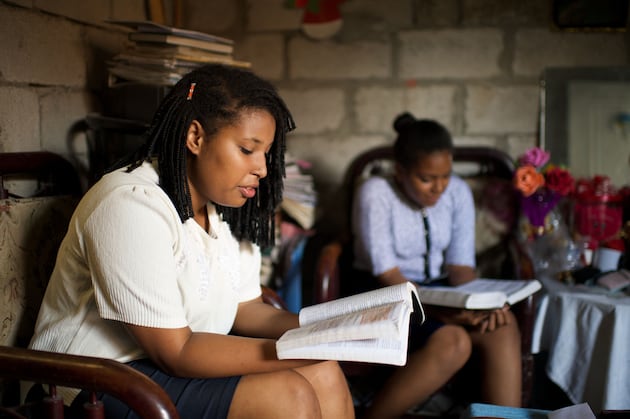
Members of The Church of Jesus Christ of Latter-day Saints find that using various translations of the Bible helps them understand the gospel of Jesus Christ.
December updates to the General Handbook allow for more flexibility in using the Bible in the home and church.
“In general, members should use the preferred or church-published version of the Bible in church classes and meetings,” the handbook states. “This helps maintain clarity of discussion and a consistent understanding of doctrine. Other Bible translations may also be used.”
“Some may benefit from translations that are doctrinally clear and easy to understand. Examples of such translations can be found in the Church’s Bible list.”
Relief Society General President Camille N. Johnson said, “This is not a departure from the Church’s recommended translations. We are simply acknowledging that some members may benefit from a different translation.”
Sister Tamara W. Runia, First Counselor in the Young Women General Presidency, said, “Our hope is that no matter which translation we use, everyone feels welcome and respected. Most importantly, we understand how the scriptures speak to our spirits and draw us closer to God as we read them every day.”
Tracy Keeney of Huntsville, Arkansas, said having access to several different translations and versions helps her understand better.
Growing up in several states in the southern United States, she was often one of the few church members at school. Other students and friends of different faiths were using versions of the Bible other than the King James Version, so she borrowed those versions from the library.
“Referencing other translations of the Bible helped me understand why my friend and I understand the Bible differently,” she said. “I increasingly realized that how the scriptures are translated makes a huge difference in how they are interpreted.”
Since then, Keeney has heard BYU religion professors and other Latter-day Saint scholars mention other translations.
She said she has always maintained the Church’s publications of the Old and New Testaments as her primary Bible sources, and said the footnotes, cross-references to the Book of Mormon, Bible Dictionary, and Joseph Smith Translation are “absolutely invaluable for thorough study.”
But being able to refer to other translations of the Bible “can be very helpful in gaining a deeper, richer understanding of what the author is saying, and can help clarify why people who use different versions of the Bible understand things differently than we do.”

Salt Lake City resident Terry Broadbent said he was grateful for the recognition of the new Bible translation he has been using for several years.
He uses an app that gives him access to several English translations. You can also read the two translations side by side, which I have done to read the Spanish Bible next to the new English version. He also has a published version of the Bible that features the Joseph Smith and King James Versions of the Bible side by side.
“We plan to utilize all of these resources as we study the Old Testament in 2026,” Broadbent said.
Anthony Piña of Normal, Illinois, is grateful for the church’s invitation. Over the years, he has found that comparing multiple versions and translations of the Old and New Testaments provides insights that enhance the understanding and appreciation of scripture.
“As a teacher, referring to modern translations has helped many of my students avoid misunderstandings caused by archaic words in the King James Bible, whose meanings have changed over the centuries,” Ms. Pina said.
Other individuals and families have found that some translations are easier for people to understand, depending on their reading level and comprehension ability.

BYU religion professor Gay Strathern wrote in a 2011 article titled “Modern English Bible Translation”:
“Although the King James Version of the Bible has an important legacy and remains a favorite among English-speaking Latter-day Saints, there are many ways modern translations can further deepen our understanding of the Bible.”
She acknowledged that translating from one language to another is always a difficult and complex process.
“While we love, respect and study the King James Version of the Bible, it is not the only source of our doctrine,” Strathairn said.
The General Handbook states that if members find doctrinal discrepancies between translations of the Bible, they should refer to the Book of Mormon, Doctrine and Covenants, Pearl of Great Price, and the teachings of the Latter-day Prophets.
Sergio Aramburu from Santiago, Chile, was careful to say that Sunday classes and meetings can be a good place to discuss the Bible.
“If you are unsure about something, you should immediately refer to other canons or ask your teacher or church leader during class,” he said. “We used these classic or preferred versions so that everyone connected in the same way and understood the same things.”
He cited the Eighth Article of Faith: “We believe that the Bible, properly translated, is the Word of God. We also believe that the Book of Mormon is the Word of God.”
Aramburu concluded, “Our beliefs and beliefs are not based solely on the Bible, because we have the four canon books and we have the present prophets of God on earth, and we believe in them. That is the most important thing to us.”

Recommended translation
Under Bible in the Gospel Library is a list of translations published by the Church or recommended for use by the Church. This includes:
3 church editions, 6 license translations, 5 translations in progress, 118 other priority translations
Preferred or church-published versions of the Bible include the King James Version of the Bible (English), the Reina Varela 2009 Edition (Spanish), and the Almeida 2015 Edition (Portuguese).
Examples of translations that the Church has determined achieve both readability and doctrinal clarity include:
English Standard Version (ESV) New Revised Standard Version (NRSV) New International Version (NIV) New Living Translation (NLT) New King James Version (NKJV) New International Reader’s Version (NIrV)
Resources for studying the Old Testament in 2026
As Church members prepare to resume their Bible gospel study for Come, Follow Me in 2026, beginning with the Old Testament, Church News recently compiled a list of helpful resources.
This includes the Come, Follow Me manual, Gospel Library’s Old Testament Bible Help, Old Testament Stories for kids, and Insights from the Apostles videos.
Also see the “Come, Follow Me” section of Church News.


